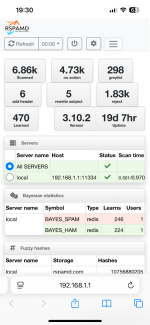
Essentially RSpamD is solely built to do one job which is to analyse emails and sift out the spam. It does this through a mixture of rules which apply a 'score' to how likely something is to be spam. The various rules will look at different parts of the email and assign a score to each of those parts and then look at the overall score and see if it's high enough to be marked as spam.
This is combined with an AI element that learns over time - so if it's flagging emails with the word 'Viagra' in them as spam but you happen to be a doctor specialising in erectile dysfunction and therefore keep marking them as 'not spam' manually then it will take a hint and automatically lower the points added to the spam score for that word.
You can also go in to the long list of spam scoring rules and manually tweak them up or down to tailor it to your needs and add blacklists and whitelists - so you can block or allow certain things independently of the spam score.
TLDR? - Outlook is like Paint. It will do a basic job pretty well but you have limited features. RSpamD is like Photoshop. It's a lot more complex and while it will take longer to setup and learn it's also a lot more powerful and capable.
As for my 10 point question - well I'd gone off on a tangent really. The pic I posted is for a thing called PiHole (free software and can be run on a £15 Raspberry Pi). It's got absolutely nothing to do with email. What that does in a nutshell is take a list of websites that deliver adverts to your browser / phone apps / etc and prevents them from sending you stuff you don't want / need. What's nice is that it works at the network level, so you set up one small cheap device and then it will block ads for any device that you connect to your home network without needing to install anything on any other device.
Plenty of tutorials online and very easy to do even without any real networking knowledge. Just follow the instructions and copy/paste the code. Takes about 15 mins to setup from scratch. A little bit longer if you combine it with Unbound to create a recursive DNS server - but that's a bonus 20 point question