|
The Sahara and back in six days |


|
|
|
|
We rode to the Sahara and back on a BMW
R1150GS, Aprilia CapoNord and Triumph Tiger 955i. Here’s the day-by-day
story…
DAY ONE, MONDAY, JULY 30, 2001, Bilbao to
Lajo, 580 miles
Thirty-five hours after departing Portsmouth,
the ferry finally heaves into Bilbao, northern Spain. From here, the Autopista
del Norte motorway winds south through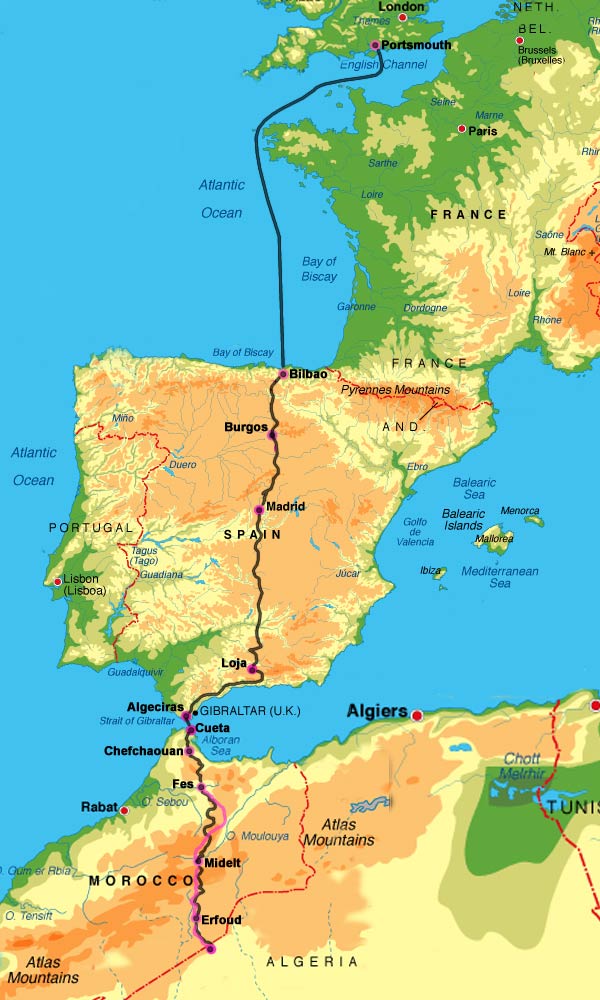 the Cantabrian mountains before dumping us on the rolling plains of the Ebro
valley.
the Cantabrian mountains before dumping us on the rolling plains of the Ebro
valley.
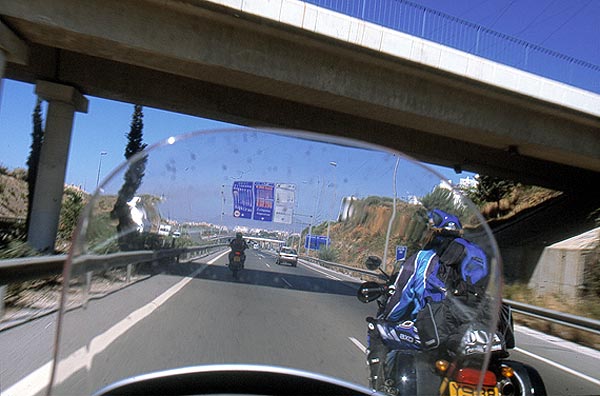
Today is a day for cramming in miles. The
motorway is peaje, or toll, to Burgos, but then free all the way to Malaga and
the Mediterranean. With unleaded at around £2.50 per gallon and the roads
half-deserted, it’s no problem to knock off big miles. With their easy, punchy
power and roomy saddles, the bikes are equally adept and relatively painless.
Even though we’re hurrying, the flavour of
Spain is impossible to miss. In the northern mountains, the smell of smoking
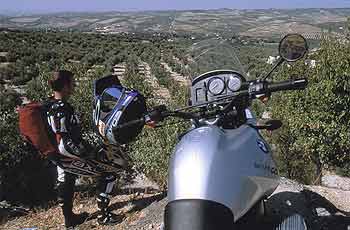
hams fills the air. Then, 400 miles later, among a boundless ocean of neat olive
groves, the pungent aroma of extra virgin sweeps across the rolling hills of
Andalucia.
Along the way, the temperature has climbed from
showery mid-60s to a more sultry 90° or so beyond Madrid.
 As
the bikes beat south, we’ve already chosen our favourites. Smith has gone for
the Capo Nord, Hill for the Tiger and me for the BMW. We all generally agree on
the bikes’ various strengths and weaknesses, so the choice is as much down to
what we individually value in a bike as their inherent abilities.
As
the bikes beat south, we’ve already chosen our favourites. Smith has gone for
the Capo Nord, Hill for the Tiger and me for the BMW. We all generally agree on
the bikes’ various strengths and weaknesses, so the choice is as much down to
what we individually value in a bike as their inherent abilities.
All three are proving comfortable, roomy and
kind to dodgy knees. Cruising at around 95, their engines are relaxed in quite
different ways. Where the GS rumbles, the Tiger tingles, with the Aprilia
somewhere in between. In fact, compared to the GS, it doesn’t particularly
feel like a twin at all.
Then we notice that the BMW’s rear tyre has
been damaged. At 7.45pm we drop into the town of Loja and find the local bike,
scooter and lawnmower shop. After a few phone calls, the boss tells us he can
get a 150/70 Metzeler by 9.30 and have it fitted by 10.30. In the morning? No,
tonight.
Meanwhile we check into the nearby Hotel
Mirador – air-conditioned rooms at £14 apiece – shower and eat. Just as we
finish dinner, the bike is ready. Try that on a Monday night in Guildford.
DAY TWO, TUESDAY JULY 31, Loja, Spain to
Chefchaouan, Morocco 210 miles
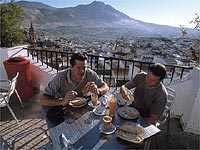
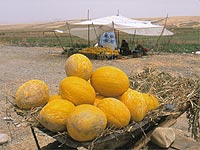 My,
this touring game is tough. Even as we lounge over breakfast on the terrace
overlooking Loja’s old town, the sun is bright and intense as it bakes the
last dawn mist out of the valley. Our route takes us past Granada – where the
somewhat stiffer test of the Dakar Rally started two years before – and on to
the Costa del Sol. Here, the clean clear skies of central Spain succumb to the
brown murk of Malaga and Torremolinos, grim piles of tourist slums crammed into
the narrow coastal strip.
My,
this touring game is tough. Even as we lounge over breakfast on the terrace
overlooking Loja’s old town, the sun is bright and intense as it bakes the
last dawn mist out of the valley. Our route takes us past Granada – where the
somewhat stiffer test of the Dakar Rally started two years before – and on to
the Costa del Sol. Here, the clean clear skies of central Spain succumb to the
brown murk of Malaga and Torremolinos, grim piles of tourist slums crammed into
the narrow coastal strip.
With – mercifully – no time to linger, we
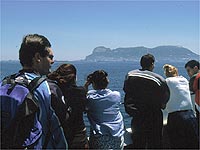
speed south past Gibraltar’s impressive rocky heights and on to the ferry port
of Algeciras. From here, a mere £40 buys a return trip to Africa for bike and
rider. Services to Ceuta (pronounced " say-oo-ta " ) are frequent and
there’s no need to book.
We take the fast catamaran and 40 minutes later
we’ve crossed the Med and landed in northern Africa. Except we haven’t
really.
Despite being on the African continent, the
port of Ceuta is actually part of Spain and the European Union, a legacy of the
colonial days before independence in 1956. Sixty-five years to the day before
our arrival, General Franco launched his fascist takeover of Spain from here.
The place still has a monument to the grim old dictator, fittingly crumbling and
graffiti-covered.
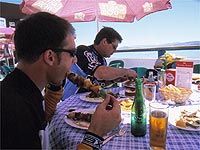
After exploring the imposing fortress of Monte
Hecho, which overlooks the port, the Aprilia’s dash tells us it is 96°F in
the shade, so we find a bit of it by the sea and order some lunch. In the
distance, the mountains of northern Morocco shimmer in the haze. We’re heading
somewhere 500 miles south of them. The next couple of hours are what you might
call Mohammedan.
Mohammed No1 is a beaming wide-boy who kindly
accepts a 6000 peseta " tip " for lubricating our way through Moroccan
customs formalities. Mind you, it’s probably a price worth paying since we had
with us not a shred of evidence that any of us was entitled to ride the BMW.
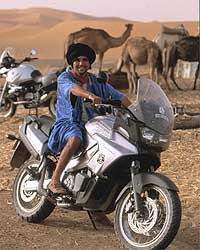 An
hour down the road at Tetouan, Mohammed No2 slithers to a halt beside us on a
battered DT50 as we stop to check the map. Most urban Moroccans speak French,
and many have a little English. After confiding cheerily that he had a brother
living in " Richmond, Surrey, England " , No2 explains the heavy
traffic is due to a Berber festival.
An
hour down the road at Tetouan, Mohammed No2 slithers to a halt beside us on a
battered DT50 as we stop to check the map. Most urban Moroccans speak French,
and many have a little English. After confiding cheerily that he had a brother
living in " Richmond, Surrey, England " , No2 explains the heavy
traffic is due to a Berber festival.
Apparently, once a month Berber tribesmen –
the original inhabitants of Morocco, now mainly confined to the Atlas region –
descend from the mountains to do business in the old town and today looks like
our lucky day. We politely decline his offer to be our guide.
Instead, we head on south, around Tetouan’s
dust-blown ring road, into the Rif mountains and on to Chefchaouan. In former
times this was notorious bandit country. In its way, it still is. Behind almost
every roadside bush lurks a furtive fellow who at the last moment leaps out with
a strange rolling motion of forefingers and thumbs. There are probably subtler
ways of selling hashish, but around here it’s a more-or-less legitimate way of
life.
As an antidote to two days full-on riding, we
check into the best hotel in one of the most dramatic towns in Morocco.
Chefchaouan has an interesting and volatile past. Eighty years ago, simply not
being at the bloody end of a scimitar would have been achievement enough.Up
until then, only three Europeans had ever visited the ancient town, founded as a
refuge for Moors fleeing from Spain. All three were disguised, and one failed to
survive the experience.
As a trio of dry and dusty trailie riders,
we’re bothered by more trivial modern-day matters – we’re looking forward
to removing hours of road grime in the Hotel Asmaa’s swimming pool.
" Sorry, we are cleaning it – full of
bleach. "
Ah, well, a cold beer will have to do, instead.
No joy there, either. The Asmaa turns out to be the first hotel I’ve
encountered in Morocco – a country not normally noted for shoving the Koran
too firmly in your face – which is dry. That’s right, no booze. Somehow a
Fanta doesn’t quite hit the spot after nearly 800 miles in the saddle.
DAY THREE, WEDNESDAY, AUGUST 1, Chefchaouan
to Midelt 265 miles 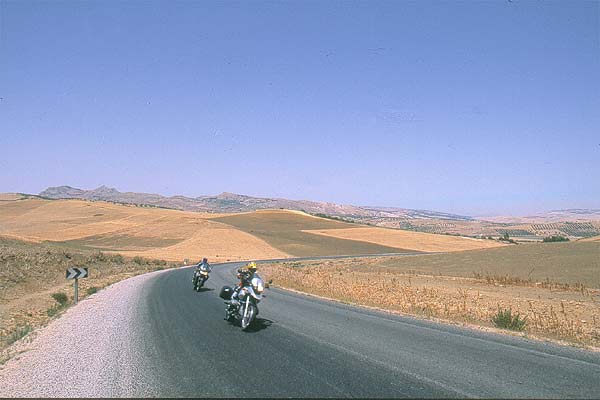
Moroccan roads are a big surprise. From
Chefchaouan, the P28 – the equivalent of our A-roads – scratches its way
south through the Rif valley to Ouazzane, and then for mile after mile of fast
sweeping bends through the wheat farming country in the broad Ouerrha valley.
Yesterday’s short mountain stretch had plenty of shiny, slithery Tarmac, but
today’s is superb.
Hill’s grin confirms as much whenever he
climbs off the Tiger. Smith’s crazed expression tells the same tale of the
Capo Nord. Despite its deeply conservative geometry, on twisty roads the Aprilia
is deceptively easy to sling about. The suspension feels like good kit, it
steers accurately and always feels safe and predictable. The rear suspension was
initially too hard, but – like the GS – the pre-load is easily wound up on
the remote screw.
If the Capo Nord’s Brembo brakes were the
least powerful and most wooden of the trio, the BMW’s similar calipers are the
best. The one problem is the lack of cushioning effect from the Telelever forks.
Grab the anchors too hard and the front tyre squeals as the ABS steps in.
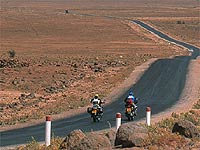 Unlike
in Spain, where 500 miles per day was no problem, there’s no way to rack up
easy mileage here. Most roads are twisty, and though they’re only busy along
the coastal strip, what traffic there is has more faith in Allah than basic road
skills. The driving principle is that if you’re going to crash, it’s what
God wants, so there’s not much point in sticking to any sort of Highway Code.
Unlike
in Spain, where 500 miles per day was no problem, there’s no way to rack up
easy mileage here. Most roads are twisty, and though they’re only busy along
the coastal strip, what traffic there is has more faith in Allah than basic road
skills. The driving principle is that if you’re going to crash, it’s what
God wants, so there’s not much point in sticking to any sort of Highway Code.
Eventually, P28 joins the busy main route from
Rabat and Casablanca and on to bustling Fes, Morocco’s ancient capital – and
the place where Tommy Cooper’s hat came from. After lunch at a pavement café
on one of the city’s broad, leafy boulevards – the French colonial influence
is obvious – we head south on P24.
Before long the road clambers from the baking
plains into the forested pre-Atlas hills around Ifrane. Built by the French in
the 1930s, this is a curious combination of university town and ski resort, and
looks about as Moroccan as Val d’Isère. At 5400ft, the temperature is
agreeably in the mid-80s, though you can find snow as late as March.
From Ifrane the route crosses a mountain plain
before climbing again, over the Middle Atlas range. This is what it’s all
about. Clear blue mountain air, with the odd eagle soaring overhead, and empty,
rollercoaster roads under your wheels. 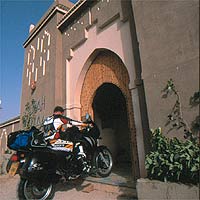
High in a mountain valley we drop in on a
Berber family’s tent. While the kids shriek and sob, the grown-ups are more
alert to the commercial possibilities. After shooing away a neighbouring family
who look like they are about to get in on the act, they’re entranced by images
of themselves in Hill’s digital camera. Unfortunately, this provokes them to
offer us tea. Fearing a dose of dysentery, we politely decline, but thank them
with a handful of dirham, the local currency.
The fuel station at our next stop in a place
called Timahdite has three functional diesel pumps and a single petrol pump
which doesn’t work. Bugger. Still, on the range the bikes have, reaching Zeida
– the next town – should be no problem. Then, near the Col du Zad, with 180
miles on the odometer, the Aprilia begins to stutter and misfire. When we
eventually limp to a petrol pump, it swallows 19 litres of gas. If Aprilia is to
be believed, it had over a gallon left. Not good. Especially not good if
you’re headed to where we’re going.
So where does the desert begin? It’s hard to
say exactly. Somewhere near Doncaster on the A1(M), a sign absurdly announces
your arrival in " The North " . The Sahara’s like that, too. It
doesn’t arrive suddenly, but creeps up on you by barren degrees.
After the relative lushness of the forested
hills to the north, we’re now in a high, arid plain between the Middle and
High Atlas. In this dusty vista, the town of Midelt appears. At the far end sits
the mock fort of the Hotel Kasbah Asmaa. The porter opens the gates, plants a
ramp on the step, and grins broadly as we ride into the courtyard.
After last night’s
alcohol-and-swimming-pool-free frustration, the Kasbah Asmaa proves a passable
imitation of paradise. The bar is full of cold beer and the pool full of clean
cool water, overlooked by the 12,000ft crest of the High Atlas ridge.
DAY FOUR, THURSDAY, AUGUST 2, Midelt to
Erfoud, 150 miles
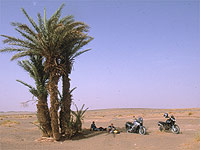 After
a courtyard breakfast in the balmy cool of a desert dawn, plus an oil and chain
check for the bikes – from which the shaft-drive GS stands smugly aloof – we
head out of Midelt’s dusty plain. The route south zig-zags up a shoulder of
the High Atlas mountains, over the Col de Talghamt pass, then down into the true
desert beyond. At the 6000ft summit it’s a pleasantly cool 85°F, but from
here the temperature builds relentlessly.
After
a courtyard breakfast in the balmy cool of a desert dawn, plus an oil and chain
check for the bikes – from which the shaft-drive GS stands smugly aloof – we
head out of Midelt’s dusty plain. The route south zig-zags up a shoulder of
the High Atlas mountains, over the Col de Talghamt pass, then down into the true
desert beyond. At the 6000ft summit it’s a pleasantly cool 85°F, but from
here the temperature builds relentlessly.
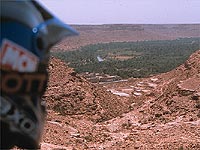
Apart from the occasional cluster of date palms
around an oasis, the ground is as bare and barren as lava. Even the emptiness is
spectacular. Suddenly, south of the village of Rich, it gets more magnificent
still. The road emerges from the Tunnel de Légionnaire, built by the French
Foreign Legion in the 1930s, into the gorge carved through the pink Atlas
Mountains by the Ziz river. This is Morocco’s Grand Canyon.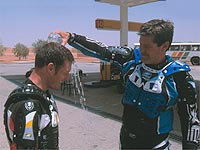
Breathtaking, yes, but in August this is utter
madness. Above 100°F, the air heats you up rather than cools you down. Hill
likens it to pointing a hair-drier directly at your face. You try standing on
the pegs to get more breeze, only it actually heats you up. It seems strange to
batten down visor and zip-up jacket, but it’s actually cooler that way –
unless you’ve just soaked yourself with water. But in this climate you dry so
quickly that even the effect of that is brief.
Officially, the final stretch of road to Erfoud
is simply called P21, but to us it’s Heatstroke Highway. In the open desert,
it reaches 114°F in the shade – and there is no shade. We even come across
the dried-up remains of a camel that had succumbed to the severity of the
Sahara. With no water, a man alone might last a day. In August, when the furnace
is at its fiercest, you need to drink six, seven, eight litres of water a day
just to stop your blood turning to dust.
In this murderous heat, there are two things
man should not do to his fellow man. One is to steal his camel. The other is to
sneakily switch on his Beemer’s heated grips while he isn’t looking…
DAY FIVE, FRIDAY, AUGUST 3, Erfoud to Fes,
285 miles
We’re on our way before dawn to visit the
dunes at Erg Chebbi, 25 miles south of Erfoud over rough desert tracks. This is
the bit where it actually starts to look like the romantic images of the Sahara
in your head. Legend has it the dunes were created by Allah to bury the nearby
village of Merzouga after the residents refused to give shelter to a woman and
her child. Which is nice. As we tow dust clouds across the open desert, the sun
rises furtively through the haze before lighting the Sahara furnace once again.
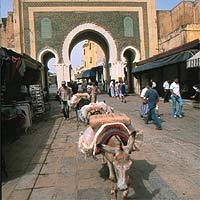 Shallow
sand in open desert is once thing, deep soft sand on road tyres another. Mucking
around in the dunes, Hill and Smith are jelly-legged with exhaustion after 10
minutes. Yet a typical day on the Dakar Rally would have taken us as far
off-road as we’d so far accomplished on Tarmac in two days. No wonder men like
six-times winner Stephane Peterhansel become legends.
Shallow
sand in open desert is once thing, deep soft sand on road tyres another. Mucking
around in the dunes, Hill and Smith are jelly-legged with exhaustion after 10
minutes. Yet a typical day on the Dakar Rally would have taken us as far
off-road as we’d so far accomplished on Tarmac in two days. No wonder men like
six-times winner Stephane Peterhansel become legends.
Ibrahim the camel herder, who we park up next
to, is obviously made of similar stout stuff. He lives out here, selling camel
rides to tourists, of whom there are few in August. Selling fossils is the other
way to make ends meet. He poses for the camera, helps pick up Smith when he
drops one of the bikes and is as cheerful as the desert is grim. Tough? It
doesn’t bear thinking about.
By now the sun is climbing. We’ve only just
got here and now it’s time to go home. To Midelt our route is as before. Then,
instead of going the way we’d come on route P21, from Boulojoul we take the
gun-barrel straights of P20, before rejoining the Middle Atlas and cascades of
mountain bends even more riotous than on the way.
The Aprilia and BMW love it, leaving the
Triumph wallowing behind with its soggy suspension. It trampolines alarmingly
when its brakes are released into a turn, a fault the BMW’s equally plush, but
non-diving Telelever forks manage to avoid. Even with Hill bossing it about with
all his bulk, the Tiger’s a bit of a handful to hurry through S-bends. 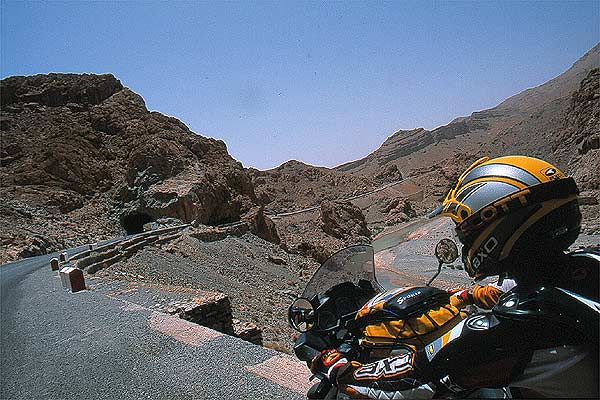
Arriving in Fes in the rush-hour, we are
immediately adopted by the usual local lad on a moped. Between suicidal bouts of
taxi-baiting, Rafael explains that Fes has three cities – the old, the new and
the Jewish – and our hotel was in the old one, the medina. Having taken us
there he wasn’t too happy with a 20 dirham tip (about £1) rather than the
half day’s guiding he’d hoped for. Still, it’s better than a stab in the
foot from an irate scorpion.
DAY SIX, SATURDAY, AUGUST 4, Fes to
Sotogrande, Spain, 290 miles
In cool, shaded alleys around the Hotel Batha,
the cafes, souks and crannies swarm with life and colour. The oldest part of the
city, Fes el Bali, dates from the Eighth Century and is the largest medieval
city in the world. Spices and silken brocades, chicken feet and goat heads, Nike
trainers and Madonna T-shirts – you can get them all here.
You could explore this warren for a week, but
we have to scratch north to Tetouan and the border with Ceuta once more. It’s
late when we arrive in Spain, flopping into the first hotel we can find in
Sotogrande. After four days on Morocco’s mainly mediocre food, we compensate
greedily on Spanish cuisine.
All three of these bikes are pretty able,
coping with good roads, bad roads and even no roads at all. Each can cruise
effortlessly at 100mph-plus, and demolish mountains with some panache. And such
versatility comes bundled with good range, comfort and luggage capacity.
Two iron-bum days later, we’re queuing for the ferry home. In Bilbao’s 60° cool, the BMW’s oil temperature gauge climbs two-thirds up the scale. It’s the hottest it has got all week.