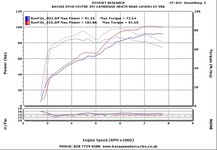
101bhp at the rear wheel

  • Thread starter Thread starter Peter Reilly
  • Start date Start date
yes, usually to do wi noise regs, its a common thing (look at a suzuki bandit curve for a proper dip:eek:)

The 1200 bandit also has a handy wire connector under the seat,unplug and it advances ignition and fills the dip in the curve,and your pants!,buells have the same,there must be one on the gs somewhere:confused:
 
so it uses more fuel ? and the economy is better ?

possibly on a cross section of riding, but if you use the extra power, you'll use more fuel - laws of physics n all that

...except that you get more energy out of a petrol burned at a balanced air fuel ratio. If the AFR is pushing 16, it's a lean mix and will burn with low emissions but won't be extracting as much energy from the fuel as it could. To get the most out of your fuel, depending on octane rating, the AFR should be around 13. I recall when I had a map produced for my Sprint, they aimed for 13.5 as a reasonable compromise between efficiency and emissions.
 
The standard PCIII is designed to work with a standard bike, i.e. no mods at all. I think the moral of the story is that if you fit a freeflow air filter and exhaust then the bike will run very lean, as has been mentioned on other posts. A custom map will fix this and release the full potential of the mods as long as you disconnect the lambda sensors.

As I understand it, the lambda sensors are crude narrow band ones that simply make the bike run lean when they detect too much fuel in the exhaust. If you leave the sensors connected, they will force the bike to run lean, effectively remapping the remap. I actually removed mine completely and fitted blanking plugs in the exhaust bosses.

So far, I am very pleased with the overall results.
 
As I understand it, the lambda sensors are crude narrow band ones that simply make the bike run lean when they detect too much fuel in the exhaust. If you leave the sensors connected, they will force the bike to run lean, effectively remapping the remap. I actually removed mine completely and fitted blanking plugs in the exhaust bosses.

That's exactly what dynojet UK told me.

The PC V (when available for the GS) will allow you to replace the lamda sensors with wideband ones (which connect to the PC). This set up will constantly monitor the AFR throughout the rev range and allow the PC to adjust it to a sensible figure in real time i.e. no need for a custom map.

I find the GS smooth, powerful enough and reasonably economical so I probably won't bother with a PC but I could be tempted with the PC V depending on price.
 
so it uses more fuel ? and the economy is better ?

possibly on a cross section of riding, but if you use the extra power, you'll use more fuel - laws of physics n all that

under normal riding you use less throttle, its when the power is used when you use more juice, average riding can return better mpg:thumb2
 
In response to an earlier request, here is the torque as well as the power curve. The trough at 5,000rpm is not noticeable on the road, at low speed anyway. What you do feel of course is the increase in torque, which is 5-10% across most of the rev band.
 

Attachments

  • rsz_gs_dynojet_power_and_torque.jpg
    rsz_gs_dynojet_power_and_torque.jpg
    102.8 KB · Views: 176
Approx how much did all the mods cost?
Does look a reasonable % increase across the power and torque curves.
So would be intestested in the value of £ / bhp.
thanks
 
so I probably won't bother with a PC but I could be tempted with the PC V depending on price.

Looks like the PC V may not be available for pre-2009, this is the reply I got when inquiring availability date for my 2008:

We are only releasing the PC5 for the 2009 models and we have not look at any of the 2008 models to develop a powercommander for them yet.

Let me know if you have any other questions. Thanks.

Mike Shefler
Dynojet Research Inc.
1-800-992-4993
 
...except that you get more energy out of a petrol burned at a balanced air fuel ratio. If the AFR is pushing 16, it's a lean mix and will burn with low emissions but won't be extracting as much energy from the fuel as it could. To get the most out of your fuel, depending on octane rating, the AFR should be around 13. I recall when I had a map produced for my Sprint, they aimed for 13.5 as a reasonable compromise between efficiency and emissions.

Quite right... However, run it too lean, and you risk overheating and a possible case of going bang. I 'd rather sacrifice a bit on fuel consumption rather than absolute power. This is a GS we are talking about anyway.

The power curve on the graph is interesting but also rather academic. Where is the torque?
 
We are only releasing the PC5 for the 2009 models and we have not look at any of the 2008 models to develop a powercommander for them yet.

Let me know if you have any other questions. Thanks.

Mike Shefler
Dynojet Research Inc.
1-800-992-4993

Do you know what the difference is? I can understand why it might not work on a 2007 model but I have assumed that 2008 would be O.K.
 
Quite right... However, run it too lean, and you risk overheating and a possible case of going bang. I 'd rather sacrifice a bit on fuel consumption rather than absolute power. This is a GS we are talking about anyway.
The GS runs relatively lean as standard but BMW appear to have built in a reasonable safety margin. I run mine with standard can but Keihan (no cat) headers so it's a bit leaner than standard but certainly have never had any problem (which seems to be consensus amongst riders with bike set up in this way). If I fitted a PC it would provide a richer, "safer" mixture but I wouldn't bother doing it for that reason. Even people with both aftermarket headers and can don't seem to have any problems although it is, of course, a theoretical possibility.


Back
Top Bottom