

You are using an out of date browser. It may not display this or other websites correctly.
You should upgrade or use an alternative browser.
You should upgrade or use an alternative browser.
12 Nm on the plugs? thats not very tight
- Thread starter beaver
- Start date


Quite an interesting thread this , as a mechanical bod all my days working on all sorts of things , lots of stuff can just be screwed together by feel , BUT just occasionally one gets a " surprise" I was dropping the forks back through the yolks on a wee xt660z that I bought recently and nipped them up to hold it . Went to manual for the correct torque as its all alloy , once started on the torque step ups I had go back to check both manuals as , done by feel you would NEVER have pulled them up to this tightness , a wee wake up call to check if you are not sure .
Deleted account 191119001
Registered user
- Joined
- Aug 13, 2017
- Messages
- 12,798
- Reaction score
- 9
yes.. and if he takes it out, it won't be crushed (not fully)... I'm not keen on that TBH
Yep but the one he took out was crushed, so maybe a smidgeon more torque at factory level who knows.

problem I see with an uncrushed washer is that the plug itself has a mass... and as we bounce down the roads here in the UK with all our pot-holes, the plug will effectivley want to wag up and down due to the clearance in the thread.. I know this will be minimal in real terms, but will in effect further crush the washer top and bottom so you don't have a uniform seal preasure all the way around... ?... I know this is theory but I'm sure we have the software at work to calculate the forces involved / needed to do this.. I may be way out but IMO, I'd rather have mine fully crushed so it's no where to go.
I'd also say a lose plug could cause more damage to a thread as it bounced about with external and compression forces pulling on it... May years ago I had a steel head in a boat lose a plug through it coming lose.. had to be heli-coiled but was always a problem after that
I'd also say a lose plug could cause more damage to a thread as it bounced about with external and compression forces pulling on it... May years ago I had a steel head in a boat lose a plug through it coming lose.. had to be heli-coiled but was always a problem after that

Finger tight, then quarter turn. Always worked for me. 

Had a laugh reading this thread. I don't have an LC, but I can appreciate why someone with a new bike would want to get it right. But looking at the plugs in the video there must be a good 40mm of thread on them. At which point the content about it losing its earth connection if it loosened a tad made me chuckle.
The one comment I didn't read from anyone was that perhaps that 'crush washer' on the plug itself is not actually to be crushed but instead it is shaped to act more like spring washer. Therfore, when you tighten to said torque and then remove, it gives the impression it hasn't been 'crushed'. I would suspect this is more likely, because otherwise I have to ask what are you torquing up against? Surely is up against that 'spring washer'. Heat expansion of all the components will seal it further quite quickly. No?
Saying all this, I'm with all the other comments on just doing it by feel (which is why we're all used to seeing those washers flattened. LOL). Never had a problem myself doing it this way. I also agree that 12nm sounds very low. But if you consider that washer to be a spring washer (not a crush washer) then it makes more sense that it's a feasible torque. Maybe.
Sent from my SM-N910F using Tapatalk
The one comment I didn't read from anyone was that perhaps that 'crush washer' on the plug itself is not actually to be crushed but instead it is shaped to act more like spring washer. Therfore, when you tighten to said torque and then remove, it gives the impression it hasn't been 'crushed'. I would suspect this is more likely, because otherwise I have to ask what are you torquing up against? Surely is up against that 'spring washer'. Heat expansion of all the components will seal it further quite quickly. No?
Saying all this, I'm with all the other comments on just doing it by feel (which is why we're all used to seeing those washers flattened. LOL). Never had a problem myself doing it this way. I also agree that 12nm sounds very low. But if you consider that washer to be a spring washer (not a crush washer) then it makes more sense that it's a feasible torque. Maybe.
Sent from my SM-N910F using Tapatalk
Had a laugh reading this thread. I don't have an LC, but I can appreciate why someone with a new bike would want to get it right. But looking at the plugs in the video there must be a good 40mm of thread on them. At which point the content about it losing its earth connection if it loosened a tad made me chuckle.
The one comment I didn't read from anyone was that perhaps that 'crush washer' on the plug itself is not actually to be crushed but instead it is shaped to act more like spring washer. Therfore, when you tighten to said torque and then remove, it gives the impression it hasn't been 'crushed'. I would suspect this is more likely, because otherwise I have to ask what are you torquing up against? Surely is up against that 'spring washer'. Heat expansion of all the components will seal it further quite quickly. No?
Saying all this, I'm with all the other comments on just doing it by feel (which is why we're all used to seeing those washers flattened. LOL). Never had a problem myself doing it this way. I also agree that 12nm sounds very low. But if you consider that washer to be a spring washer (not a crush washer) then it makes more sense that it's a feasible torque. Maybe.
Sent from my SM-N910F using Tapatalk
But its not a spring washer!.. and wondered why coil sticks fail on plugs that are lose??
Well, I haven't seen the particular washer in question.But its not a spring washer!.. and wondered why coil sticks fail on plugs that are lose??
But personally, I've always wound up the plugs without a torque wrench and usually stop when i felt that washer 'crush', but I'm wondering if maybe that's not how that washer is meant to me used?
ps. If you can belive Wikipedia, then I've just read the sealing washer is described as a 'crush washer'... I also see you can buy replacements, which does suggest one time use - theoretically.
So rewinding back to the op, 12nm does seem low, especially if there's no evidence of it being 'crushed'. Unless it's a spring washer? I'm getting dizzy
 lol
lolSent from my SM-N910F using Tapatalk
Deleted account 191119001
Registered user
- Joined
- Aug 13, 2017
- Messages
- 12,798
- Reaction score
- 9
Well in the video we can clearly see washer is crushed, so think post 45 seems about right whatever Nm that would be.
I'm inclined to agree. But no one (including me) has really answered the question ie. Is 12nm sufficient if the washer doesn't crush? There was a comment questioning the torque wrench used. Maybe the 15nm was in fact 12?!
With all that thread, I'd be very surprised if any damage, even accumulative, would happen if the tried and tested method was used.
Sent from my SM-N910F using Tapatalk
With all that thread, I'd be very surprised if any damage, even accumulative, would happen if the tried and tested method was used.
Sent from my SM-N910F using Tapatalk
Deleted account 191119001
Registered user
- Joined
- Aug 13, 2017
- Messages
- 12,798
- Reaction score
- 9
I'm inclined to agree. But no one (including me) has really answered the question ie. Is 12nm sufficient if the washer doesn't crush? There was a comment questioning the torque wrench used. Maybe the 15nm was in fact 12?!
With all that thread, I'd be very surprised if any damage, even accumulative, would happen if the tried and tested method was used.
Sent from my SM-N910F using Tapatalk
Also do all crush washers crush under the same Nm if the crush washer was from a different maker, maybe it would take a few more Nm to crush, just a thought to get beaver going for Friday, as I know he likes everything spot on...
These are all NGK plugs, so they will make their own washer to crush at a given torque...
I'm not sure the one in the vid does show it crushed however... there is a still on the LHS that clearly shows the used one crushed in comparison with a new one.. however, the one he has in the socket that he's just taken out does not appear to be crushed at all? that said, looking at its condition, its not been in for long so can we assume its one he's put in at 12 Nm and its not crush (as I agree with)... the one in the still on the LHS has been used for a good few miles, so can we assume this is the original BMW fitted one?
I'm sure my plugs have never been out and show the same.. the one thats done 12K and was fitted by BMW from day one is crushed flat.. the ones I put in to 12 Nm and then removed were only slightly crushed...
so do BMW factory used a bigger torque when fitting them initialy?.. and if they do, then why tell us 12 Nm?
One thing is for sure, if fitted at 12Nm and not fully crushed, they won't crush over time so when removed at 12K they are flat (before anyone suggests it)
The pitch on the plug is about 1mm.. a crushed washer measures 1.1mm where as the un-crushed one is around 1.6mm... so to crush it fully it would be screw in by hand and 1/2 a turn?
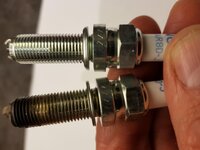
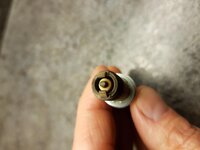
As we know LC's take 4 plugs when you replace them .. so I have two new ones left over so I've taken a pic of mine .... (below)
One thing is for sure.. the electrode going oval.. my plugs as I say have been in for just over 12K miles and the electrode measures 2mm dia side to side, but only 1.6mm where it sparks.. so the gap has opened up from an original 0.8mm (aprox) to 1mm... that will put a load on the coils then... maybe 12K is a bit long for plug changes??
I'm not sure the one in the vid does show it crushed however... there is a still on the LHS that clearly shows the used one crushed in comparison with a new one.. however, the one he has in the socket that he's just taken out does not appear to be crushed at all? that said, looking at its condition, its not been in for long so can we assume its one he's put in at 12 Nm and its not crush (as I agree with)... the one in the still on the LHS has been used for a good few miles, so can we assume this is the original BMW fitted one?
I'm sure my plugs have never been out and show the same.. the one thats done 12K and was fitted by BMW from day one is crushed flat.. the ones I put in to 12 Nm and then removed were only slightly crushed...
so do BMW factory used a bigger torque when fitting them initialy?.. and if they do, then why tell us 12 Nm?
One thing is for sure, if fitted at 12Nm and not fully crushed, they won't crush over time so when removed at 12K they are flat (before anyone suggests it)
The pitch on the plug is about 1mm.. a crushed washer measures 1.1mm where as the un-crushed one is around 1.6mm... so to crush it fully it would be screw in by hand and 1/2 a turn?
As we know LC's take 4 plugs when you replace them
.. so I have two new ones left over so I've taken a pic of mine .... (below)One thing is for sure.. the electrode going oval.. my plugs as I say have been in for just over 12K miles and the electrode measures 2mm dia side to side, but only 1.6mm where it sparks.. so the gap has opened up from an original 0.8mm (aprox) to 1mm... that will put a load on the coils then... maybe 12K is a bit long for plug changes??
Attachments

I went to a car club talk years ago on spark plugs, I'm boring, I cannot for the life of me remember the manufacturer.
I do recall, that you did it to a certain torque setting then + 1/8th of a turn or used an angular setting.
Of course none of us use any anti seize paste on the spark plugs, as that does effect the torque value.
Sent from my SM-G925F using Tapatalk
I do recall, that you did it to a certain torque setting then + 1/8th of a turn or used an angular setting.
Of course none of us use any anti seize paste on the spark plugs, as that does effect the torque value.
Sent from my SM-G925F using Tapatalk
Deleted account 191119001
Registered user
- Joined
- Aug 13, 2017
- Messages
- 12,798
- Reaction score
- 9
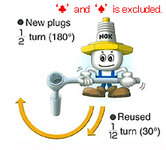
Yes.. very... they are 10mm so 10-12 Nm.. but it goes on to say that new plugs should be turned 1/2 a turn from contact.. which is what I'm saying above (but is more that 10-12 Nm)..
So lets agree.. new plugs 1/2 a turn.. re-used 12 Nm ??

Attachments
Deleted account 191119001
Registered user
- Joined
- Aug 13, 2017
- Messages
- 12,798
- Reaction score
- 9
Yes.. very... they are 10mm so 10-12 Nm.. but it goes on to say that new plugs should be turned 1/2 a turn from contact.. which is what I'm saying above (but is more that 10-12 Nm)..
So lets agree.. new plugs 1/2 a turn.. re-used 12 Nm ??
Yep that seems to be the crusher on the head.............

Beaver why dont you just put them in at 12 NM as recommended and try it?
If they were to come loose you will soon find out soon enough.
If they were to come loose you will soon find out soon enough.
Deleted account 191119001
Registered user
- Joined
- Aug 13, 2017
- Messages
- 12,798
- Reaction score
- 9
Beaver why dont you just put them in at 12 NM as recommended and try it?
If they were to come loose you will soon find out soon enough.
Where is the fun in that..............
How quickly would you really find out? I mean the plug is deep in there, with a long stick coil stuffed in on top of it and then a plug cover to boot.Beaver why dont you just put them in at 12 NM as recommended and try it?
If they were to come loose you will soon find out soon enough.
In reality, you'd have to keep checking. So how long will it have been loose by the time your next check comes around?
Sent from my SM-N910F using Tapatalk
Deleted account 240831001
Registered user
- Joined
- Feb 7, 2015
- Messages
- 39,182
- Reaction score
- 4,588
I’ve only ever cleaned the threads, blown down the hole in the cylinder head with a straw to make sure it’s clean, put light oil on my finger and run it around the threads on the plug then screwed it in hand tight plus a bit.
As for re-using them and worrying about the crush washer, I just do the same with the plus a bit being a bit less
As for re-using them and worrying about the crush washer, I just do the same with the plus a bit being a bit less
