
Airheads for Dummies

Arsey

I identify as a Donkey. My pronouns are He/Haw
UKGSer Subscriber
Joined
Mar 5, 2008
Messages
38,215
Reaction score
20,193
Location
Guernsey or Plessala
Ok,with the risk of incoming hostile fire,could someone explain in simple,terms the different bikes available ?

I know fuck all about airheads.

For instance ,how are these 2 both R100GSs as they look totally different ?

86aaf39e33d108827b916980bee5370c.jpg
f41baa5adc04bc6aac29309ab58a6100.jpg


And is this the same as the last pic but with the PD treatment/red seat ??

2a17a2e3fc86d1eea1249e02b8817c6a.jpg


Sent from my iPad using Tapatalk
 
This may help. You even get a little picture :D http://micapeak.com/bmw/gs/

The difference between the top two bikes is the later bike (top picture) has the later style indicators (push button as per the 1100 gs) and also has the frame mounted fairing and what are refereed to as roo bars apart from that they are essentially the same. The rear suspension is the forerunner of the units used on the 1100/1150 - they even use the same crown bearing which is obviously massively under stressed on these bikes.

The bottom bike is a paris dakar R80 g/s. This is a monolever bike and while they fetch much more money than the two other bikes they don't ride as well and have poor suspension. Theses were really a styling exerciser. The front forks came from the road bikes of the early 80s. The biggest problem is the wheel base changes when you hit bumps on the bends giving it a feeling like its wagging its arse. In its favour is the engine is so under powered and gutless that you seldom get to speeds that the wagging suspension becomes dangerous. Any attempt to load them up will result in an "instant off" unless a death like grip is maintained on the bars.

Power wise

100GS puts out around 50 BHP at the rear wheel
R80 g/s around 38 BHP
 
The black & yellow bike and the white bike are pretty much the same in that they are the paralever (swing arm) generation (1988 to 93/94). However, the early aralevers (1988 to circa 1990) came with the smaller "tombstone" screen/fairing as on the white bike. From late '90 (or 1991) they came equipped with the 'roo bars, taller screen and panels as on the black one.
The bike in the last picture is the G/S generation which are the originals (1980/81 to 1987). These were R80's (R65 frame !) and were equipped with the monolever swing arm. They are also worth quite a bit more money than the paralevers these days !
 
There are others on here infinitely better qualified to reply but briefly the first two are Paralevers (GS)as you can clearly see from the o/s pics (Parallel tie bar below the drive shaft housing) and are therefore later bikes. The third is a Monolever and therefore an earlier bike (G/S). It looks like a genuine Paris Dakar to me (single seat and larger tank) but I'm not an expert. The first is an R100GS ( I have one similar), the second I think is a Basic.
HTH (a bit!):rob
 
Thanks for the info guys .That explains it !

I like the look of the Basic ! I should have bought the one in the pic above that Florence was selling !

But then again,this is quite nice


Sent from my iPad using Tapatalk
 
Thanks for the info guys .That explains it !

I like the look of the Basic ! I should have bought the one in the pic above that Florence was selling !

But then again,this is quite nice


Sent from my iPad using Tapatalk

The bike in your 2nd photograph isn't a basic (hopefully you were referring to this)
 
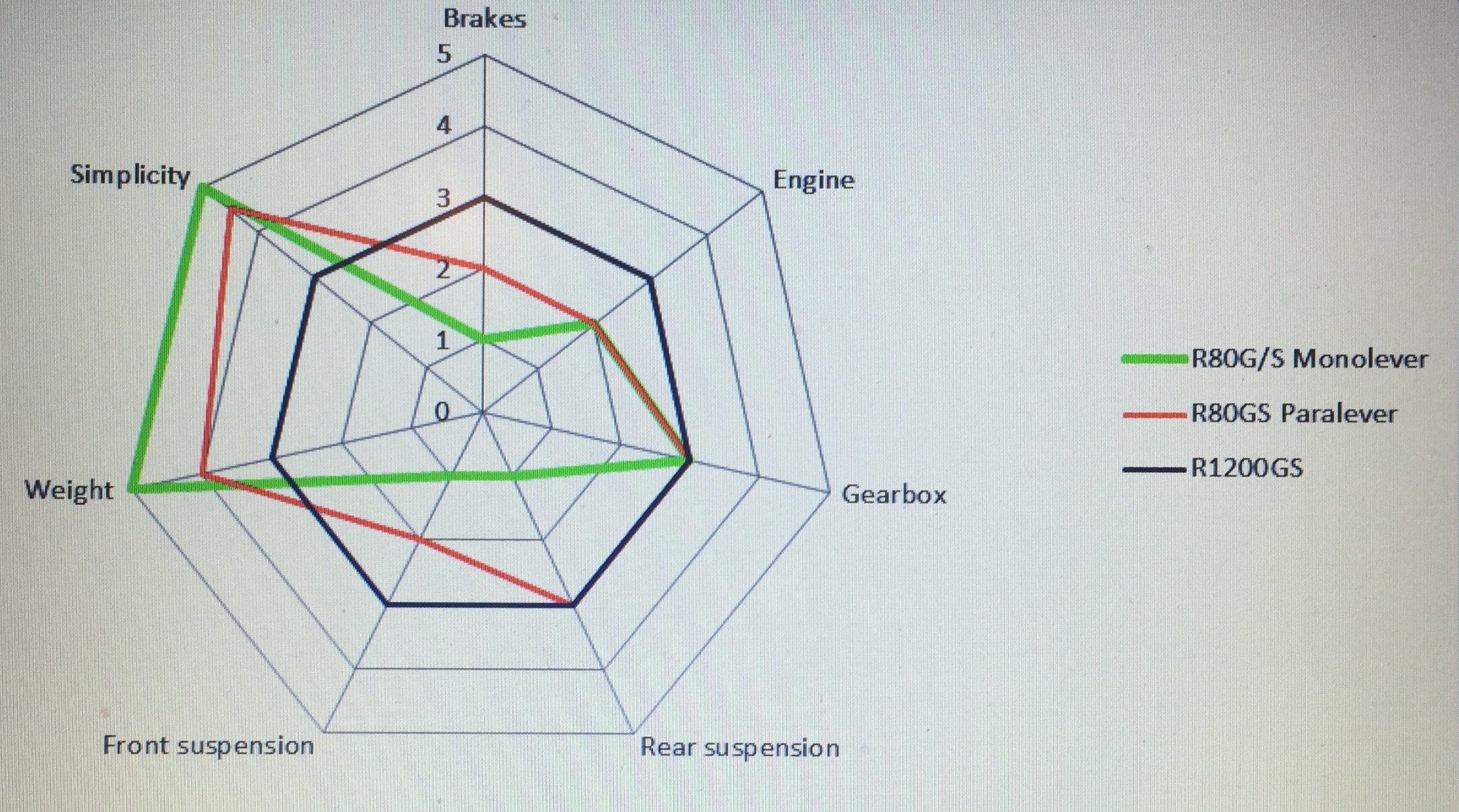
And in an entirely unscientific and subjective assessment of how each (in my limited experience) feels compared to an oilhead 1200GS, when a score of 5 is best...


33682564636_b61fa1a919_k.jpg
 
If you want to look at it, buy a R80G/s, if you want to look at it and bare knuckle ride occasionally get the R100Gs, if you don't want to look at it but want to ride it buy a 1100/1150,

The standard airhead brakes are scary, I think you get used to them though, like when you first started riding and you hit 40mph, they can be upgraded though, for a price both in money and looks.
 
Easy cheat:
R80G/S: rear wheel has 3 retaining bolts....its a "mono"
R80GS or R100GS: Later model, wheel has 4 retaining bolts...its a "paralever"
Mono's have a more pronounced Raise to the rear end when under acceleration, which the paralever stops.

Mono's worth more money at the moment (as long as the mileage/condition/originality is the same as the later bike)
Paralevers ride better, but don't look as good IMHO.....
Early paralevers don't have the fairing with surrounding bars ("roo bars"), which came into the UK in 1991 (I had one, loved it!...where are you now H91BMY?)

Buy a nice early Paralever from Florence, and enjoy.......(other sellers are available!)
 
And in an entirely unscientific and subjective assessment of how each (in my limited experience) feels compared to an oilhead 1200GS, when a score of 5 is best...


33682564636_b61fa1a919_k.jpg

I don't think Paralever brakes are any better than G/S brakes, in fact with the extra weight they are probably worse!
 
I don't think Paralever brakes are any better than G/S brakes, in fact with the extra weight they are probably worse!

Hmmm.... Mine definitely felt better on the later bike, even tho there was still a rubber hose on the Kalahari and there's a new Goodridge on the G/S. I'm yet to try a different set of pads on the G/S so there's still something to try before going all big disc or twin disc modification daft (and pushesing the forks further past their design limits).

The ST calliper and smaller wheel combo was probably about the same as the Kalahari. Poor, but bearable.

The Paralever forks helped too, as they react quite dramatically to sudden brake application on the G/S, though a bit less since fitting the BMW fork brace.:thumb2
 
If you want to look at it, buy a R80G/s, if you want to look at it and bare knuckle ride occasionally get the R100Gs, if you don't want to look at it but want to ride it buy a 1100/1150,

The standard airhead brakes are scary, I think you get used to them though, like when you first started riding and you hit 40mph, they can be upgraded though, for a price both in money and looks.

This is a pretty good summary. Did a few hundred enjoyable kms (tar and dirt) on my 89 100GS yesterday. I have the suspension and handling pretty well sorted out to suit me and have upgraded the front brake to the stage where it is adequate, the rear brake possibly has some retardation effect but it is insignificant. The lack of power was evident on one of my favorite winding roads up and over a small mountain. Acceleration out of uphill corners is sedate at best. On flatter going it has no probs maintaining a decent speed.

I could (and have done in the past) modify the engine and gain a few hp at the cost of a lot of $$$ but, IMO, it makes more sense to enjoy it for what it is. I have another bike with a bit more oomph more suited to the mountain roads.
 
I could (and have done in the past) modify the engine and gain a few hp at the cost of a lot of $$$ but, IMO, it makes more sense to enjoy it for what it is. I have another bike with a bit more oomph more suited to the mountain roads.

I fitted a moorespeed engine in my 100PD for a while. While the engine was great fun the chassis and brakes just weren't up to the job I ended up stiffening everything up to the point that it wasn't fun to ride. It really was a better bike in standard format.
 
The brakes are fairly easy to sort out, I've done a lot of research into it and mine all stop with 2 fingers.....................but you have to spend some money! they're almost as good as a 1200 and I know 'cause I've got one!
 
All the bikes can be upgraded to the point that everything works as well as is needed, but it takes a lot more knowledge , skill and expertise to get the R80 G/S right than the R 100GS.
I have one of each, main difference is the paralever which is just a better system than a straight swinging arm. But with an Ohlins on both and well sorted forks the difference is minimal, and some folks were able to win the Paris Dakar on a G/S so it cant be that bad.

I have been able to upgrade everything else to near enough a equal standard, but a lot of that involves going back to basics and ignoring contemporary fads, most of which are simply based on fashion with little regard to basic engineering principles.


Back
Top Bottom
