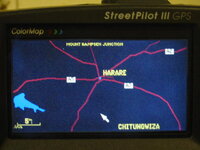
Whatton:
You wrote
"You seem to be the resident GPS expert on this board..." Although I am honoured by your comment, I will have to respectfully decline the compliment, I'm not a GPS expert at all. I have a certain amount of specialized knowledge about certain GPSR's that I use myself (SP III, SP 26xx, and the GNS 430 and 530 aviation panel mount units), but so far as anything other than those units, I really have no more knowledge than anyone else who posts here.
I'll try and answer your question
"What’s your personal recommendation for a colour unit to use on the bike, in the UK with the odd trip to France etc." based on my own past experience, but do keep in mind I am no expert, and I don't have a broad knowledge of all the units out there that might be suitable for you.
First off - at least you know what you want to do with your GPSR (use it in one country, with occasional trips to another country, and you know you want colour and battery power.) That alone puts you far ahead of 90% of the prospective purchasers out there, most of whom just know that they want a new GPS gadget, but have not given any thought to what they want to use it for.
You specified colour and batteries. That rules out the SP 26xx family, which does not have internal batteries.
You indicate you want to use it in the UK and occasionally France. That suggests to me that you would probably be well served by a unit with 50 to 130 megs of memory. 50 megs is kind of on the low end, but more about that later.
Garmin (the only manufacturer I am familiar with) make GPSR's for four different markets - outdoor, automotive, marine and aviation. Within each market there are units that are designed specifically for that one market. There are also a number of crossover units aimed at two of those markets, and a few models that are kind of like 'jack of all trades' - a bit like those screwdrivers you buy with 10 bits in the handle, they will do everything in a pinch, but nothing really well.
The StreetPilot series (original StreetPilots, SP III, SP 26xx) are the automotive-specific units. In general, they have the largest memory capacity of any of the Garmin units (automotive routing requires a lot of map storage capacity, more than any other discipline), and they have really brightly lit screens, these screens use "through the screen" backlighting - a big fluorescent light BEHIND the display.
Marine units offer the user more ability to customize display parameters (marine users are generally more technically savvy than automotive users, although the motorcycle users seem to be equally as savvy as the marine users). They generally have less storage capacity, because boats don't go as far or as fast, and there are fewer 'roadways', so to speak. They also have screens that are side-lit, rather than back-lit, because battery life is very important to boaters, as opposed to automotive users. The automotive users always have 12 volts available, this is not always the case on sailboats.
The 'outdoor' market addresses hunters, hikers, kids who play "hide and go seek", etc. - these folks want inexpensive units.
The GPS 176, 176C, and the follow-on 276 products are marine - automotive crossover units. They do a good job in each segment, but are primarily intended for the marine market. You give up screen contrast and screen backlighting power in exchange for longer battery life. They also lack some of the very advanced autorouting features (e.g. advanced road preferences, custom avoids, etc.) that are showing up now on the SP 26xx series. But, I have a number of friends who use these 176 units on their motos and are happy with them.
The GPS V, and more recently, the 60C and 60CS, are the 'jack of all trades' units. It appears to me (just my own opinion, don't take this as gospel) that users get a smaller screen and limited memory capacity in return for something that they can put in their pocket and use for any purpose - automotive, outdoor, marine, or (very limited) aviation.
For you, considering what you have said, I think you should have a close look at the SP III (either new or used) or the 60CS. You should be able to buy a used SP III, with a current map product (CityNavigator version 6) and a 128 meg memory chip for about 70% or less of the current retail price. If the unit is being sold with a previous generation map product (e.g. CityNavigator 5), then simply discount the price above (street retail X .7) by the cost of buying a map upgrade. If you buy a used unit, be alert to the different configurations on the market - I made a post elsewhere here sometime in the last two weeks, explaining how to do 'due diligence' when buying a used SP III.
On the other hand, the 60CS looks interesting, however, it has less internal memory than a SP III (56 megs vs. 128 for the SP III). This is partially offset by the fact that it uses less bulky maps (CitySelect vs. CityNavigator). There is no
visible difference between CitySelect and CityNavigator - every road, lane and cow path that exists on CS is also there on CN - and for personal automobile or moto use, both products are equally satisfactory, you will not notice any difference whatsoever between them. CS maps take up about 30% less space, so a 60CS with 56 megs memory and CitySelect in it is sort of like a SP III with 80-85 megs in it and CityNavigator.
Garmin has a little "comparator" program that will allow you to look at the differences in technical specs between these units. go to this link:
Garmin 60CS GPSR and then click on the MOBILE product comparison. Don't click on OUTDOOR product comparison, that will take you into the 'hunter-hiker-hide and go seek' models that are unsuitable for automotive use.
Personally - I ride full time for at least 3 months of the year, I cover huge distances and ride in both North America and Europe. So, I stick with the top of the line automotive specific units. But, it sounds like you could make do with the previous generation auto unit (the SP III), which was top of the line until November 2003, or perhaps be well served by the 'jack of all trades' model. I'm not ruling out the 276, but you pay more money for processing power and marine functionality that you don't need at all, and the displays on the 176 were not as bright or high contrast as the displays on the SP III. Whether technology has brought improvements to the 276, I don't know. But the 276 design spec still puts battery life ahead of screen brightness and contrast.
PanEuropean.