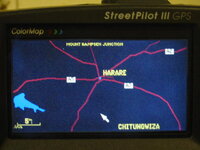
And why not this one?

  • Thread starter Thread starter ALHTHS
  • Start date Start date

ALHTHS

Guest
Garmin anounced the GPSMAP 276C (http://www.garmin.com/products/gpsmap276c/).
It looks like it can do turn to turn navigation and it can accept data cards (up to 256Mb). It is colour, waterproofed (IPX7) and it provides USB interface (fast data transfers) as well as a serial interface.
It is expected to sell around the £500 mark, so to me looks like a clear winner over the 2610/2620/2650 and the GPSMap 60CS.
 
It is a nice machine, for sure, but it is primarily a marine unit, not an automotive unit. One of the big problems with its predecessor, the 176, was that the display was not bright enough for motorcycle use, because it is expected that the marine users will shade the unit when they are using it.

The two automotive specific units - the SP III and SP 26xx - both have honking great backlights in them, of a different design altogether than the other backlights, to ensure sufficient brightness under all driving conditions. This explains why the SP III had such short battery life compared to the 176, and also why Garmin didn't even bother to put batteries in the SP 26xx.

If you have both a boat and a motorcycle, and expect to use the unit equally in both environments, then it would be a GREAT dual purpose unit. But it is not the best choice (on any criteria except, possibly, price) for pure automotive or moto use.

PanEuropean
 
Paneuropean,

You seem to be the resident GPS expert on the board.

What’s your personal recommendation for a colour unit to use on the bike, in the UK with the odd trip to France etc. Internal batteries would be an advantage.

Budget around £600.
 
Buy my SPIII Deluxe!

Atlantic/Euro-basemap (see below), all the bits and bobs that came in the box (including the box and packaging, manuals etc), v5 European City Navigator with full unlock codes, Mapsource CD, Touratech handlebar mount, bare end data/power lead, 128Mb card, USB Datacard reader, serial data transfer lead, remote aerial lead, fag-ash lighter power lead-cum-speaker and perhaps a WorldMap thrown in.

£500

Greg
 

Attachments

  • img_1229.jpg
    img_1229.jpg
    45.3 KB · Views: 484
If you have a Costo card, £535 they have some in with ver 6 mapping so you can keep the registration a while and get a free update next year for ver 7.
John:D
 
I'm not allowed in the Costco club, I don't meet their stringent criteria. I’m still waiting to see what Paneuropean has to say…. he must be out there somewhere?
 
Whatton:

I'll try to post a reply later today. Have been sort of busy with work the last 24 hours, gotta go catch a flight in another hour.

PanEuropean
 
whatton63 said:
I'm not allowed in the Costco club, I don't meet their stringent criteria. I’m still waiting to see what Paneuropean has to say…. he must be out there somewhere?

Whatton...it's easy to get a Costco card if you want one.......don't give up just like that.......;)

PS don't they do a personal card anyway for those who need a 'personal' membership rather than a business one?
 
PanEuropean,

This is from Garmin's product description: "This portable GPS navigator features a 256-color TFT display that's easy to read in bright sun..."

Well... I haven't see the unit yet but I hope it is true. Anybody had the chance to test drive the unit yet?
 
Fanum said:
Whatton...it's easy to get a Costco card if you want one.......don't give up just like that.......;)

PS don't they do a personal card anyway for those who need a 'personal' membership rather than a business one?

Fanum, I've been on their website mate, and the individual membership criteria is:

Individual Membership
Membership is available to individuals over the age of 18 years who meet one of the qualifying requirements listed below:

The annual membership fee is £25.00 (plus VAT) for the primary cardholder, which includes a spouse card.

Current or retired employee of:

Banking/Finance
Civil Servant
Education
Fire/Rescue
Local Government
Medical/Health Service
Police Force
Post Office

Qualified as:

Optician
Dentist
Pharmacist
Solicitor/ Barrister/ Magistrate/ Advocate

Provide proof of eligibility with the following:
1. Employee ID Card
Or
Employee Payslip
Or
Certificate of Professional qualification
Plus
2. An original copy of a current utility bill (ie, gas, electricity, telephone) from home address.
Or
Bank statement from home address (utility bill or bank statement must be dated within last 3 months).

I'm afraid I'm not employed in any of these worthy professions. I’m just a lowly electrical engineer, keeping the wheels of industry turning ;)
 
Whatton:

You wrote "You seem to be the resident GPS expert on this board..." Although I am honoured by your comment, I will have to respectfully decline the compliment, I'm not a GPS expert at all. I have a certain amount of specialized knowledge about certain GPSR's that I use myself (SP III, SP 26xx, and the GNS 430 and 530 aviation panel mount units), but so far as anything other than those units, I really have no more knowledge than anyone else who posts here.

I'll try and answer your question "What’s your personal recommendation for a colour unit to use on the bike, in the UK with the odd trip to France etc." based on my own past experience, but do keep in mind I am no expert, and I don't have a broad knowledge of all the units out there that might be suitable for you.

First off - at least you know what you want to do with your GPSR (use it in one country, with occasional trips to another country, and you know you want colour and battery power.) That alone puts you far ahead of 90% of the prospective purchasers out there, most of whom just know that they want a new GPS gadget, but have not given any thought to what they want to use it for.

You specified colour and batteries. That rules out the SP 26xx family, which does not have internal batteries.

You indicate you want to use it in the UK and occasionally France. That suggests to me that you would probably be well served by a unit with 50 to 130 megs of memory. 50 megs is kind of on the low end, but more about that later.

Garmin (the only manufacturer I am familiar with) make GPSR's for four different markets - outdoor, automotive, marine and aviation. Within each market there are units that are designed specifically for that one market. There are also a number of crossover units aimed at two of those markets, and a few models that are kind of like 'jack of all trades' - a bit like those screwdrivers you buy with 10 bits in the handle, they will do everything in a pinch, but nothing really well.

The StreetPilot series (original StreetPilots, SP III, SP 26xx) are the automotive-specific units. In general, they have the largest memory capacity of any of the Garmin units (automotive routing requires a lot of map storage capacity, more than any other discipline), and they have really brightly lit screens, these screens use "through the screen" backlighting - a big fluorescent light BEHIND the display.

Marine units offer the user more ability to customize display parameters (marine users are generally more technically savvy than automotive users, although the motorcycle users seem to be equally as savvy as the marine users). They generally have less storage capacity, because boats don't go as far or as fast, and there are fewer 'roadways', so to speak. They also have screens that are side-lit, rather than back-lit, because battery life is very important to boaters, as opposed to automotive users. The automotive users always have 12 volts available, this is not always the case on sailboats.

The 'outdoor' market addresses hunters, hikers, kids who play "hide and go seek", etc. - these folks want inexpensive units.

The GPS 176, 176C, and the follow-on 276 products are marine - automotive crossover units. They do a good job in each segment, but are primarily intended for the marine market. You give up screen contrast and screen backlighting power in exchange for longer battery life. They also lack some of the very advanced autorouting features (e.g. advanced road preferences, custom avoids, etc.) that are showing up now on the SP 26xx series. But, I have a number of friends who use these 176 units on their motos and are happy with them.

The GPS V, and more recently, the 60C and 60CS, are the 'jack of all trades' units. It appears to me (just my own opinion, don't take this as gospel) that users get a smaller screen and limited memory capacity in return for something that they can put in their pocket and use for any purpose - automotive, outdoor, marine, or (very limited) aviation.

For you, considering what you have said, I think you should have a close look at the SP III (either new or used) or the 60CS. You should be able to buy a used SP III, with a current map product (CityNavigator version 6) and a 128 meg memory chip for about 70% or less of the current retail price. If the unit is being sold with a previous generation map product (e.g. CityNavigator 5), then simply discount the price above (street retail X .7) by the cost of buying a map upgrade. If you buy a used unit, be alert to the different configurations on the market - I made a post elsewhere here sometime in the last two weeks, explaining how to do 'due diligence' when buying a used SP III.

On the other hand, the 60CS looks interesting, however, it has less internal memory than a SP III (56 megs vs. 128 for the SP III). This is partially offset by the fact that it uses less bulky maps (CitySelect vs. CityNavigator). There is no visible difference between CitySelect and CityNavigator - every road, lane and cow path that exists on CS is also there on CN - and for personal automobile or moto use, both products are equally satisfactory, you will not notice any difference whatsoever between them. CS maps take up about 30% less space, so a 60CS with 56 megs memory and CitySelect in it is sort of like a SP III with 80-85 megs in it and CityNavigator.

Garmin has a little "comparator" program that will allow you to look at the differences in technical specs between these units. go to this link: Garmin 60CS GPSR and then click on the MOBILE product comparison. Don't click on OUTDOOR product comparison, that will take you into the 'hunter-hiker-hide and go seek' models that are unsuitable for automotive use.

Personally - I ride full time for at least 3 months of the year, I cover huge distances and ride in both North America and Europe. So, I stick with the top of the line automotive specific units. But, it sounds like you could make do with the previous generation auto unit (the SP III), which was top of the line until November 2003, or perhaps be well served by the 'jack of all trades' model. I'm not ruling out the 276, but you pay more money for processing power and marine functionality that you don't need at all, and the displays on the 176 were not as bright or high contrast as the displays on the SP III. Whether technology has brought improvements to the 276, I don't know. But the 276 design spec still puts battery life ahead of screen brightness and contrast.

PanEuropean.

 
Just a follow up note - I see from looking at the specifications on the Garmin web site that the 276 has a TFT display, and the SP's have LCD displays, therefore I suspect that the issue of the SP's having more contrast and brightness than the 176/276 has not changed.
 
Paneuropean, I'm grateful for your reply. I thought I was asking the right person and the quality of your response has proved this (it’s the first time I’ve printed a reply for re-reading!)

I’ll now go out there in the wide world and take a serious look at the SP III and the 60CS. I need to have hands on experience before making a decision.

Cheers,
Kev
:thumb
 
PanEuropean said:

They also have screens that are side-lit, rather than back-lit, because battery life is very important to boaters, as opposed to automotive users. The automotive users always have 12 volts available, this is not always the case on sailboats.

The GPS 176, 176C, and the follow-on 276 products are marine - automotive crossover units. They do a good job in each segment, but are primarily intended for the marine market. You give up screen contrast and screen backlighting power in exchange for longer battery life. They also lack some of the very advanced autorouting features (e.g. advanced road preferences, custom avoids, etc.) that are showing up now on the SP 26xx series. But, I have a number of friends who use these 176 units on their motos and are happy with them.

I previously had a GPS V and currently have a GPSmap 176 (monochrome).

While the backlit GPS V was a little better, the sidelit screen on the 176 is fine.

I disagree about battery life being important to boaters (including sailboaters). Except for 1 unit, very GPS I have seen on a boat has been cabled to a 12v supply (including handheld units).
For 4 years I was the state Communications Officer for a volunteer marine rescue organisation so I have seen a lot of units.
Also, marine users seem prepared to spend more on their GPSRs than the 4WD market with motorcyclists somewhere in between.

Apart from tidal data, the GPSmap 176 is not marine specific.
What it is is; fully featured and customisable, which some of us prefer.

I selected the 176 because of its larger screen, faster redraw rate, memory card and 'technical' nature.
The GPS V screen is a little sharper but the other factors outweight this.

My selection of a non-autorouting unit was also effected by Australian rural mapping on City Navigator being very poor.

The GPSmap 276C seems to be a combination of the 176 and GPS V in its design concept. I would expect this was the result of feedback from users.

The GPSmap 276C appears to have a similar technology screen to the GPSmap 60C which should be great for both motorcycle and marine use.
I expect a similar darkness issue in a cabin or car but with external 12v available this should not be an issue.

The user interface also needs to be considered and some of us may prefer the more traditional button interface over touchscreen.

Memory size is an issue for land based navigation and the use of limited size and pricey Garmin data cards in the GPSmap 276C is a bit hard to understand.
Data card size is definitely an issue for land based navigation
(I note comments about a 256MB third party card. Has anybody actually seen it ? I also have concerns about it's 210 pound pricetag)
Makes you wonder if this crippling was done deliberately to protect SP sales ?

I believe that all units should have internal batteries but do not understand the non-standard rechargable battery in the GPSmap 276C.
Perhaps your battery comments come from Garmin ?
I would really like to know why they think this.
 
Hi Burnie:

Thanks a lot for adding your comments for Whatton's benefit. Like I mentioned earlier, I don't have any hands-on experience with the 172/176/178 series, so your comments are very valuable.

I'll try to shed a little light on where some of the information I gave came from. The remarks about the differences in the screen backlight construction (and screen construction itself - TFT vs. LCD) came from discussions I had in person with the hardware engineers at Garmin Kansas two years ago. At that time, the 196 - a combination aviation - automotive unit, with emphasis on the aviation function - was just in the final stages of being prepared for release. This unit was based on the same form factor as the 176 (you can see it at this link: Garmin 196.) The hardware engineers pointed out that the whole design of the screen illumination was different, and they told me they thought I would be better off sticking with the SP III for motorcycle use. A few months later, I bought a 196 for aviation use, and I tried it out on the motorcycle - sure enough, the hardware dudes were correct, the 196 washed out when riding in bright sunlight. I could read it fine in bright sunlight as long as I was prepared to move either my body or the GPSR to an optimum viewing angle, but that's not the easiest thing to do on a motorcycle that is always changing heading. It's no problem when you are sitting in a boat.

So far as the memory media specification goes (Garmin proprietary memory sticks in the SP III, 176, 196 and now the 276), I can assure you that the folks at Garmin dislike the proprietary memory stick format as much as the end users do. There was an audible sigh of relief from everyone when the 26xx series came out, using COTS (commercial off-the-shelf) compact flash (CF) media. You will note that Garmin doesn't even sell larger size CF cards for the SP 26xx series - they are more than happy to have the customers go to Wal-Mart and other big discount houses and buy it there. The 276 has been built on the same platform as the 176 and 196, the only reason that the memory specification has not changed is because this new unit is using the same tooling as the older units. Besides, now that Garmin includes a 128 meg memory stick with every unit sold, there is less pressure on the users to need to buy a larger memory stick (compared to back in the days when the GPSR's came with a 32 meg stick). The only time this is a problem nowadays is when someone buys the wrong tool for the job - e.g. a 176 or 276 (primarily marine units) for primary use as an automotive unit.

I am by no means an amateur historian of Garmin GPSR's, but I can tell you "for sure" that the 176 was designed primarily for the marine market, the 196 primarily for the aviation market (both are "crossover" or "dual purpose" units based on the same platform), and the GPS V evolved from an earlier aviation only design to become the "jack of all trades" unit. The SP series - anything with SP in the name - has always been a single-purpose automotive unit. My experience here comes from buying over half a million dollars of Garmin GPSR's (primarily aviation units) over the last 12 years.

The only reason that the SP's, SP III's, x76's et al were designed with a proprietary memory stick in the first place was because back when the original work was being done for the hardware design - in the late 1990's (remember, it was the predecessor of the SP III that introduced that little memory stick) - there were no consumer level COTS memory modules widely available. It's interesting to note that Garmin has moved away from proprietary memory, in favour of using COTS modules that users can buy from a variety of very competitive sources, whereas other big personal electronics manufacturers - most notably Sony - are sticking with proprietary memory, viewing it as a profit center. The recent release of the SP 2620 with a huge hard drive in it again illustrates that Garmin has no interest in selling memory modules.

Lastly - about electrical power - I don't know squat about boats (I shipped my moto to Europe a few years ago on the QE II, that was the last time I was on a boat), but I do know that the marine market segment encompasses everything from weekend fishermen in aluminium transom boats with outboards on the back to the yachting set. Certainly, the larger boats will have 12 volt power available, but the smaller ones often don't. The higher end Garmin marine units, such as the 2010 and 2010C, which have screens the size of a laptop computer, run on external power only. But many of the users of the smaller format devices - the 172 and 178 in boats, and 196 in smaller aircraft - either don't have 12 volts present, or (in the case of small aircraft) don't have 12 or 28 volt outlets available. Hence the need to ensure that these units will run on batteries only for a fair length of time. Since the screen is the major consumer of power on units with LCD screens and big backlights (SP III and SP 26xx), this screen type is not suitable for applications where long battery life (from a small number of batteries) is a requirement.

PanEuropean
 
I appreciate that you are probably talking to the auto group who have different design goals to the marine group.

I guess I do not see why Garmin is making units more specialised to a single purpose.
Fundamentally, all we are talking about is small changes in firmware to enable auto features on marine units.
(there have long been rumours that autorouting could have been enabled on the 176 but was stopped by marketing)

Is it possible to get a statement out of Garmin about their memory card policy ?
2 new marine units (172 and 178) have also come out with non-standard data cards.
The rear case on the GPSmap276C has been retooled for the rechargeable battery so modifying the card slot should not have been an issue.
Apart from the SPIII and SP2610, other units (GPSmap 176 and most marine units) are not sold with a memory card included (Bluecharts are extra cost)

I am talking about 5 to 25M boats of which 99% do have 12v available.

I am happy to provide feedback to Garmin, even answering hundreds of questions if they wish.
It just seems that the current Garmin feedback process could be better.
I have provided feedback on the website but received no acknowledgement that it was received
(Garmin if you are reading this; please do NOT implement an auto-reply).
 
Picture this:

Whatton at the bar………… Politely stands listening to the conversation between Pan European and Burnie, acknowledging with knowing nods each poignant comment. Noting down GPS manufacturers models. Having gathered the details of what he should be looking to buy from the good advice Pan European gives him, he spots a game of killer being organised on the pool table in the back room. Interrupting the conversation he thanks Pan European again for his excellent advice and moves to the back room, and finds the Landlord has chucked a tenner in, which is always makes for an interesting game.

Cheers,
Kev
 
Sorry but the answer is always...... .... it depends

Mainly it depends on what is relevant for YOUR useage.
The problem with your first unit is that it is hard to definite what your usage will be.


Back
Top Bottom