Australia 2012 - From South Wales to New South Wales and beyond.

SteveJ

Member
UKGSer Subscriber
Joined
Mar 3, 2010
Messages
37
Reaction score
0
Location
Port Talbot, S.Wales
Proper preparation prevents poor performance so they say, but when you embark on any adventure fate always has the last word in your destiny.

Ok, so I cheated the the first 12,000 miles and flew out of a cold UK winter into the warmer climes of a Sydney summer on 2 January 2012. Having spied a second-hand 1150GS for sale for some months via the excellent BMW Touring Club of NSW web site, I took it for a test ride only to find that the driveshaft was slipping. Despite the expertise of it owner (and BMW wizard) Graham Furgeson of Clubman M/cs of Tempe, a two-week wait for the replacement part to arrive from Europe was not on my intended schedule.

Week 1. Sydney to The Great Ocean Road (GOR)
I finally left Sydney and its 3 million inhabitants behind me on 21 January and started my clockwise trek on two wheels around this massive continent. The idea being that I would avoid most of the 'wet' season up north and gently aclimatise myself to the heat.
On the first day I crossed the Snowy Mountains via the, mostly gravel, road between Nowra and Cooma in pleasant 25.C sunshine. Not unlike a jaunt on a British summer's day; with plenty of trees to shade you from the sun.
Dropping down from the Great Dividing Range to Corrryong in Victoria the temperature shot up to 35.C; as if someone had opened the proverbial oven door.
Relief came on entering the alpine region around Bright. A skiing resort in the winter and paraglider's heaven in summer. This region is steeped in history surrounding the 1850s gold rush and abounds with all the stories that go with man's greed for the shiny stuff; from anti chinese-race riots to the poverty which most prospectors faced when they're dreams failed to materialise.
In the area South of Wangerratta Ned Kelly and his gang disregarded the law for many years until his luck ran out in 1880. At Glen Rowan a life-size diorama of his last stand at Annie Jones's hotel sits eerily on the edge of town.
Despite the hospitality of a couple in Melbourne, I only stayed an afternoon in this pretty city. It was an involuntary stay as my GS was temporarily barricaded-in to allow the annual Australia Day parade to pass by. That evening I raced south and arrived just in time to see the daily march of the penguins at Philip Island.
The ferry across Port Philip Bay from the Mornington cut out a long detour through Melbourne.
Ahead of me lay the Great Ocean Road. Built by returning soldiers from WW1, this road is a true feat of engineering and man's ability to overcome natural obstructions. It has everthing a motor cyclist could ask for stunning views and windy bends.

Week 2 G.O.R to Broken Hill
After being mesmerised by the beauty of the G.O.R. I headed inland at Warrnambool to get a taste of outback Australia; destination Cameron Corner.
Passing the towns of Penhurst, Ouyen, Mildura and Wentworth the countyside got steadily more arid until I reached the semi-desert area around Broken Hill. Broken Hill is famed for it's mineral wealth and a giant spoil heap, 300 feet high by 7 kms long, dominates the landscape for miles. Incongruously perched on top of the spoil heap is a cafe with great views.
I rested at Broken Hill for a day to take in the history of this isolated community. Just out of town in the village of Silverton is a museum run by Englishman Adrian Bennett and his wife dedicated to the Mad Max 2 movie.
The museum is a must for anyone who grew up in the 80s and saw these films. Most of the movie was filmed in the surrounding area.
Craving for even more outback adventure I topped up my supplies and headed north on the gravel road to Cameron Corner. In heat of 30.C plus I waited for the cooler evening air before setting off. Refreshed after over a week of non-stop travelling, I was well prepared for the arduous trek before me.
Contrary to popular belief this desert area was prone to road closures due to heavy rainfall. The penalty for being caught on a closed road can be anything up to $A1,000. Driving on such a road deteriorates the road even further thus the hefty fine.
For the four hours I rode that evening I only passed one other vehicle. Camping that night I got a true feeling of solitude in the Australian 'bush'. With a massive canvas of stars above my head, it is a memory that will stay with me long after the red dust has disappeared from my boots.

pic1-1.jpg

The Silver City Highway linking Broken Hill to Cameron Corner. Welcome to the Outback.


pic2.jpg

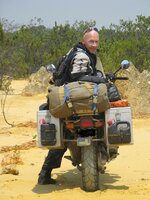
My fully-loaded GS. Note the missing TT oil & fuel bottles. TT has only one outlet Down-under, remarkable for a place which was made for adventure bike riding. I brought my own panniers & frames from the UK as these are both expensive top buy in Oz.

Before the sun gets too hot I 'kill' the 200 kms to Tibooburra, about half-way to Cameron Corner, before taking shelter from the midday heat. Fuel stops are notably few and far between in this part of the world and every drop of fuel is precious; this is also reflected in the price. In a typical urban area it's $A1.50 per ltr (£1/ltr), but out here its over $A2/ltr.
The riding is also hard and takes it's toll at the end of the day. The 200 kms is done 'up on the pegs' and in conditions ranging from gravel (more like ball bearings) to pure sand. Average speed is about 30 KmPH and you're aware that one slip could mean the end of the trip due to handlebar clutch or brake damage. 300 Kgs of bike & luggage is also hard to pick up on your own.

pic3.jpg

Another section of the Silver City Highway near Tibooburra


At 4pm it's back to the road, which from Tibooburra onwards is mostly sand. I slept well that night; I was exhausted.
Next morning, after a few kms of sand riding I reach Cameron Corner, a remote Roadhouse on a piece of land on the boundary of NSW, Queensland and South Australia. I rest for a few hours at the Roadhouse taking in a well deserved cooked-breakfast and chatting to the owners.
The GS never faultered in its first test of hard dirt riding and the oil level is as it was when I left Sydney.

pic4.jpg

Boundary demarcation plate at Cameron corner

From Cameron Corner the road west is closed, so it's back to Broken Hill on the 400 kms of dirt. 50 Kms out of Cameron Corner my attention is drawn to a roadside memorial to Bradley Holmes. A GS rider who died here a few years back in a freak accident when he thrown from his bike and it landed on top of him. Rest in peace Bradley.
Later in the day, still up on the pegs my concentration lapses for a few seconds and I'm on the deck, but the only damage is a broken indicator; I'm lucky. Two days later I'm back on the tarmac (and civilisation) at Broken Hill and well and truely done in. On the 5 February I celebrate my 49th year on the planet and splash out on a bottle of red wine.

pic5.jpg

A section of wild dog/dingo fence which runs around the state boundary of NSW. It's total length is in excess of 8,000 kms !

Week 3 Broken Hill to Coolgardie
Having recouperated from my Cameron Corner excursion it was a pleasure to be back on the flat black stuff and making progress west. Passing Port Augusta I started what was probably the most boring part of my trip; the Eyre Highway. The highway is the pre-curser of that other Australian feature the Nullabor. If the trip to Cameron Corner had been physically exhausting, then the Nullabor was a mental endurance test. The name is made up of two Latin words, 'Null' meaning nil and 'abor' relating to trees (as in aboratum).
 
Great, another ride report to make me jealous:blast:beerjug:
 
Australia trip report (Part2)

The Nullabor plain starts (for west bound traffic) at the Nullabor Roadhouse.
It's renown for being boringly straight and extends for over 1,000 kms.
The Nullabor was kind to me when I crossed it, the midday temperatures being around 25.c, allowing me to stay in the saddle all day. After 200 kms you reach the Western Australia border where, as with most state crossings, to try and eradicate disease in fruit through fruit flies, you have to declare and dispose of any fruit and veg you may have.
The three main dangers which affect the motorcyclist crossing the Nullabor are collisions with wildlife, road trains and the effects of fatigue; all of which I encountered at some point.

pic6.jpg

Australian warning signs on the Nullabor.

With plenty of time for the mind to wonder it's surprising how fast you can re-focus when an stray emu crosses your path when you're standing on 120 Kph.
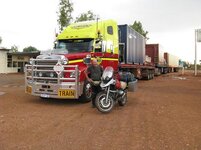
The giant 72-wheeled road trains weigh-in at over 90 tons and although they seem easy to pass, when you reach the front of the truck the combination of the pressure wave eminating from the bonnet and a strong gusty side wind are enough to throw your bike at a 45 degree angle on a collision course with the opposite verge.

pic7.jpg

The start of the Nullabor. Note the height of the salt bush scrub. Nowhere to hide here from the fierce heat.

Both fuel and water are expensive commodities along the route. Petrol was over $A2/lt (£1.30/lt.) Tap water at Roadhouses was usually bore water and while it would keep you alive it tasted vile. Even so it was protocol to ask before filling up a water bottle and not to be regarded as free.
The straightest section of road (146 kms) lies between Caiguna and Balladonia .

pic8.jpg

Testament to the straightness of the roads

pic9.jpg

Self at the Madura plateau. Half way across the Nullabor.

pic10.jpg

Imagine a road this straight for over 1,000 kms.

The town of Norseman brings a smile to west bound travellers as it marks the end of the monotony of the Eyre Highway; it took me three days to cross. The town is named after a horse who one day in the late 1890s managed to get a nugget of gold stuck in his hoof, making his owner a rich man and starting a gold rush in the area. Gold is still mined here.
200 kms further up the road are the gold field towns of Coolgardie and Kalgoorlie. The wide streets and grand buildings of the former give clues to its wealthy past, while Kalgoorlie still prospers. Its 32,000 souls kept alive by a giant, 600 km long water pipe from Perth. For the more adventurous off-roader (and if the route is passable) the Holland Track runs 500 kms from Coolgardie to Albany on the coast. The track was initially used by early gold prospectors as a direct route to the gold fields. Most hauled their tools and possessions by wheel-barrow the whole distance; an incredible feat.
Heading for Perth my route took me west to Southern Cross. My memory of this day are of finding myself in the centre of a pack of Harley-riding 'angels' and of spending the afternoon in an open-air swimming pool sheltering from the searing 40.C heat. By evening it had cooled slightly and I started out on a 150 kms gravel road trek which would eventually take me to Hyden, home of the spectaculer Wave Rock.
The following day I reached Perth, a landmark on my trip. 8,000 kms from Sydney in 23 days, time for a rest at a distant aunt's house and an oil change for the GS; which still hadn't used a drop of oil since Sydney.
I stayed at my aunt's for three days taking in all the luxuries of a fixed abode; a bed, proper cooking facilities and a shower.
(to be continued..........)
 
Last edited by a moderator:
Australia trip report (Part 3)

Week 4. Perth to Nanutarra

Before leaving Perth I visited Rottnest Island to see the curious Quokkas (looks something like a cross between a rat and a kangeroo). I circumnavigated the island for three hours on a pedal-bike before I even saw one. Then as luck would have it there were more than you could throw the proverbial stick at; not that you'd want to do that to these fearless marsupials.
pic11.jpg

A quokka. It stands about 2 feet high.

Yearning for the road again I said my goodbyes and by midday was scrambling between the Pinnacles, a photogenic arrangement of rocks just off the main highway. Anyone who has seen Billy Connolly's world tour of Australia will remember him dancing naked among these rocks. They are a bit touristy, but none the less an impressive sight. The coast is not far away and an empty Cervantes beach is an ideal place to cool off in the heat. Not sure about the shark situation so I don't linger in the sea for long. A white sea eagle soars above me, it's a peaceful place after the bustle of Perth.

pic12.jpg

Self, well covered from the sun. Cervantes beach.

I stop at Port Dennison for my usual evening meal: chicken,potatoes and asparagas if I'm near habitation, or Stagg chili and rice when out 'bush'; all cooked on my trusty Coleman multi-fuel stove. I camp at Seven Mile beach with a cooling breeze off the sea.
By-passing Geraldton because of its shear size, I call in at the Billabong Roadhouse to shelter from the sun and refuel. Here I had my first encounter with Western Australia flies. For reasons unknown they seemed to be in plague proportion. My plan B for eating my food in peace was to mount up and head for a windy spot a few kms up the road where the highway hugged the coast. My plan worked as the strong breeze seemed to do the trick. Flies were to be a menace for the next few hundred kms, and then they vanished ??? It was at Billabong Roadhouse that I met John & Mel, two Canadians on a similar tour, riding Harleys. They'd set off from Brisbane a few days before I left Sydney. I was to met up with them again over the coming weeks at various locations on the 'lap'. What amazed me about John & Mel is that they rode in T shirts, a sure way to get sun burn out here.

pic13.jpg

John & Mel, Coral Bay.

At Carnarvon I could sense the climate becoming more tropical. Maybe it was the sight of bananas growing in the paddocks or the increased humidity. The mile-long jetty, constant strong breeze and getting the GS bogged down to the exhaust box in soft sand just before turning in for the night are my memories here.
Crossing the Tropic of Capricorn I spend some time at Coral Bay a small town on the Ningaloo reef. A snorkel trip and some time on the beach are a good way to cool off, but I leave my guard down and get slightly sun burnt legs. I notice that even the nighttime temperatures are around the upper 20s. Camping in the 'wet' season is becoming uncomfortable.

pic15.jpg

Coral Bay.


I make the mistake of leaving Coral Bay in the heat of the midday sun; my reasoning was either 'cook' on the beach, or 'cook' on the road. I'm 100 kms out of Coral Bay when I feel the heat rising off the tarmac and hitting my face. Even with a closed visor I smell the heat vapourising the moisture from my buff - (without being sexist)a smell similar to when your misses is doing the ironing. It's to late to turn back and with nowhere to shelter I press on. Later I learn that it's been 42.C. With all that heat and moisture there is lightning ahead and within a few minutes of pulling over at the Nanutarra Roadhouse a storm unleashes itself. The first rain I've seen since Sydney. It's severe, with strong gust fronts and heavy downpours. I watch it from the dry porch of the roadhouse. John and Mel are also there also in awe of the force of the storm. The temperature has dropped to a pleasant 25.C, but the storm is not over. John & Mel head off on the road to find accommodation at the next roadhouse (200 kms away) while I cook up a meal and ponder on my options. A few Kms up the road is a junction which I turn off at to seek a quiet spot to bed down. As I turn I'm greeted with a red dust storm heading my way; to me it looked as if the devil himself was in that dust cloud. A very eerie feeling of impending danger came over me. Amongst the bush I felt safe and decided to climb half-way up a nearby hill to view the storm. From an elevation of a few hundred feet I could see a vast area of flat bush land in front of me with lightning strikes igniting small fires as it hit the ground. I watched for what seemed ages at this unique show of nature, before heading back to the GS. Then the storm came directly over head and scared the living daylights out of me. With deafening thunder claps which lit up the ground around me I crouched with fear every time one broke. Making my way back to my swag, I realised that I hadn't set it up and now had to do so in the middle of a deluge.
It took seconds to get soaked to the sink and the night ended with me striping off, throwing my clothes over a bush and diving into the swag. Even inside the swag the thunder was intimidating. Eventually the storm subsided and I fell asleep.
The next morning the sun shone and all was quiet, bar for a loud buzzing sound; the W.A. flies were back in force. Knowing that within seconds of stepping outside I would be covered in them, I planned my escape. First I had to dress in my sodden clothes strewn over the nearby bushes, then break camp and away. In a record 10 minutes I was on the road and heading north. An 1150 GS is no match for WA flies.

pic16.jpg

The storm at Nanutarra. Probably the most frightening experience of the trip.

(to be continued....)
 
Last edited by a moderator:
no pics showing :nenau

Same here. Even tried opening in another window but got the message "invalid attachment".
:nenau

Oh feck! They were all there this morning but referred to a UKGSer URL which, I guess, the system has since cleared down.

BHT has a bigger hammer than me. I've asked him to repair the thread.

:hammer

Greg
 
Australia trip report (Part 4)

Week 5 Nanutarra to Katherine

In my haste to get away from the WA flies I miss breakfast and plan to buy milk at the Fortescue Roadhouse 200 kms up the road. With my clothes drying-off nicely in the warm morning air (already 28.C at 9am !) I spot a warning sign mentioning that the roadhouse is shut for refurbishment. No milk, but worse still, no fuel. The next fuel is at Karratha, further north; just outside the fuel range of the GS's 22 lt. tank. I ease off the throttle. It works and I limp into Karratha with the fuel light glowing for the last 20 kms. I'm lucky, but it's a sobering reminder that a closed roadhouse can ruin your day.
Karratha is only a few kms from Dampier, a small town famous for its iron ore sea terminal and the home of Red Dog; a wandering dog who stole the hearts of the locals in the 1970s. The film, based on a true story, is now available on DVD in the UK. I watched it on the flight over and must admit shed a tear. A great movie, but don't dwell too much on the scene where the motorcyclist gets killed by a stray 'roo. Most of the film was shot on location around Dampier and Port Headland. A statue of the dog stands at the entrance to the town. The whole area for miles around is dominated by iron ore mining. It's exported all over the world, even to my home town of Port Talbot in Wales.
I spend the rest of the day hiding in the shade of a beach shelter at Hearson's Cove, taking short dips into the sea to try and cool off; only problem is as I head further north the sea is also getting warmer.
I have the beach to myself and, because of its isolated location, camp the night here.
Fully rested, the next day I pass Port Headland and it's endless traffic of giant ore carrying road trains (some of these weigh in excess of 150 tons when loaded up) and clock up just under 1,000 kms to get to Broome. A long day travelling on the empty Great Northern Highway with the Sandy Desert on my right. North Western WA is devoid of tourists at this time of year purely because of the unbearable high humidity. Though the 'wet' season may take some getting used to, I liked the idea of less people around me, that's one of the reasons I came here.

attachment.php

John 'squire' Skrivener, Broome. 'scrambler' the dog is riding pillion

A fine example of this phenomenon can be found in Broome. During the 'dry' season the town's population of 10,000 increases five fold.
Arriving in the town after a hard day's riding I talked myself into the treat of an air-conditioned room. At the 'Last Resort' backpackers I had a dorm room to myself for $20 (£12), the place was deserted, but was assured that in a few month's time it would be packed to the gunnels.
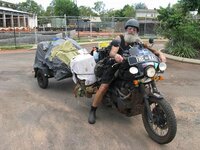
Broome once had a thriving pearl industry employing mainly Japanese divers. In a twist of fate at the start of the Second World War, most returned home to Japan, and in 1942 bombed the hell out of the place. Only to return in the 1950s looking for work again. Today harvesting pearls by diving has all but died out and cultivated pearl farming now flourishes. I stayed in Broome for an extra day as it has a certain charm. While looking around I met another m/c traveller, John 'Squire' Skinner and his dog 'scrambler', also doing the 'lap'. John seemed better prepared than I for his trip as he was towing a trailer behind his Triumph trail bike, with what looked like, everything including the kitchen sink aboard. An amazing character.
Later in the day I spotted Mel on his Harley. His partner, John, having left for Darwin earlier. I enjoyed Broome and was glad that I had sampled it during its quieter time.

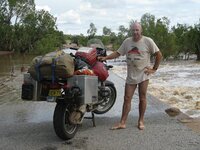
attachment.php

Checking the water depth before 'fording' a flooded crossing, NT.

With my sights now set on Darwin I only had one viable option; to continue on the main highway. Due to the 'wet' most sections of the Gibb River Road were closed. This 400 kms short-cut across the Kimberley plateau usually opens in April after it has been 'graded', but as the 'dry' season progresses it gradually gets more rutted with use. A good excuse to return in the future perhaps.
The next two days are hard, with 1,000 kms to kill and miles and miles of nothing; oh, and 35.C temperatures. Fuel stops are again few and far between, but my TT 3L can gives me a little peace of mind.
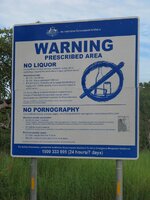
Aboriginal settlements are more common up here in the north and for the first time I don't feel intimidated by them; most that I'd encountered so far on my trip were high on drink or drugs. A common road sign you see near these settlements are notices banning 'drink and ....... pornography'.
At other towns your advised to lock-up any spare fuel as some locals have a habit of sniffing the stuff.
A good way of cooling off up here are the gorges, though check for the possibility of crocs. I swam in a gorge inhabited by the 'freshies' (Johnson's crocodiles), but beware of the 'salties'. The former are relatively timid and are poor at grasping large prey, something to do with their weak jaws. The later are killers. They're very aggressive and during my time up here heard of at least 3 people being taken by them.

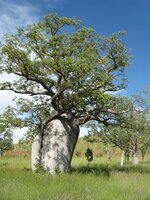
attachment.php

A Boab tree.

At the end of the week I'm at Kununarra and spend my last night in a swag, it's just too hot and humid up here. Sleeping under the lean-to shelter of the local boating club on the edge of Lake Kununarra to stay dry in the downpours, I woke up to see my first croc floating on the surface of the lake. It looked like a piece of timber, but seems to be motoring along. I assume it's a 'freshie' as the lake is at a high altitude, but shocked when I see that when I pitched camp in the dark I didn't see the boat ramp that could have brought the croc to my doorstep.

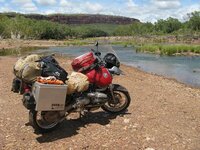
attachment.php

Victoria River, NT.

East of Kununarra I pass into the Northern Territory and the highway follows the course of the Victoria River. The grass is now a deep shade of green (due to the rain) and the scenery is breathe-taking. With such pretty views riding is pleasurable once again. At the end of the day I roll into Katherine, a crossroads between the road south and the road to Darwin.
With a few hours before nightfall I head up to the famous gorge and cool off at the Southern Rock pool. I have the place to myself. I dread to think how crowded this tranquil spot would be in the tourist season, but for now I'm at peace with myself and the world.
Riding back into Katherine before it gets dark I find Mel's Harley parked outside the Palm Court backpackers on the edge of town. We share a spacious dorm to ourselves and then head for the pub to exchange stories. Here we experience the ozzy tradition of jelly-wrestling, but avoid getting into the slippery tub where all the action is taking place. Some people pay good money to see this type of action in strip clubs, lol. Apologies for not taking my camera along.

attachment.php

Would you live in this town ?

(to be continued....)
 

Attachments

  • 226.JPG
    226.JPG
    98.6 KB · Views: 1,094
  • 252.JPG
    252.JPG
    91.9 KB · Views: 868
  • 257.JPG
    257.JPG
    112.4 KB · Views: 794
  • 264.JPG
    264.JPG
    104.8 KB · Views: 866
  • 280.JPG
    280.JPG
    102 KB · Views: 607
Last edited by a moderator:
Australia trip report (Part 5)

Week 6 Darwin and the road south

Mel and I decide to ride together up to Darwin. The road-sides up here are peppered with personal roadside shrines to the victims of road traffic collisions. Alcohol, stray wildlife and fatigue seem to be the main causes. On this last few kms up to the 'top end' we bump into Ben & Di South, a British couple heading for Japan, two-up, on their XT. Ben has a GS back home, but decided on shipping the XT to Austaralia. Making a detour to Litchfield National Park we enjoy a cool dip at Florence Falls rock pool. Croc-free, but it's a Sunday afternoon and with easy access every man and his dog are here, a far cry from my earlier dip at Katherine.

attachment.php

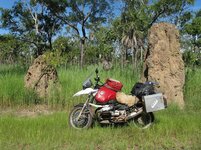
Typical NT scenery. Termite mounds and tall green grass

We reach Darwin in the late afternoon and a sense of euphoria comes over us; we've reached the 'top end'. Darwin city centre is a bustling place and seems to be an anomaly to the usual tourist influx during the 'wet', perhaps it's the International Airport that makes it an easy place to access. Young backpackers are everywhere and the dorms are overflowing. There is noise all night from youngsters who never seem to sleep and a noisy air-con unit makes for hardly any sleep. For me this made Darwin a place I didn't want to hang around in. I change the GS's engine and driveshaft oils, and am horrified when I drop the gear oil; it's black and over the last few kms have noticed the smell of hypoid oil dripping onto the exhaust. I can't help but think there is trouble ahead. Feeling tired due to not having much sleep, plus the exceptionally high humidity makes for a lousy day.
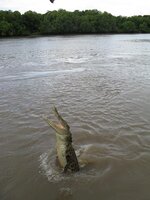
Adding to this we spend another night at the Chili backpackers and head off early for Kakado National Park the following day. I'm well and truely done in, but the thought of a croc watching tour gets the adrenaline pumping. The croc boat tour on the Adelaide River does not disappoint. Salties are everywhere and come to within inches of the boat, one monster, Hannibal, measures six metres, is estimated to be over 100 yrs old and, as his name suggests, eats other crocs !

attachment.php

Saltie or freshie ? The wave-like jaw line gives it away as a saltie.

Later Mel and I part company to cross this flooded wilderness. At the end of the day I'm back in Katherine and while getting supplies for the desolate ride south, I feel unwell due to the fatigue. I must rest for a few days to recover. I spend the time in Katherine learning more about the local aboriginals, their customs and traits. At Katherine they out number the white population by about 5 to 1. Without being derogatory they are very loud and smell to holy high, but there are reasons for this.
Apparently the shouting comes from having to communicating with each other from big distances and the idea of not washing is due to the possibility of leaving their sent at water holes, thus the possibility of frightening away the animals they hunted. They never look you in the eye when talking, it's a mark of respect.

attachment.php

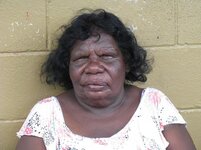
Local aboriginal woman, Jose.

attachment.php

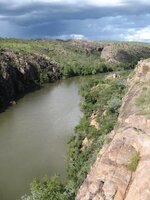
Katherine gorge, NT.

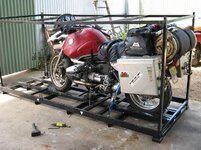
A few days in Katherine and I'm fit again. Loaded up with supplies I leave Katherine at dawn as the swarms of giant fruit bats come back to roost in the town, there are thousands of them. 300 kms down the road the GS's gearbox wedges in 5th gear. I stop at a roadhouse to see the gearbox oil leak is getting worse. Pondering on my options I decide to back-track to civilisation at Katherine. 3 hrs later I just about scrape into town with a slipping clutch. The local motorbike shop sells me a crate and I make plans to ship the GS back to Graham-the-BM-wizard in Sydney by road.

After 16,000 kms (10,000 miles) my Austaralian adventure is over :(

Strangely, I'm not too disappointed, and assume that there is some prophetic reason for the break-down - maybe there was a big 'roo waiting to jump out in front of me further down the road.
The bike is crated-up for a road truck journey south, while I make my way to Darwin and fly to Sydney.

attachment.php

Game over :( The GS crated up.

(to be continued......)
 

Attachments

  • 291.JPG
    291.JPG
    163.6 KB · Views: 785
  • 300.JPG
    300.JPG
    98.7 KB · Views: 800
  • 327.JPG
    327.JPG
    79.2 KB · Views: 846
  • 269.JPG
    269.JPG
    119.8 KB · Views: 823
  • 325.JPG
    325.JPG
    107.9 KB · Views: 877
Australia trip report (Part 6)

Week 7 Sydney

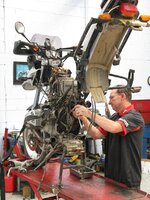
In the week that it took for my GS to arrive by truck from the 'Top End', I gave Graham-the-BM-wizard a hand with another GS that was having its clutch replaced. In this case it was another 02 model with only 50,000 Kms (30,000 miles) on the clock. Its owner had, like myself, set out from Sydney, but his luck had run out just down the road at Melbourne. By co-incidence the driveshaft was also showing signs of slipping.
Anticipating that Graham would have my bike 'sorted' shortly after it arrived, I decided to advertise it on the BMW Touring Club of NSW web site, where I'd first seen it. Within a few days I had a buyer.
It later transpired that my GS had suffered a clutch input-shaft bearing failure. The disintegrated bearing fragments wedging in the selectors and jamming the gearbox in 5th :(

attachment.php

Graham Ferguson of Clubman Motorcycles, Sydney.
An absolute 'wizard' on GS problems

The logistics:
I decided on the 'buy-it-out-there' (BIOT) option re the GS. Motorbikes are expensive in Australia, even Japanese models. My Australian 02 plate 1150GS cost me $A8,500 <£5,000> with 87,000 kms <50,000 mls> on the clock. I have a similar bike back home, with similar mileage, which is valued at
<£3,000>.
Basic person liability insurance comes when you buy the bike (included in the rego - a combined mot/road tax document); but be aware that there is a 3% surcharge on 2nd-hand vehicles, payable by the purchaser.
Any other insurance requirements you might think you need are extra.

Why the BIOT option ?
Air/Sea freight seemed expensive and full of red tape.
Renting. There is usually a clause in the small print that prohibits gravel road riding.
I'd researched all three options, but didn't plan on bad luck coming my way, either at the start or at the end. I'd planned to hit the ground running when I arrived in Sydney, but that was not to be. My friends John & Mel bought their Harleys for $A25,000 a piece and had problems selling their bikes after their trip. I sold mine within days.

Best tip: Don't ride before dawn and after dusk. If you do the chances are you'll eventually hit one of Australia's big motorbike killers; kangeroo, wombat, buffalo, emu, camel or even domestic livestock.

attachment.php

Road trains - don't pick fights with these monsters of the highway.

attachment.php

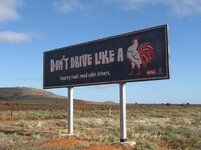
An amusing road sign in South Australia.

attachment.php

Yours truly. The Pinnacles, Western Australia

attachment.php

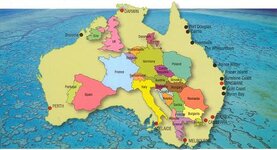
It's a big country

I write this article after returning home to Wales, leaving my guard down and ploughing into a herd of welsh black cattle on a lonely, unlit stretch of common land, on a dark night only a few miles from my home. Because the beasts were facing away from me there were no iris reflections from their eyes, only the last-minute glimpse of their white hooves at 50 mph. I consider myself lucky as I didn't break any bones and was able to walk away from the incident; though my left collar bone is now an inch closer to the one on my right.

Take care out there.
 

Attachments

  • 330.JPG
    330.JPG
    112.3 KB · Views: 124
  • 204.JPG
    204.JPG
    93.4 KB · Views: 117
  • 085.JPG
    085.JPG
    80.1 KB · Views: 126
  • Australia, size of.jpg
    Australia, size of.jpg
    31.7 KB · Views: 125
  • 167.JPG
    167.JPG
    110.9 KB · Views: 121


Back
Top Bottom