best paint for fork legs?

I had major hassle with Smoothrite chipping off. It was fine for a few weeks but brittle when aged. However I used it over Hammerite primer so maybe it's best used direct to metal.
A thin etch primer coat could be handy.
More than handy, a necessity for alloy I’d say - certainly so when I’ve used sheet aluminium on other jobs. I’ve also had Hammer/Smoothrite work on plastic, but with a suitable primer coat(s) on first.

R
 
I used Hammerite smooth to do my rocker covers and engine front cover and other bits and pieces as per post 14 on this thread. I just cleaned the metal, feathered the edges of any sound existing coating and abraded the whole lot with a scotchbrite pad - no primer. About six thin coats gently dried with a hot air gun between coats. Absolutely no problems with chipping in five years of use. It still looked good when I part exed the bike before Christmas.

I also used Hammerite black satin to do various other bits (bars etc). Again, zero problems (same application method as above - no primer)
 
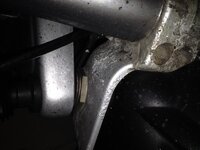
I think I'll tackle mine soon. Here's the fork bridge...what a mess!

I'm curious if the methods mentioned already are suitable for the lower fork legs. Like the other bmr's i've had, they are a bit pitted and have light and dark spots. I assume the dark bits are oil deposits etc from the road. No matter how much I scrub they do not come up clean. Will the scotch brite etc clean them sufficiently:nenau
 

Attachments

  • IMG_2593.jpg
    IMG_2593.jpg
    47.6 KB · Views: 1,938
I think I'll tackle mine soon. Here's the fork bridge...what a mess!

I'm curious if the methods mentioned already are suitable for the lower fork legs. Like the other bmr's i've had, they are a bit pitted and have light and dark spots. I assume the dark bits are oil deposits etc from the road. No matter how much I scrub they do not come up clean. Will the scotch brite etc clean them sufficiently:nenau

Get some panel wipe from an automotive paint supplier and go over it with a scotchbrite soaked in it.
 
Years ago I had a friend whose father worked high up in the company that brings us Hammerite - I'm not sure it was owned by ICI then. We used to get it quite cheap (mate was a real tightarse so would charge us for what his father gave to him to give to us!) and were among the first to use Smoothrite.
He did explain that it has an initial hardening period of a few hours, but then tends to soften. It then slowly hardens again over 30-45 days. This allows items to be assembled soon after painting, but which will likely not be used for while.
Most of us suffer from wanting to get things back together once they look clean and shiney, and then back on the road. If the paint has no fully hardened gets damaged in the first weeks.

I remember painting a frame with a light blue Smoothrite, which was disappointingly delicate for those few weeks, but then hardened to a durable finish. Fortunately I was so slow at the engine and gearbox build that it was over a year before I put anything into the frame.
 
Be careful with hammerite smooth. The formulation has changed it is now a very thin paint that is difficult to apply and recoat, unlike the thick coat you used to be able to put on without it running. Not sure when it changed. I just ran out of some old stuff and purchased a new tin. Smells different too so the solvent has probably changed. Useless.


Back
Top Bottom