
BMW charger question.

Akulaking

Well-known member
UKGSer Subscriber
Joined
Feb 8, 2016
Messages
754
Reaction score
383
Location
Leicestershire
Simple question. Can I charge my 1250 with this charger, via the socket on the left side of the bike?
I’ve tried, the power light comes on, it gets warm. No other lights come on. I’ve switched the ignition on and off, the red zero light comes on, but never progress's to light the 1/3, 2,3 3/3 lights. From what I can glean the power socket is switched off by the canbus system after a few mins, does that mean it won’t take power in as well as output it? image.jpg
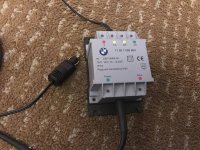
 
Simple question. Can I charge my 1250 with this charger, via the socket on the left side of the bike?
I’ve tried, the power light comes on, it gets warm. No other lights come on. I’ve switched the ignition on and off, the red zero light comes on, but never progress's to light the 1/3, 2,3 3/3 lights. From what I can glean the power socket is switched off by the canbus system after a few mins, does that mean it won’t take power in as well as output it? View attachment 327941
That’s the correct one to do the job and open the socket up to accept a charge. The red light means it’s charging at the max rate. After a few hours the other lights should come into play as the charge level increases in the battery.
 
Ok thanks for that. Do I have to switch the ignition on after plugging it in? That seems to bring the red zero light on.
 
The way to do it ....

1. Switch the ignition on.

2. Plug the charger into the socket.

3. Switch on the power to the charger and the lights should show power is on to the charger and it is charging with the red light on.

4. Switch the ignition off and leave things like that.

The charger should then charge at full power for a while (red) then reduce to standby (green) as time goes on.

Give it a go. (y)
 
Mine also cycles between charge levels, when it gets to green it goes back through the cycle, I assume there's there's a reason for this though I don't know what the reason is.
 
The way to do it ....

1. Switch the ignition on.

2. Plug the charger into the socket.

3. Switch on the power to the charger and the lights should show power is on to the charger and it is charging with the red light on.

4. Switch the ignition off and leave things like that.

The charger should then charge at full power for a while (red) then reduce to standby (green) as time goes on.

Give it a go. (y)
I’ll give that a try. Thanks.
 
The way to do it ....

1. Switch the ignition on.

2. Plug the charger into the socket.

3. Switch on the power to the charger and the lights should show power is on to the charger and it is charging with the red light on.

4. Switch the ignition off and leave things like that.

The charger should then charge at full power for a while (red) then reduce to standby (green) as time goes on.

Give it a go. (y)
Sorry to butt in; would that be the same for the old 1100 Wilb ?
 
Sorry to butt in; would that be the same for the old 1100 Wilb ?
With non CAN Bus bikes you should just need to plug it in and switch it on Snelly👌. That’s how I use it with my R100 and it works fine.
 
Mine also cycles between charge levels, when it gets to green it goes back through the cycle, I assume there's there's a reason for this though I don't know what the reason is.

This charger is a good one - had mine twenty years, (y)

It will trickle charge the battery.

This means that it will drop back down to charge (red) when the voltage of the battery falls over time - keeps it fully charged.
 
As per post #4, this is from the manual. Took me ages to find instructions for that charger, I use it on a 2008 GS.


ATTENTION!!!! You must first turn the key on to the bike, then you plug the charger into the accessory socket, then you plug the charger into the wall for power, then you turn the key off.


Failure to do it this way will result in the charger not charging the battery and overheating.
 
I have one of these in use on my F750GS works well without turning the ignition on and off.

From memory on my old R1200R the start procedure was

Connect the charger via the socket with the power turned off
Turn the ignition on let it go through the power up cycle
Turn the ignition off
Turn the power on to the charger within 15 second of turning the ignition off.
 
The way to do it ....

1. Switch the ignition on.

2. Plug the charger into the socket.

3. Switch on the power to the charger and the lights should show power is on to the charger and it is charging with the red light on.

4. Switch the ignition off and leave things like that.

The charger should then charge at full power for a while (red) then reduce to standby (green) as time goes on.

Give it a go. (y)
Bang on, worked a treat. Thanks for the info 👍🏻
 
As per post #4, this is from the manual. Took me ages to find instructions for that charger, I use it on a 2008 GS.


ATTENTION!!!! You must first turn the key on to the bike, then you plug the charger into the accessory socket, then you plug the charger into the wall for power, then you turn the key off.


Failure to do it this way will result in the charger not charging the battery and overheating.
I couldn’t find this in the book, but yes, I tried several ways with no joy, but as wilbjr21 said above it’s all about doing it in the correct order. Seems a bit odd but I imagine it’s so the canbus knows what’s happening and doesn’t shut the socket off.
 
I have one of these in use on my F750GS works well without turning the ignition on and off.

From memory on my old R1200R the start procedure was

Connect the charger via the socket with the power turned off
Turn the ignition on let it go through the power up cycle
Turn the ignition off
Turn the power on to the charger within 15 second of turning the ignition off.

That should work just fine.

The Idea is to get the charger recognised by the the onboard ECU.
Bang on, worked a treat. Thanks for the info 👍🏻

That's great - thank you. (y)
 
How often have you seen or heard the term “CAN-bus” in the context of a compatible charger for the accessory socket? Way too often and almost always dead wrong.

“CAN-bus” is probably the most misused term in all of BMW-related forum electrical discussions. For an understanding of what the CAN-bus actually is and does I suggest reading the article on Wikipedia.

The ZFE (Zentrale Fahrzeugelektronik or Central Chassis Electrics) is one of several controllers on modern BMW motorcycles. Its job is to manage chassis electrics. It senses logical inputs from switches and responds by turning things (lights, horns, grip heaters…) on and off. It also monitors current draw. If the current draw exceeds a threshold then the circuit is shut down so the ZFE replaces fuses. If the current draw is below a threshold on a light circuit the ZFE assumes that there is a burned out bulb or a wiring fault and tells the Kombi (the instrument cluster) to display a warning. The ZFE manages the accessory port and shuts it down if too much current is drawn (> 5A). The ZFE also monitors the accessory port for the presence of a compatible charger and connects it to the battery for charging.

Compatible chargers are often referred to as “CAN-bus” chargers or some other term using “CAN-bus”. This is nonsense and has led to a great deal of confusion. This misuse of the term “CAN-bus” probably originates with charger vendors. Early on the vendors would characterize chargers as being suitable for “CAN-bus equipped” motorcycles as a way of saying that the motorcycle had a ZFE. Later the terminology morphed into terms like “CAN-bus compatible”, “CAN-bus charger” and “CAN-bus mode”.

The CAN-bus itself does not play a role in charging via the accessory port. That many say it does is part of the mythology.

The ZFE “listens” for a specific electrical handshake from a charger and if the handshake is present the ZFE connects the charger through to the battery. No CAN-bus messaging is required to accomplish this.

A ZFE compatible charger sends and repeats a pulse train to the accessory port. The pulse train starts with the charger presenting 12V to the port for 1 second. Then it waits for 150 milliseconds. Next it sends a series of ten 12V pulses each having a duration of 10 microseconds and spaced 100 milliseconds apart. It repeats this pulse train until it senses that the ZFE has connected it to the battery and then it starts its charging procedure.

Of course you can always attach a charger directly to the battery but BMW instructs you to not do so while the battery is installed in the bike. Why? The reason is that many modern chargers are “smart” and will try to recondition (desulphate) a battery if it decides that the battery needs reconditioning. The desulphation process involves the application of high voltage pulses to the battery and if the battery is connected in the bike then all the bike’s expensive electronics also get exposed to the high voltage pulses as well. So there is some risk of damage involved. BMW isn’t going to try to explain how to determine whether your particular charger has a desulphation capability or not so it just tells you not to charge the battery directly in the bike to mitigate the risk.

If you have a smart charger and intend to connect direct to the battery while the battery is in the bike you should read the charger’s manual to see if the desulphation mode can be disabled. I use the Optimate 4 charger in its “CAN-bus mode” (sic) direct to the battery because in that mode high voltage desulphation is deactivated. I can’t be bothered with charging via the accessory port.
 
How often have you seen or heard the term “CAN-bus” in the context of a compatible charger for the accessory socket? Way too often and almost always dead wrong.

“CAN-bus” is probably the most misused term in all of BMW-related forum electrical discussions. For an understanding of what the CAN-bus actually is and does I suggest reading the article on Wikipedia.

The ZFE (Zentrale Fahrzeugelektronik or Central Chassis Electrics) is one of several controllers on modern BMW motorcycles. Its job is to manage chassis electrics. It senses logical inputs from switches and responds by turning things (lights, horns, grip heaters…) on and off. It also monitors current draw. If the current draw exceeds a threshold then the circuit is shut down so the ZFE replaces fuses. If the current draw is below a threshold on a light circuit the ZFE assumes that there is a burned out bulb or a wiring fault and tells the Kombi (the instrument cluster) to display a warning. The ZFE manages the accessory port and shuts it down if too much current is drawn (> 5A). The ZFE also monitors the accessory port for the presence of a compatible charger and connects it to the battery for charging.

Compatible chargers are often referred to as “CAN-bus” chargers or some other term using “CAN-bus”. This is nonsense and has led to a great deal of confusion. This misuse of the term “CAN-bus” probably originates with charger vendors. Early on the vendors would characterize chargers as being suitable for “CAN-bus equipped” motorcycles as a way of saying that the motorcycle had a ZFE. Later the terminology morphed into terms like “CAN-bus compatible”, “CAN-bus charger” and “CAN-bus mode”.

The CAN-bus itself does not play a role in charging via the accessory port. That many say it does is part of the mythology.

The ZFE “listens” for a specific electrical handshake from a charger and if the handshake is present the ZFE connects the charger through to the battery. No CAN-bus messaging is required to accomplish this.

A ZFE compatible charger sends and repeats a pulse train to the accessory port. The pulse train starts with the charger presenting 12V to the port for 1 second. Then it waits for 150 milliseconds. Next it sends a series of ten 12V pulses each having a duration of 10 microseconds and spaced 100 milliseconds apart. It repeats this pulse train until it senses that the ZFE has connected it to the battery and then it starts its charging procedure.

Of course you can always attach a charger directly to the battery but BMW instructs you to not do so while the battery is installed in the bike. Why? The reason is that many modern chargers are “smart” and will try to recondition (desulphate) a battery if it decides that the battery needs reconditioning. The desulphation process involves the application of high voltage pulses to the battery and if the battery is connected in the bike then all the bike’s expensive electronics also get exposed to the high voltage pulses as well. So there is some risk of damage involved. BMW isn’t going to try to explain how to determine whether your particular charger has a desulphation capability or not so it just tells you not to charge the battery directly in the bike to mitigate the risk.

If you have a smart charger and intend to connect direct to the battery while the battery is in the bike you should read the charger’s manual to see if the desulphation mode can be disabled. I use the Optimate 4 charger in its “CAN-bus mode” (sic) direct to the battery because in that mode high voltage desulphation is deactivated. I can’t be bothered with charging via the accessory port.

CAN Bus stands for Controller Area Network - it is a pair of wires where various components are connected. The main idea is to save wiring.

It is a common system used in Instrumentation.

I'm not at all sure what your contribution adds to the simple task of charging the battery ?
 
How often have you seen or heard the term “CAN-bus” in the context of a compatible charger for the accessory socket? Way too often and almost always dead wrong.

“CAN-bus” is probably the most misused term in all of BMW-related forum electrical discussions. For an understanding of what the CAN-bus actually is and does I suggest reading the article on Wikipedia.

The ZFE (Zentrale Fahrzeugelektronik or Central Chassis Electrics) is one of several controllers on modern BMW motorcycles. Its job is to manage chassis electrics. It senses logical inputs from switches and responds by turning things (lights, horns, grip heaters…) on and off. It also monitors current draw. If the current draw exceeds a threshold then the circuit is shut down so the ZFE replaces fuses. If the current draw is below a threshold on a light circuit the ZFE assumes that there is a burned out bulb or a wiring fault and tells the Kombi (the instrument cluster) to display a warning. The ZFE manages the accessory port and shuts it down if too much current is drawn (> 5A). The ZFE also monitors the accessory port for the presence of a compatible charger and connects it to the battery for charging.

Compatible chargers are often referred to as “CAN-bus” chargers or some other term using “CAN-bus”. This is nonsense and has led to a great deal of confusion. This misuse of the term “CAN-bus” probably originates with charger vendors. Early on the vendors would characterize chargers as being suitable for “CAN-bus equipped” motorcycles as a way of saying that the motorcycle had a ZFE. Later the terminology morphed into terms like “CAN-bus compatible”, “CAN-bus charger” and “CAN-bus mode”.

The CAN-bus itself does not play a role in charging via the accessory port. That many say it does is part of the mythology.

The ZFE “listens” for a specific electrical handshake from a charger and if the handshake is present the ZFE connects the charger through to the battery. No CAN-bus messaging is required to accomplish this.

A ZFE compatible charger sends and repeats a pulse train to the accessory port. The pulse train starts with the charger presenting 12V to the port for 1 second. Then it waits for 150 milliseconds. Next it sends a series of ten 12V pulses each having a duration of 10 microseconds and spaced 100 milliseconds apart. It repeats this pulse train until it senses that the ZFE has connected it to the battery and then it starts its charging procedure.

Of course you can always attach a charger directly to the battery but BMW instructs you to not do so while the battery is installed in the bike. Why? The reason is that many modern chargers are “smart” and will try to recondition (desulphate) a battery if it decides that the battery needs reconditioning. The desulphation process involves the application of high voltage pulses to the battery and if the battery is connected in the bike then all the bike’s expensive electronics also get exposed to the high voltage pulses as well. So there is some risk of damage involved. BMW isn’t going to try to explain how to determine whether your particular charger has a desulphation capability or not so it just tells you not to charge the battery directly in the bike to mitigate the risk.

If you have a smart charger and intend to connect direct to the battery while the battery is in the bike you should read the charger’s manual to see if the desulphation mode can be disabled. I use the Optimate 4 charger in its “CAN-bus mode” (sic) direct to the battery because in that mode high voltage desulphation is deactivated. I can’t be bothered with charging via the accessory port.
This is really informative, thanks


Back
Top Bottom
