
Calling drill bit specialists!!

Deleted account 250722001

Registered user
Joined
Aug 2, 2019
Messages
1,052
Reaction score
415
Can you please recommend me a quality set of M3 to M10 LEFT hand drill bits and corresponding stud/bolt/bit extractors to
extract rounded/snapped/seized bolts.Something like this but more sizes
Ta much
If on Amazon all the better
 

Attachments
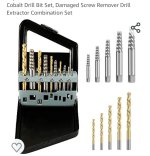
  • Screenshot_20231209_174307_Amazon Shopping.jpg
    Screenshot_20231209_174307_Amazon Shopping.jpg
    111.1 KB · Views: 20
Last edited:
Mine are Sealey.

I wouldn't use a stud extractor unless there was no other way, I hate the bloody things after working for over 30 years as a Marine Engineer.
There are better methods, including making a drill guide from an old bolt if you have access to a lathe to keep the drills central and prevent wandering off into the parent item.

Try YouTube for some excellent tutorials.
 
Tks Adam - alas no lathe, just a cutting wit partner :D so down to a kit like that- I'm fine with it and have used them successfully- needs focus and patience- and a centre point puncher -but I only have a couple of bits and no left hand drills bits so thought about a set like the second pic
 
Always worth having a set in the garage for the odd time you have a snapped bolt. Oddly enough I used my LH drill set yesterday to remove a seized and rounded phillips screw from a breadmaking machine base, it came out like a charm with my battery drill in reverse.
 
aaah bread machines.... tasty kit- the amazon one doesn't have cobalt left hand drill bits
any clues /tips/ I've also seen some LH drill bits with what can only be described as three heads/point at the business end
 
Most fasteners are either made from pretty tough steel or are case hardened so you will need a set capable of dealing with the hardness.

Cobalt steel is just about OK for this if taken slowly and cooled/lubricated during cutting, but carbide tipped drills are best if you can find them or better still solid carbide. Not cheap, but good.
 
I agree re using l/h drills, and often that alone's enough to shift the stuck bolt.

You only have to break one extractor to learn that you've just made a bad situation far worse!
 
There are better methods, including making a drill guide from an old bolt if you have access to a lathe to keep the drills central and prevent wandering off into the parent item.
I wonder whether someone with a lathe could make up sets of these in 3-4 popular thread sizes and sell them here?

Fatastically useful, easy to make on a lathe, almost impossible without.
 
These Amazon ones would do you in the sizes you require, but are conventional RH fluted. They would at least allow you to open out the snapped fastener if its a hardened one but the drill will need to be slow speed and cooled regularly otherwise the cemented carbide tip will overheat and detach from the drill shank.


This guy has some good tips:


As does this guy:

 
You don’t want to be going in with the tapping sized drill and I’d avoid stud extractors like the plague.

Personally I’d use solid carbide drills rather than carbide tipped ones because if they get too hot you’ll melt the braze and leave a nasty little piece of carbide in the hole.

Drill a hole about 4.5mm diameter through the broken stud using a RH drill bit then use a 7.5mm left hand bit (solid carbide again) and hit it hard because what you’re hoping will happen is that the drill will grab the stud and spin it out when that happens.

I’ve done literally dozens of jobs like this and if it doesn’t spin out get yourself an 8mm wide chisel, smack it into what’s left so it’s jammed in there and use a vice grip on the chisel to screw it out :thumb2
 
Hummmm 8mm wide chisel... Stud right by radiator !
Methinks perhaps a more gentle/delicate approach is needed????
But I got him out.
Tks about solid carbide drill bit; now to find a small set of those
 
Hummmm 8mm wide chisel... Stud right by radiator !
Methinks perhaps a more gentle/delicate approach is needed????
But I got him out.
Tks about solid carbide drill bit; now to find a small set of those

I think you misunderstood that part, all you’d be doing is jamming it into the remains of the stud after already drilling a 7.5mm hole through it so you’d barely be touching anything and it’d be doing what a stud extractor does but without any risk of getting it jammed in there.

I’m glad it’s out though :thumb2


Back
Top Bottom
