Can anyone explain how the 1150 starter works

TangibleSolid

Member
UKGSer Subscriber
Joined
Aug 31, 2004
Messages
60
Reaction score
7
Location
Sheffield, England
Hi folks,
This is related to my previous post here http://www.ukgser.com/forums/showthread.php?t=227577

It's still not sorted but i'm confused how the starter knows to ....start

I thought that it got a trigger from the small black wire attached to the solonoid but when I test it I get the following results

Ignition off........zero volts
Ignition on bike NOT running....12 volts
Ignition on bike not running press starter button....12 volts
ignition on bike running....13.8 volts

So is this correct? (it appears to be getting voltage from the load relief relay, according to the wiring diagram) and if it is, how does the starter 'know' to start?
If it isn't right, why doesn't the starter kick in immediately when I turn on the ignition?

After advice, the starter relay has been swopped for a new one and the handlebar switch has been tested as working correctly so i'm satified its not these at fault.

Also what does the load relief relay do exactly??
Any help greatfully received
Cheers
 
You push the starter button after turning on the ignition switch.
 
Ignition off........zero volts
Ignition on bike NOT running....12 volts
Ignition on bike not running press starter button....12 volts
ignition on bike running....13.8 volts

That doesn't sound right to me.. have you rechecked?

Greg
 
The Starter Motor.......

The starter motor is either a permanent-magnet or a series-parallel wound direct current electric motor with a solenoid switch (similar to a relay) mounted on it. When current from the starting battery is applied to the solenoid, it pushes out the drive pinion on the starter driveshaft and meshes the pinion with the ring gear on the flywheel of the engine.

The solenoid also closes high-current contacts for the starter motor, which begins to turn. Once the engine starts, the key-operated switch is opened, a spring in the solenoid assembly pulls the pinion gear away from the ring gear, and the starter motor stops....:blagblah
 
The starter motor is either a permanent-magnet or a series-parallel wound direct current electric motor with a solenoid switch (similar to a relay) mounted on it. When current from the starting battery is applied to the solenoid, it pushes out the drive pinion on the starter driveshaft and meshes the pinion with the ring gear on the flywheel of the engine.

The solenoid also closes high-current contacts for the starter motor, which begins to turn. Once the engine starts, the key-operated switch is opened, a spring in the solenoid assembly pulls the pinion gear away from the ring gear, and the starter motor stops....:blagblah

The contacts for the motor don't close until the pinnion has been engaged with the flywheel as a result of the solenoid movement - hence 'pre-engaged' starter.

Greg
 
basically the path is

press starter button this supply's 12v to starter relay, which energises closing it's contacts which in turn supply 12v to the starter solenoid which energises pushing the starter pinnion in to place and closing the starter motor contacts which are supplied 12v from the battery/alternator, the starter spins up the engine which starts, you let go of the starter button this de-energises the starter relay which opens it's contacts de-energising the starter solenoid, which then using spring power to return the starter pinion to it's resting position which also opens the starter motor contacts, so de-energising the starter motor

if your starter is starting on it's own accord then one of the above steps is failing
 
Thanks for all the replies.
Roddy has very concisely explained what I also thought should happen BUT it doesn't.
If you look at the wiring diagram in the Haynes manual, when you switch on the ignition it energises the load relief relay, which in turn indirectly sends 12v down the black 'trigger' wire to the starter motor. Hence my reading of 12v without pressing the starter. When you press the starter this energises the starter relay which is ALSO connected to the black ‘trigger’ wire (thereby not showing any difference on the meter, 12v either way).
Hence the voltage readings shown above.
I couldn't believe them either which is why I checked them twice and then posted this.
I'm still confused about how the solonoid energises ONLY when the starter button is pressed (except on my bike which is where all this started..... see above:()
:confused: :confused: :confused:
Cheers
 
Last edited:
just had a look see at the Haynes manual (page 8.38) ? it's not the clearest of diagrams

my understanding is the load relief relay (LRR) is powered when the ignition is switched on, so some of the non-essential circuits get powered, this is effectively the switched live.

now when you press the starter button as well as engising the starter circuit it also sends 12v to the other side of the LRR so breaking power to the LRR coil this breaks power to the non-essential circuits so theres reduce loading of the battery during start up, once the engine starts and you release the starter button the LRR re-energises so sending power to the non-essential circuts again.

so 12v goes to one side of the LRR coil and the other side of this coil is sitting at earth via the starter solenoid, but doesn't start it cause there is no potential difference between solenoid coil in and out, now press the starter button and you send 12v to the other side of the LRR coil meaning this coil has no potential difference between it's coil contacts because both of them are at 12v

now the starter solenoid had 12v one side of coil and earth on the other so energises

it's a while since I did this sort of thing so could be talking bollox :)


HTH
 
Last edited:
Thanks for this Roddy,

Its starting to make sense to me and what you're saying is backed up by the fact that if I pull off the black wire on the starter while the bike is running I lose lights, indicators etc. (Because the LLR is not energised by breaking it's earth contact I assume)

I'm coming to the conclusion that the starter solonoid is my problem. I have to say I never encounted a solonoid that was 'too eager'. Only time I had problems before on a vehicle was when the solonoid would NOT engage!

Looks like a new starter motor unit is on the cards :(

Thanks to everyone who offered assistance
 
The small black lead going to the starter solenoid should NOT have any voltage except when you press the starter button.

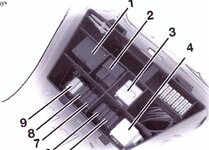
Change relay No 4 - it's probably duff. Was this the one you swapped for a new unit? If it was, I'd start looking carefully at the wiring for physical damage.

Greg
 

Attachments

  • Scan10002.jpg
    Scan10002.jpg
    72.8 KB · Views: 271
It sounds like a duff relay rather than the starer motor/solenoid, as the solenoid will only activate if there is power, when you had the starter out was the solenoid moving freely the throw of the solenoid is about 15mm from memory, if this isn't moving the full distance then maybe this could send power to the starter via the contacts this movement makes ?

The LRR soinds like it's okay since when you take the black wire off you lose lights, so suggests it's working but it does't tell you how reliable it's working

there is a comment in the Haynes manual page 8.22 section 26 regarding the starter relay,
 
I have changed the starter relay for a known good one and it makes no difference.
I have swopped the load relief relay with the horn relay (same part no. stamped on the top, same wiring diagram on the side) still no difference.
I have spent hours (an entire day) closely examining the wiring but I can find no damage.
I have had the RH handlebar switch to bits three times but can find no damage, shorts or sticky switches.
When the bike is running I can hear an occational 'click' from the solonoid, this tends to proceed the starter fully engaging and trying to mesh with the ring gear. Not a pleasent noise when the bike is already running.

There is definately 12v at the black wire when the ignition is switched on (irrespective of pressing the starter button) raising to 13.99v when the bike is running (which based on the wiring diagram and Roddy's previous explanation, makes sense)

I can only think that the solonoid is not working correctly although I confess to still not entirely understanding how it works.

Thanks for your continued help
 
Missed this.

Mate, just PM'ed you again.

I will go and have a look at my bike, if you want me to, but as we previously discussed, all said here confirms the route we were taking regarding what voltages should be present on your starter solenoid and motor assy.

Ah, you're here.

The solenoid could have sticky contacts, making a connection to the trigger terminal and showing the 12v via the motor coils.

I think solenoids may be available but simpler to borrow a complete assy.
 
There is definately 12v at the black wire when the ignition is switched on (irrespective of pressing the starter button) raising to 13.99v when the bike is running (which based on the wiring diagram and Roddy's previous explanation, makes sense)

There should bo NO voltage on this wire - I took the cover off and checked my bike this morning to confirm!!

  • Disconnect the black wire from the starter and then measure the voltage on the wire and separately on the tag on the motor. Both should read 0 volts.
  • If the tag reads anything like 12v, you have a problem with the motor - but as you have swapped that for a known good one, it unlikely to be the problem.
  • If the wire reads 12v, then you need to find out where that voltage is joining that circuit.

Working up the black wire from the starter, it's a 1.5mm wire with one connector en-route to terminal 87 of the starter relay (No 4 in the picture I posted above).

What the relay does is connect terminal 87 to terminal 30 when you press the starter button. The socket that terminal 30 locates should be 12v all of the time (as it's connected to the battery).

The relay is activated by applying 12v to terminal 85. Check the socket that terminal 85 plugs into - there should be 0 volts until you press the starter button with the ignition on - then there should be 12v.

If that is working as it should, swap the relay for another.

If the socket that 85 plugs into has a constant 12v, trace the 0.35mm black/yellow wire back to the starter button. There is a 4-plug connector somewhere in the line - the wire joins at terminal 50A and then to the switch. If it has 12v all the way back to the switch, the switch is faulty.

Hope this helps.

Greg
 
can I make one obversation ? sorry if it's statement of the obvious

where are you measuring between to get 12v at the black wire on the starter, if your measuring between the black wire and the large copper nut thats directly above it you will read 12v, but the 12v is at the copper nut as this is the supply for the starter motor, it's not 12v at the black wire,

to check the black wire, measure between the black wire and the chassis, one of the bolts that holds that starter on should be fine, if your still getting 12v on the black wire, follow Gregs suggestions
 
ok guys,
I have checked yet again and I am getting 12+v between the black wire and the chassis (wire disconnected from the starter motor) when the ignition is on. I don't get any voltage reading between the spade connector on the solonoid and chassis

On the wiring diagram this power is shown as coming from the ignition switch via the load relief relay which is also connected to the (infamous :D) black wire.

Just to be sure, I've got a mate with a 1150 gs (without any starter issues) to check his bike this morning with a meter, and its the same as mine.

If I pull the load relief relay out I don't get any voltage until I press the starter button when I get 12+v between the black wire and the chassis

Roddy has explained this further up the thread and his explanation seems to be in keeping with my results (on my bike with a starter problem, and my mates which is working correctly)

I'm still unsure if it's the solonoid but I don't see what else it could be.

Thanks for staying with me on this


Back
Top Bottom