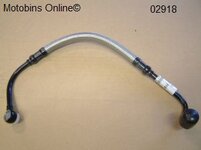
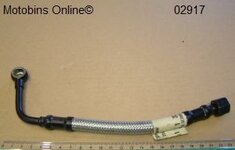
Central Oil Cooler on GS PD

Roger Chatterton

Well-known member
UKGSer Subscriber
Joined
May 26, 2007
Messages
1,665
Reaction score
13
Location
Diss Norfolk UK
Hi All,
to cut a rather oily and messy story short, I am after some info re the Oil Cooler hoses on my 100 GS PD.
The cooler has been moved to the centre of the bike, instead of out on the crash bar - so my question is-
will the standard length hoses ( ie those for the crash bar mounted cooler) be long enough to reach the centrally mounted cooler, or do I need to get the (presumably longer) hoses for the RT ?

I know I can measure etc, but bike had to be RAC'd to my 'bike repair man's garage, and I am off to Moto- Bins to see Beatrice in the morning ! I need bike ready for Thursday for a quick trip to France.Moto-Bins has both types in stock thankfully.
Thanks for your help, and trust me, a split hose can make the 'bike VERY messy very quickly -fortunately happened as I was slowing down for traffic lights - thought the bloody thing had caught fire.:eek:
 
I'm sure you will need the RT/RS ones. There's a lot of non flexible pipework on the standard GS hoses that are specific to the crash bar mounting.
 
How about taking it off altogether Roger ???
 
I have thought about that, and there have benn (Heated !!!) discussions on here about it - all I know is that, in hot weather, going across Europe, and getting held up in slow moving traffic for example, I'd rather have an oil cooler than not, despite chances of hoses splitting ( very unlikely I thought - hmmmm....) .
I have the extended sump, so it might not be a major problem, but I would agree for Winter riding, not necessary then.

Thanks Rob - I have a feeling you're right - my hoses have a straight section of tubing after the banjo bolt on the oil filter, and then rubber hose from there on up to the connecting bit to the filter. Having looked on the Mot-Bins website ( see below) - these hoses for the originally sited cooler don't look as if they'd fit.
I'll probably use the old hoses as a template to get some braided ones made up when I have time. Plus a little "bypass" hose would make sense, so's I could bypass cooler altogether if something similar ever happens again !:augie
 

Attachments

  • thumbnail-1.jpg
    thumbnail-1.jpg
    18.1 KB · Views: 170
  • thumbnail.jpg
    thumbnail.jpg
    18 KB · Views: 177
Interesting that you state you'll keep the oil cooler for slow moving traffic, as it's a passive type cooler, (ie no associated fan), it's at it's most effective when moving fairly quickly.
You'll probably find that the oil temperatures with and without the cooler when stuck in traffic are very similar.
You could test how much difference it makes by using the stick-on temperature sensors, most remain at their highest temperature after they've cooled down.
Test the bike on a congested route with the oil cooler covered up, then repeat the test with it uncovered, it would be interesting to know the results.
 
Interesting that you state you'll keep the oil cooler for slow moving traffic, as it's a passive type cooler, (ie no associated fan), it's at it's most effective when moving fairly quickly.
You'll probably find that the oil temperatures with and without the cooler when stuck in traffic are very similar.
You could test how much difference it makes by using the stick-on temperature sensors, most remain at their highest temperature after they've cooled down.
Test the bike on a congested route with the oil cooler covered up, then repeat the test with it uncovered, it would be interesting to know the results.

Don't be daft.
Admitedly, no moving air assistance but you've got the surface area convection plus the extra oil capacity, of course it helps in jams etc..
 
Maybe got a bit confused there - sorry - I think that what I was meaning is that oil temp does rise when stuck in slow moving traffic, but as soon as you can speed up a bit, maybe filtering, a break in the traffic, or simply got clear of the hold up, then I would have thought that the speed of cooling would be better with the cooler than without it.
And of course, I knew there was no fan on the cooler !!!
Also depends a bit on which oil you use ....but we won't even start on that can of worms.

So, would be interesting for someone to check on temp difference on a route with and without a cooler. My main concern right now though is to just get everything working with the cooler, and to bugger off to France for 4 days - might do some research afterwards, but really see no real reason to remove the cooler- if in doubt , leave it on, would be my maxim.

Put it this way - if I ws looking to buy another PD, if it had had its oil cooler removed, I would be hesitiant to buy it, as you have no idea if it might have suffered at some point, - but hypothetical point really I suppose.
Anyhow, off to walk dog, and give a sigh of relief that the whole oil episode was nothing more serious, and that it didn't happen hammering down a French Peage somewhere !!
Happened at the right time, and in the right place really - there is a God after all ! :)
 
I did some messing about with our Thermal imaging camera. The oil definitely through the cooler when the engine gets hot.

Steady run of around 5 miles at speeds up to 40 MPH

IR_0044.jpg


You can see the oil cooler giving up it's heat once the engine starts to get hot

IR_0065.jpg
 
Don't be daft.
Admitedly, no moving air assistance but you've got the surface area convection plus the extra oil capacity, of course it helps in jams etc..

Not doubting that, but you'd be suprised how little difference the cooler makes. I've carried out the oil temperature reading with and with an oil cooler on three different engine capacities, the information I've given is based on testing.
 
You can see the oil cooler giving up it's heat once the engine starts to get hot

IR_0065.jpg

Interesting... you braked to a halt before taking the TI and the carrier and circumference are warmer than the disc, I suppose the reflective surface of the disc gives off less radiation. Comment a bit off topic, but TIs are always rather 'illuminating'.
 
The heat from the disk surface quickly dissipates into the carrier but does not transfer to the hub as I'd expected. Interesting to watch live and see just how the heat moves around the bike components.

Here's a better one of the disk. It's a cast iron PFM disk, awful thing that warps when it gets hot. You can see the hot spot on the circumference of the disk that caused the juddering. The Stainless disk I replaced it with is a big improvement.

IR_0058.jpg


Here's one with more heat in the disk. The hubs still cool though

IR_0057.jpg
 
The heat from the disk surface quickly dissipates into the carrier but does not transfer to the hub as I'd expected. Interesting to watch live and see just how the heat moves around the bike components.

Here's a better one of the disk. It's a cast iron PFM disk, awful thing that warps when it gets hot. You can see the hot spot on the circumference of the disk that caused the juddering. The Stainless disk I replaced it with is a big improvement.

IR_0058.jpg


Here's one with more heat in the disk. The hubs still cool though

IR_0057.jpg

Yes, the carrier really does sink a lot of heat, more than I would have expected. Also interesting that the exhaust cools quite quickly after stopping (compared to the rocker cover).

Sort of thing to start one welding fins onto this, that and the other component if one was inclined...
 
If you need new oil cooler hoses, the hoses from a R100R/R80R should fit perfectly, as they were originally fitted with a centrally mounted oil cooler.

If your hoses are past it, but the metal parts (banjos and any pre-formed tubing) are solid, take the pipes to someone who makes pipes for hydraulic machinery (there's such workshops all over the place), and they will replace the flexible piping for you, crimping it properly back onto the metal fittings.

If you live in a large town or city, there will be someone who makes pipes for JCBs/diggers.

If you live near a harbour or port of any size there will be someone who makes hoses for hydraulic marine machinery.

If you live in the countryside an agricultural engineer will either have the necessary equipment, or will know someone who does.

I had a hose break last year, bought some braided high pressure pipe of correct diameter, removed split hose, replaced with braided hose, jubilee clipped at each end, and no problems whatsoever since. Total cost of repair less than £10. (I already had the clips)

You should be able to get yourself sorted, one way or the other.
 
That seems to be a fun bit of kit you have there, Mr Farmer. Don't suppose you could bring it to the Wee-Kend for our delectation? :augie
 
Thanks for all the help, and I got hoses for an RS/RT, as they looked exactly right - probably the same as for the 100R as suggested above.
I think braided hoses are an excellent idea, along with a little "bypass cooler" hose too ( in the spares kit) - just in case ! The rate it was spewing out oil was remarkable, and could have ejected most of the engine oil very quickly I think. :pissl
Thermal pics are interesting, but I won't be removing the cooler, even if the difference is marginal - maybe it's just peace of mind, but having ridden across Europe in hot conditions, even peace of mind is a valid reason !!
 
A mate of mine raced in the rally of tunis back in the mid eighties on an airhead without an oil cooler with no trouble at all.

I've thrashed around the south of france and italy on a fully faired R100RS without an oil cooler with no trouble at all.
 
Beware when removing the connections at the oil cooler end, the oil cooler is made of alloy and if corrosion has set in it strips the threads. This happened to me but my local radiator repair shop was able to machine 2 new ends and fit them to the cooler

Regards
Colin
 
That seems to be a fun bit of kit you have there, Mr Farmer. Don't suppose you could bring it to the Wee-Kend for our delectation? :augie

I'm not sure the University would be keen on a load of ham fisted airhead owners mangling it's £3500 Thermal imaging camera :D


Back
Top Bottom