These little glitches (impossible speed readouts) happen when the GPSR just barely picks up enough satellites to plot a location, but the geometry of the satellites it has picked up is poor. Then, if it suddenly picks up several more satellites, and establishes good geometry, it assumes you have moved very quickly, because satellite reception was not "lost" entirely.
Howard's comment about encountering this problem coming out of a tunnel in the Alps is a perfect example. Probably what happened was as follows: The last 300 yards of the tunnel was a snowshed or similar, so the GPSR had 3 satellites - the absolute minimum to establish a 2 dimensional fix - then he rode out of the snowshed, and the GPSR picked up another 5 or 6 satellites all at once, and "corrected' the position of the vehicle.
The software engineers could eliminate this by introducing more stringent requirements for satellite geometry before accepting the information and using it to establish a position, but the drawback of doing this would be that once you lost reception, it would take much longer for the GPSR to be satisfied with the integrity of the (re-acquired) satellite reception. Because the only unwanted side-effect of this rare 'bad geometry' problem is a really high speed for half a second or so, the engineers decided not to trade off speed of re-acquisition (which is needed every time you pass under a tree or in front of a tall building) in favour of higher standards of precision (which would only be needed coming out of snowsheds and tunnels).
It is interesting to note that recently in America - where else but?

- a court tossed out a GPS record as evidence in a criminal case because there was one track record, 2 seconds long, showing an improbable speed. It was not a Garmin GPSR, though.
PanEuropean



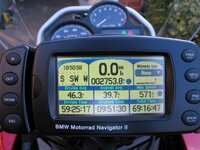





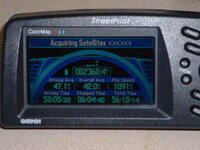


 and it kept thinking I was off route when I wasn't.


