Hi
I just did this on my bike.
The panel has two heavy duty "power input" connections - one for ground, one for 12v. The panel outputs are a strip of ground connectors all connected together and directly to the power input ground, and a strip of separate +12v volts connectors all connected separately through fuses to the power input +12v (as I recall you actually get two connectors per fuse for some of them - i.e. two accesories share a single fuse).
You connect accessories between the power outputs (i.e. one acccessory wire goes to one of the fused +12v power outputs and the other wire to one of the grounds - although in practice you can connect accessory ground wires to a nearby bit of the chassis in most cases so you only need to run the +12v wire back to the fuse panel).
To make it switched, the heavy duty +12v input needs to be switched. The heavy duty ground input can connect directly to the battery negative terminal. However, if you connect the +12v input directly to your battery, there will always be "live" power supplied to your accesories, even when the ignition is off.
So simple to make it switched - you just need to put a switch in the +12v input connection to the battery. When the switch is closed, your accessories get power, when the switch is open, the panel is not connected to the battery and so there is no power available. In principle you could use a normal manual switch to switch the power on and off - in practice no one does this as it's ugly and needs you to remember. Instead people put in a switch which automtically turns itself on and off depending on whether the ignitiion is on. This type of automatic switch is a called a relay. The relay works by opening and closing a switch between a pair of "load" terminals depending on whether 12v is applied between a pair of "sense" terminal.
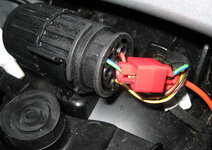
You connect your battery to one "load" terminal of the relay and the fuse panel's +12v inut to the other "load" terminal of the relay. You connnect the relay "sense" terminals to something that is powered only when the ignition is on. A good thing to pick is the back of the cigar-lighter accessory socket under the seat.
When the ignition is on, the cigar-lighter accessory socket is on, and so the relay "sense" terminals receive power and so close the switch between relay "load" terminals. This connects the fuse panel to the battery and your accessories are on. When you turn the ignition off, the cigar-lighter accessory socket loses power (after 30 secs), so the relay "sense" terminals receive no power and so the switch between relay "load" terminals opens. This disconnects the fuse panel to the battery and you accessories are off. Hey presto!
You cannot connect your fuse panel +12v input directly to the cigar-lighter accessory socket (i.e. without using the relay) as you would then only be able to draw the amount of current intended for the cigar-ligher socket for all your accessories (probably about 5 amps I'd guess). The relay should be rated sufficient to handle the total current - e.g. 70 amps.
Important! - Make sure the relay and fuse panel are both as close to the battery as possible (i.e. short wires), or put an inline 70 amp fuse near to the battery terminal for the wire to the relay load terminal. Otherwise you will have a long heavy duty unfused wire connected to your battery just waiting to chafe through, or get pinched by the seat and ready to short out the chassis and set your bike on fire and burn down your garage, your house, and your neighbour's house.
regards
Darren