
Crank shaft rear oil seal failure.

Ian J Hartley

Well-known member
UKGSer Subscriber
Joined
Jun 15, 2003
Messages
5,099
Reaction score
447
Location
Swindon, England
The bike is a February 2012 edition of the 1200GS Adventure twin cam.

In 2018 at 18946 miles I found that my rear crank shaft oil seal needed replacing due to failure.

Now at 24444 miles (18 months later ) I have just replaced the seal again due to failure.

From what I can gather through research, that there is only one manufacturer of these seals as they are an unusual size. JAGO Taiwan are the manufacturer and they are listed as MLK 65 83 8 (I/d 65, O/d 83 and width 8mm). Motorworks supply them at £28 a pop, and presumably BMW sell the identical part under Pt No 11118551418.

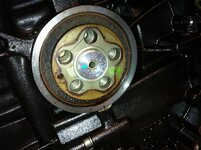
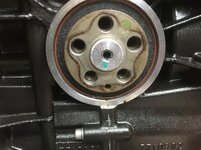
So I have been replacing like for like. Picture 1 shows the original seal fitted at creation and picture 2 is the seal I fitted at 18946 miles, and have just now replaced.

Now I know how to fit a seal, and there is no need for special tools, as it is easy to position the lip of the seal over the crankshaft. As the crankshaft protrudes enough to fit the seal and rotate it to ensure the lip has not rolled over. As to tapping it home, there is no problem with the depth as the casing has a ledge machined into it so the seal sits at the correct depth. An oil filter removal tool is the exact width for tapping the seal home. And yes I lubricated the seal lip with clean engine oil prior to fitting. My observation when tapping the seal home, is that it appeared to be an easy fit. So maybe the tolerances are not as good as they should be for a tight fit.

So long story short. Has anyone else out there had any experience with premature oil seal failures on these machines?.
 

Attachments

  • 0BEC02BB-154F-4A81-997B-C329C5183439.jpg
    0BEC02BB-154F-4A81-997B-C329C5183439.jpg
    250.4 KB · Views: 1,134
  • 3E274112-7C70-4C84-BD32-3FE5D2CDCAE3.jpg
    3E274112-7C70-4C84-BD32-3FE5D2CDCAE3.jpg
    245.1 KB · Views: 1,169
Interesting info

Leaves me with a couple of questions though.

1. Are most oil seals ptfe? - I mean on the bike, I'm sure there's a wild variety of types out there!
2. The info suggests using a lubricant (oil) to fit the seal would mean a fairly immediate failure of the seal. Ian seems to have gotten quite a period of time beyond that?

Saying all that, it was interesting info. Thanks for sharing.

Sent from my SM-G975F using Tapatalk
 
The bike is a February 2012 edition of the 1200GS Adventure twin cam.

In 2018 at 18946 miles I found that my rear crank shaft oil seal needed replacing due to failure.

Now at 24444 miles (18 months later ) I have just replaced the seal again due to failure.

From what I can gather through research, that there is only one manufacturer of these seals as they are an unusual size. JAGO Taiwan are the manufacturer and they are listed as MLK 65 83 8 (I/d 65, O/d 83 and width 8mm). Motorworks supply them at £28 a pop, and presumably BMW sell the identical part under Pt No 11118551418.

So I have been replacing like for like. Picture 1 shows the original seal fitted at creation and picture 2 is the seal I fitted at 18946 miles, and have just now replaced.

Now I know how to fit a seal, and there is no need for special tools, as it is easy to position the lip of the seal over the crankshaft. As the crankshaft protrudes enough to fit the seal and rotate it to ensure the lip has not rolled over. As to tapping it home, there is no problem with the depth as the casing has a ledge machined into it so the seal sits at the correct depth. An oil filter removal tool is the exact width for tapping the seal home. And yes I lubricated the seal lip with clean engine oil prior to fitting. My observation when tapping the seal home, is that it appeared to be an easy fit. So maybe the tolerances are not as good as they should be for a tight fit.

So long story short. Has anyone else out there had any experience with premature oil seal failures on these machines?.
That is a real bummer of a job to do. At least this often!

Thinking on the post above ref. fitting of the seal and then added to your comment about the 18k replacement slipping a tad easier than you'd expect.... I'm wondering if it's the lips of the seal leaking or is it around the seal housing?


Sent from my SM-G975F using Tapatalk
 

Ouch! Looks like I’ll be revisiting this again in a few thousand miles...:D

At least I know how to break the bike apart now.

Still it doesn’t explain why the original seal fitted by BMW at the factory failed so early. There was signs of failure at 16000 miles, though I only changed it at 18946.

Anyway, Thanks for the information, at least if it leaks again I’ll know why.:thumb2
 
That is a real bummer of a job to do. At least this often!

Thinking on the post above ref. fitting of the seal and then added to your comment about the 18k replacement slipping a tad easier than you'd expect.... I'm wondering if it's the lips of the seal leaking or is it around the seal housing?


Sent from my SM-G975F using Tapatalk

It’s not too bad a job. It takes me 2 days to break the bike to access the seal and 2 days to rebuild. And the costs are £28 for the seal and the 5 bolts which hold the clutch ring to the crank shaft as they are stress bolts at £2 each.

I could not see any evidence of wear on the seal lip and now suspect capillary action due to fitting it wet.

If the seal fails again as expected now, then I’m happy to fit the seal next time dry. I was beginning to think that the casing at the seal might be leaking, in which case that would require an engine strip down.

Ian
 
Would you think of fitting an original BMW seal this time, to rule out any possibility of a non-oem issue?

I would consider it. But I would have to look at the seal to confirm that it is different from the seals that I have been supplied by Motorworks, bearing in mind that I spent nearly a whole day searching the web for seals of the exact size required, and could only find one manufacturer who makes them.

The 83mm outside diameter is the clincher. All manufacturers go from 80mm to the next size up is 85mm. They don’t do 83mm, which makes me wonder why BMW chose that diameter, when they could easily have machined the casing out to 85mm.
 
How does an oil seal become damaged from oil? Just asking.
My understanding was that it doesn't get 'damaged'. Instead, by oiling the seal to fit it, you effectively break tbe seal, providing a pathway (all sound the seal) for oil to pass through.

I'm just not entirely clear how Ian could go so long before getting a leak, if that is the cause? But I learned something reading that link. I'd have done the same as I Ian to be honest. So I've noted it!

Sent from my SM-G975F using Tapatalk
 
Whatever the merits of the dry oil seal argument, which is a new one on me, I would be wondering whether there are other issues in play.

Maybe excessive crank end float, crankcase pressure or even the worst view, a failing main bearing. Simple enough to check out the first two.
 
I have just had the seal replaced on my 07 GS and 34k miles, i did not do it i used and independent specialist and they took a day to strip and rebuild but also they did a full service and a couple of other items but cost me just over 4 figures, please it is now done but i put it down to age rather than miles. A huge saving doing it yourself.
 
I changed the balance Shaft seal with one from motorworks and it failed 18 months later. I replaced it with a BMW one and difference in quality was very noticeable. I did the same with the front drive shaft boot. I love the prices of motorworks but not when I am having to replace the parts this often
 
I understand that the PTFE lip on the seal has to settle down for at least four hours around the crankshaft journal after assembly. With sufficient time the sealing lip then shrinks onto the journal and makes a seal. The seal even has to be left in the packaging prior to fitting.

If oil or grease is used the seal shrinks to the size of the journal plus the thickness of lubricant. When the lubricant wears away the there will be a gap between the PTFE seal lip and the journal and oil will leak through this gap. I understand that there is no elasticity in PTFE such as with the older type rubber Weston seals which also had a spring pulling the lip of the seal onto the shaft.
 
engine breather / worn rings is a great shout
end float the seal shouldn't care
up down slop in a main bearing would be an issue
running low on oil might cause it to run dry/hot and fail ?
how old was the replacement seal ? maybe sat on a shelf and designed in aging makes them fail?

when I said my non abused clutch had started to slip at 29k the first thing they said was has the rear main seal gone !!! then said never do a clutch without doing rear main and gearbox input shaft seals

well there you go another manual says must be fitted dry, you learn something everyday. I was unaware of that, nor believed it when reading in that link above

on my bike there's nowhere for leaking oil to go.... how did you spot it, clutch slip?

https://pmmonline.co.uk/technical/how-you-install-ptfe-oil-seals/
 
Had a 2012 R1200GS. Balancer Shaft seal failed at 600 miles and Crank Seal at 18k. Sold the bike so not sure if it failed again.
 
Two people I know have got K1200 LT. both with leaking rear crank seals. not high mileage bikes. I helped one to replace it. what a job that was. removing all the plastic. and wiring. the other guy just left it at the back of his garage and bought a Goldwing.
 
Last edited:


Back
Top Bottom
