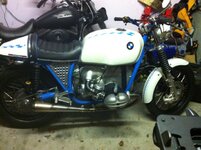
I have recently become the owner of a 1978 R80/7, it been built as a cafe racer and fitted with rear sets, my question to the collective is: should I expect the bike to have brakes?
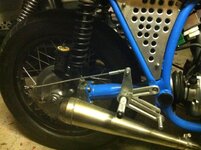
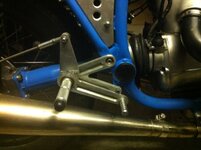
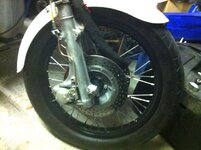
It has twin discs on the front, cable operated to the master cylinder under the tank then braided hose to the calipers, standard setup I think these are just about adequate but by no means good. The rear is my main problem, it has no rear break at all, I thought at first perhaps the pads were knackered or contaminated etc, so pulled the wheel off and they are pretty much as new, not glazed and the hub seems fine too, all the linkages work as they should, basically the whole system works as intended but no matter how hard you push the pedal at best it might slow you down a tiny bit, but it's bearly noticeable in fact it would struggle to hold the weight of the bike and rider on a hill, it cannot stop the bike at any speed. I thought perhaps it may be the rear sets which probably give less leverage ov the standard pedal. Also the actuation arm from the hub is straight up as opposed to straight down, to suit the configuration of the rear sets, in theory I don't see that this would have an adverse effect.
So am I expecting too much from a 36 year old bike, are the brakes naturally crap, is it the rear sets? Any ideas on a potential problem or method of improvement gratefully received. As said before it works as it should but just has no braking power.
It has twin discs on the front, cable operated to the master cylinder under the tank then braided hose to the calipers, standard setup I think
these are just about adequate but by no means good. The rear is my main problem, it has no rear break at all, I thought at first perhaps the pads were knackered or contaminated etc, so pulled the wheel off and they are pretty much as new, not glazed and the hub seems fine too, all the linkages work as they should, basically the whole system works as intended but no matter how hard you push the pedal at best it might slow you down a tiny bit, but it's bearly noticeable in fact it would struggle to hold the weight of the bike and rider on a hill, it cannot stop the bike at any speed. I thought perhaps it may be the rear sets which probably give less leverage ov the standard pedal. Also the actuation arm from the hub is straight up as opposed to straight down, to suit the configuration of the rear sets, in theory I don't see that this would have an adverse effect. So am I expecting too much from a 36 year old bike, are the brakes naturally crap, is it the rear sets? Any ideas on a potential problem or method of improvement gratefully received. As said before it works as it should but just has no braking power.


 #
#