Iberian gold
The Iberian Peninsula has gold exploitation from two geologically different regions. Both are parts of the Variscan belt, a collisional mountain belt that crossed central Europe and, before the opening of the Atlantic Ocean, continued into the Appalachians.
One part of the Variscan belt in the southwest part of Iberia is the Iberian Pyrite Belt, an area where gold and other noble metals come from volcanic massive sulfide (VSM) deposits formed on the ocean floor by hydrothermal vents in what was a volcanically active spreading plate boundary. As discussed above, modern hydrothermal vents are the deep-sea “black smokers,” some of which host abundant life despite the extreme conditions. The deposits in the Iberian Pyrite Belt are found in oceanic volcanic and sedimentary rocks of Devonian to Carboniferous age (ca. 383-323 Ma) (Gibbons and Moreno, 2002, p. 478), a time when the first seed plants, land vertebrates and primitive reptiles appeared in the fossil record.
Pre-Roman metal and gold working has been recognized in southwest Iberia dating back to Chalcolithic and Bronze Age times (O’Brien, 2015; Blanco and Rothemberg, 1981), but it was not until Roman times that substantial mining operations took place. Gold and silver were mined in the region, but they were not as important as other metals, such as copper, tin, iron, lead (O’Brien, 2015), with the addition of sulfur after the development of large open pits in the 20th century (Gibbons and Moreno, 2002).
Northwest Iberia is also part of the Variscan belt. This belt was formed by the continental collision that brought together the northern continental mass (Laurentia) and the southern continental mass (Gondwana), thus assembling the most recent supercontinent, Pangea. The Variscan-Appalachian orogenic belt is geologically much younger (ca. 300 Ma) than West Africa, and most of its features are well explained by plate tectonic processes. These processes and the resulting geology are complicated, however, involving the suturing together of ribbon continents and the twisting of the mountain belt in Iberia into a doubly-curving “orocline,” or bent mountain system (Gutiérrez-Alonso et al., 2004; Johnston et al., 2013). The northwest Iberian gold deposits are of the orogenic gold type reviewed by Goldfarb et al. (2001b).
Some of the earliest known gold artifacts from Spain come from Asturias in the northwest of the Peninsula, dating from the early Chalcolithic (Blas Cortina, 1994), and are currently under study. We also have the Pre-Roman Treasure of Arrabalde, found near the later Roman mining site of Las Médulas (Perea and Rovira, 1995). Pre-Roman gold is also known from the realm of the Phoenicians and the contemporary native Kingdom of Tartessos, in the south of Spain. In Extremadura, in south- central Spain, as the site where at least some of this gold was originally collected is now known, the chemical details of natural nuggets match those of the Tartessian Treasure of Aliseda (García-Guinea et al., 2005).
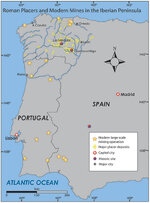
Abundant gold paleoplacers —or ancient alluvial ore deposits— in northwest Iberia were probably exploited by artisanal mining in pre-Roman times. This area subsequently became a major source of gold for the Roman Empire. Las Médulas, where Roman engineers and miners recovered gold from old, consolidated sedimentary deposits, must have been an environmental disaster at the time, but today is a landscape of colorful beauty that has been designated a UNESCO World Heritage Site (Fig. 1). The Roman mining system used at Las Médulas, aptly named Ruina Montium, was described by Pliny the Elder (transl., 1952). A newly discovered site of large-scale Roman extraction of gold from river gravels is in the Valdería, near Castrocontrigo (Justel-Cadierno et al., 2014; Fernández-Lozano et al., 2015). Both of these sites are within 100 km of the city of León, a name deriving not from “lion,” but from “legion,” for this was the headquarters of the Roman legion charged with protecting these critical sources of gold. Production evidently tapered off or ceased after the Roman decline and the Germanic invasions eliminated the technical expertise and infrastructure necessary for intense gold mining. We also briefly consider the gold-bearing region in southwestern Iberia, whose geological origin is quite different from that of northwestern Iberia.








 believe Oxenhope international airfield is pretty small. It certainly was when I attended a plane crash their back in the day.