Ducati 250 Desmo Rebuild

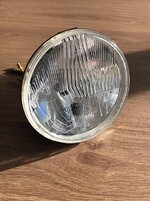
For future reference, the sealed beam headlight for a Lotus Elise is 150mm. It's a concave Cibie and fits in the original shell. Takes an H4 bulb.

Sent from my SM-G925F using Tapatalk
 
For future reference, the sealed beam headlight for a Lotus Elise is 150mm. It's a concave Cibie and fits in the original shell. Takes an H4 bulb.

Sent from my SM-G925F using Tapatalk

It's probably the same as this one then. I got it with the bike, I'm pretty sure the original owner intended fitting it.
 

Attachments

  • Cibie front.jpg
    Cibie front.jpg
    91.7 KB · Views: 386
Just found this thread and spent a pleasant hour or so reading. Lovely job and I appreciate the time & effort you've taken to document the restoration.

I had a Royal Enfield Continental GT which I used to ride to school in the early 70s. My mates had BSA Starfire and Triumph Trophy, so my Enfield (which I had bought in 2 buckets & rebuilt) was the dog's bollocks, until one of the posh kids was bought a Desmo 250 for his birthday. It would leave my Enfield standing, I was well jealous :D
 
Just found this thread and spent a pleasant hour or so reading. Lovely job and I appreciate the time & effort you've taken to document the restoration.

I had a Royal Enfield Continental GT which I used to ride to school in the early 70s. My mates had BSA Starfire and Triumph Trophy, so my Enfield (which I had bought in 2 buckets & rebuilt) was the dog's bollocks, until one of the posh kids was bought a Desmo 250 for his birthday. It would leave my Enfield standing, I was well jealous :D

The guy over the road from me had an RE Continental, he said he could get the engine out and in pieces on his bench in 90 mins lol :D
 
The guy over the road from me had an RE Continental, he said he could get the engine out and in pieces on his bench in 90 mins lol :D

Aye, practice makes perfect :D With mine, it was the gearbox which needed repeated attention...
 
Ha Ha, small world dept. one of m school buddies also had an RE Continental which made all the other guys' C15, Bantams ans Tiger Cubs look like wallflowers ...
 
Next we come to fitting the ignition sensor and setting the timing

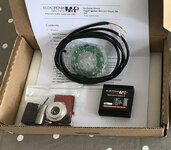
This is the kit of parts to fit. I’ve already fitted the ignition module under the seat
 

Attachments

  • 00 The kit.jpg
    00 The kit.jpg
    238.8 KB · Views: 307
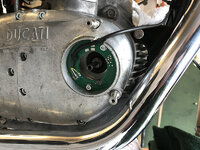
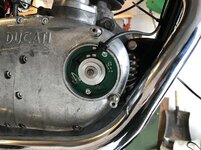
All that needed fitting was the sender and magnetic rotor. The sensor is screwed in place with two Allen screws and isn’t adjustable. Next the cam sleeve is slid onto the point’s cam shaft and secured with a screw on the end. Then the magnetic cam is slipped over it. It’s all well machined and a nice sliding fit.
 

Attachments

  • 03 sender.jpg
    03 sender.jpg
    240.6 KB · Views: 317
  • 04 sender.jpg
    04 sender.jpg
    84.2 KB · Views: 318
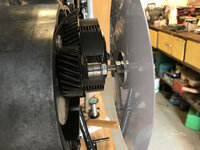
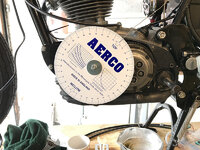
Degree disc mounted on a short piece of 8mm threaded bolt with an assortment of washers

The pointer is just a piece of bent wire attached to the horn mount
 

Attachments

  • 001 disc mounting.jpg
    001 disc mounting.jpg
    165.5 KB · Views: 362
  • 002 timing disc.jpg
    002 timing disc.jpg
    242.2 KB · Views: 346
To find TDC and set ignition timing

1 Zero the disc reasonably close to where you think TDC is (I could see the piston top through the plug hole), then rotate the engine back away from TDC a little.

2 Screw the piston stop into the plug hole and rotate the engine until the piston gently stops against it, note where it stops on the degree disc

3 Rotate the engine the other way until it stops against the piston stop, note where it stops on the degree disc

4 Add up the degrees you noted either side of TDC and half it to find midway then rotate the discs to this point.

5 Rotate the engine forward and backward up to the stop gently confirming you have the same number of degrees on either side of zero (On my engine is was accurately repeatable to .5 degrees).

6 Remove piston stop and rotate the engine to the zero mark, that should be exactly TDC

All you have to do now is rotate the magnetic cam until the led light comes on, rotate a bit more and the light goes out (you will also hear the spark), and that should occur at exactly TDC, check it against the degree disc.
 
Following the above instruction, for some inexplicable reason my spark was occurring 26 degrees to late (retarded)!! :blast:rolleyes::eek::confused:
I repeated the process 3 times but it was always the same so I set the magnetic cam to 26 degree advance and that fixed the error, firing at exactly TDC. I must have been miss reading the LED lights but I don’t know how, anyway I’m confident it's right :rolleyes::P

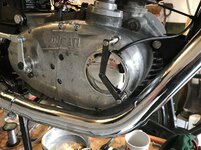
New chrome cover fitted, ignition is go!
 

Attachments

  • 05 cover on.jpg
    05 cover on.jpg
    86.3 KB · Views: 337
Wey Hey !!!.....Glad you are back with the updates ebbo. Like the others, I'm glued to this thread....:)
 
Sadly, back to the front brake... because it's leaking fluid.

First it was just weeping slightly as it stood over night. I tried tightening it up gently but eventually it felt rock hard under the spanner and the leak got worse, a lot worse, bugger. :mad:

At this point I'd didn't know what was to blame, the caliper (hope not) or the pipe, bugger :mad:
 

Attachments

  • 0001 leaking.jpg
    0001 leaking.jpg
    160.6 KB · Views: 321
Hopefully just a bad swage on the end of the pipe...

I'm certain now it is, a magnet tells me the pipe is stainless steel not galvanised steel. Stainless is really hard. I don’t think its too inclined to seat properly unless it’s well formed

What about some PTFE tape?

I considered it, but the internet suggests brake fluid might break it down and even if it didn’t break down I don’t much like the idea of PTFE wrapped joints
 
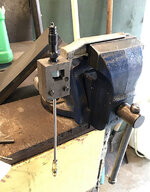
The best way forward I thought was to buy some copper/nickel brake pipe, some brake pipe nuts and try to make my own with an old Mopod brake flair tool.

When the pipe arrived I polished up some of the pipe to brighten it up and tried flairing it using silicon grease as the lubricant. That didn’t work. The pipe ends were badly malformed as the silicon grease failed under pressure causing the forming tool to twist the pipe end. What a mess.

Next try was standard axle grease ie lithium base grease, that worked a treat and perfect pipe ends were formed every time. But the pipe ends had to be washed in petrol with a toothbrush and pipe cleaners.

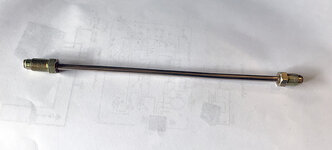
The new pipe bent easily to shape and the feel of the spanner as the joints was tightened was worlds away from the stainless pipe, it felt good :thumb System bleed and no leaks, not one. I have to say I was well chuffed :thumb:thumb:thumb The only problem is the pipe looks like copper, and that's a pet hate of mine, copper brake pipes when they should be shiny shiny silver :(
 

Attachments

  • 0002 flair tool.jpg
    0002 flair tool.jpg
    233.5 KB · Views: 322
  • 0003 new pipe.jpg
    0003 new pipe.jpg
    84.9 KB · Views: 338
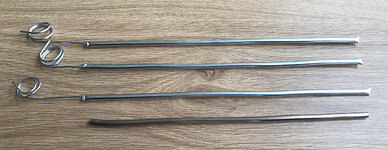
So, I cut what was left of the brake pipe up into three pieces. Nipped the ends closed with a copper wire tail at one end, sealed them with solder and took them to the friendly platters in Pocklington for zinc plating.

I explained what was going on and they said come back in an hour! one hour!!

So I went for a leisurely breakfast at Mr’s B’s Cafe on the industrial estate (very nice too) and an hour later back at the platters I was handed these utter beauties!! :eek:


Note the short end of plain copper/nickle pipe for comparison
 

Attachments

  • 0004 zinc pipes.jpg
    0004 zinc pipes.jpg
    145.5 KB · Views: 337
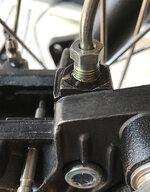
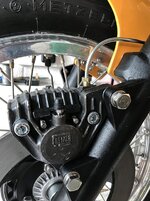
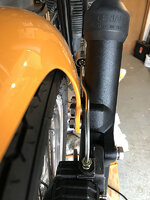
And this is the end result; pipe the right colour/look and no leaks!
 

Attachments

  • 0005 new pipe fitted 1.jpg
    0005 new pipe fitted 1.jpg
    82.5 KB · Views: 312
  • 0006 new pipe fitted 2.jpg
    0006 new pipe fitted 2.jpg
    195.6 KB · Views: 312
My thoughts on brake bleeding after three goes with this brake over a couple of weeks

Pushing the hydraulic oil up from the bottom with a syringe is a very good starting plan. The oil under pressure has no option but to fill the system, put a good drop of oil in the master cylinder first though or the oil will squirt out of the master cylinder filler, and you don’t want that! Gentle steady pressure, you don't want to blow any pipes off and spray the bike!!

Once you have oil in the system it’s much easier to bleed the air out with a clear piece of vinyl pipe than one of those special bleeding pipes with a split in the end. That little bit of back pressure they cause completely stops the oil pumping down, all you do is slightly compress the air in the system each time you pull the lever instead of pumping the oil through.


Back
Top Bottom