- Joined
- Jul 14, 2010
- Messages
- 10,597
- Reaction score
- 4,115



Are you not painting the bearings black as well, you know, for completeness?


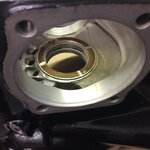
I dont like to be the bearer of bad news but you have fitted the front main bearing in the wrong position.

Hi Richie,you are of course technically absolutely correctI dont like to be the bearer of bad news but you have fitted the front main bearing in the wrong position.

Ah ok,surely the later style bearing with the 6 slots is going to allow more than enough oil to the bearing given that the oil pressure will be equal around the whole bearing.Hi Mikey, there is a very good reason why the bearing split is fitted to the correct position, if you look at the way the oil is feeding from the oil filter up into the front main bearing, the slot in the bearing will line up with the feed hole so it gets a direct feed to the crank, as opposed to an indirect feed.

Always looks like a good idea on paper, just like rotary engines, but the reality is not as straightforward.An interesting exercise would be a side valve turbo with modern production methods to overcome the inherent inefficiency of this engine layout. I wonder if the inadequate combustion chamber could be overcome with turbo charging? It would be a very small and light engine compared to the overgrown beasts we see on bikes and cars. Look at a modern boxer engine. See where the head joins the barrel? It's possible to have a engine about 1 inch bigger than that. Yes you would loose some efficiency but would the lighter weight and size coupled with a turbo compensate? After all when you put a turbo on a engine you would normally lower the compression ratio. JJH

Thanks for noticing my post. In a side valve engine (ones I've seen anyway) the valves are upside down and work in a side pocket to the block. The combustion chamber is over the piston and also to one side. The bores and piston rings wouldn't wear any faster than a ohc or pushrod engine. I'm sure? JJHAlways looks like a good idea on paper, just like rotary engines, but the reality is not as straightforward.
The low compression ratio provides the ability for massive boost, so ultimate power is not a problem.
The disadvantages are:
Lousy/Rotten/Awful fuel consumption.
Distortion under load.
Once you start to use the power, you will start to use almost as much oil because of bore distortion caused by the side valve layout.
Myke
Wear is not the problem. Distortion is.Thanks for noticing my post. In a side valve engine (ones I've seen anyway) the valves are upside down and work in a side pocket to the block. The combustion chamber is over the piston and also to one side. The bores and piston rings wouldn't wear any faster than a ohc or pushrod engine. I'm sure? JJH
Wear is not the problem. Distortion is.
The problem is that because the exhaust valve is in the block, one side of the block gets extremely hot when the engine is worked hard. As a consequence, the bore is no longer round whilst working hard. Thus, the engine drinks oil.
Myke