


For those who were waiting and those who don't yet know what I am talking about, here are my findings!
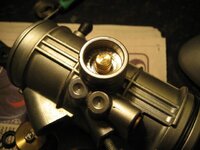
I purchased a "Fannytickler", to get rid of the righthand throttle body rattling, from Boxer Design in Germany. This evening I removed the throttle body, then drilled and levered off the sealing cap as per the instructions.
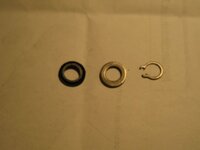
Firstly it is interesting to see how the butterfly pivot is made up. The shaft exits the body through a thin-walled bush, over which is pushed a rubbery plastic sealing washer, a metal washer then a circlip. The shaft has a certain amount of inbuilt side-play. (OK so far?)
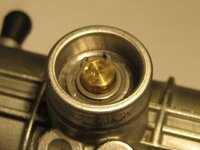
The "fannytickler" consists of a replacement brass sealing cap with a threaded hole in the middle which should be "tapped home with a rubber mallet, with or without loctite" (Mine was a sliding fit which I araldited into place!).
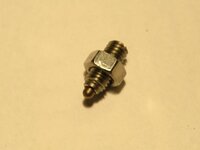
A fitting consisting of a threaded "screw" with a spring loaded ball at the end is then screwed into the hole. The instructions say this should not be screwed in "too tight or too loose". This is where I question the thinking behind this item.
The only way to tighten up the play in the shaft is to tighten the screw until the rattle stops, if you do this the spring loaded ball pushes into the hollow screw until the solid screw itself bears on the butterfly valve shaft. This could push the butterfly itself against the body of the throttle valve --not good! The spring tension on the ball is not enough to stop the rattle.
It was worth a try (£30) but I am not impressed. If I have it tight enough it does stop the rattle but the only way I can see to really cure it is to rebush both ends of the shaft, ie a new throttle body! Unless some enterprising Migsel type person comes up with a method of rebushing!
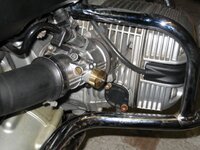
I hope the photos attach - if not I will try again tomorrow.
Tony T
I purchased a "Fannytickler", to get rid of the righthand throttle body rattling, from Boxer Design in Germany. This evening I removed the throttle body, then drilled and levered off the sealing cap as per the instructions.
Firstly it is interesting to see how the butterfly pivot is made up. The shaft exits the body through a thin-walled bush, over which is pushed a rubbery plastic sealing washer, a metal washer then a circlip. The shaft has a certain amount of inbuilt side-play. (OK so far?)
The "fannytickler" consists of a replacement brass sealing cap with a threaded hole in the middle which should be "tapped home with a rubber mallet, with or without loctite" (Mine was a sliding fit which I araldited into place!).
A fitting consisting of a threaded "screw" with a spring loaded ball at the end is then screwed into the hole. The instructions say this should not be screwed in "too tight or too loose". This is where I question the thinking behind this item.
The only way to tighten up the play in the shaft is to tighten the screw until the rattle stops, if you do this the spring loaded ball pushes into the hollow screw until the solid screw itself bears on the butterfly valve shaft. This could push the butterfly itself against the body of the throttle valve --not good! The spring tension on the ball is not enough to stop the rattle.
It was worth a try (£30) but I am not impressed. If I have it tight enough it does stop the rattle but the only way I can see to really cure it is to rebush both ends of the shaft, ie a new throttle body! Unless some enterprising Migsel type person comes up with a method of rebushing!
I hope the photos attach - if not I will try again tomorrow.
Tony T


 )and the left is more expensive due to the electrickery on that side I think.




