Government to review the new motorcycle test

Lord Snooty

Well-known member
UKGSer Subscriber
Joined
Jan 6, 2002
Messages
11,394
Reaction score
2,752
Location
Redditch, Worcs
At last somebody has seen sense and is to carry out a review of the new test that was introduced last year.

Parliamentary Under-Secretary of State for Transport (Mike Penning): I am announcing today a review of motorcycle tests in Great Britain. The new two-part motorcycle test that was introduced in April 2009 has clearly led to some concern amongst motorcycle groups, particularly about the safety of the off-road module 1 part of the test and about the difficulty of accessing the limited number of off-road test centres. The new test was introduced in order to meet the requirements of the second EU Directive on driving licences. While most elements in the module 1 test are required by the Directive, there may be scope for us to make some changes to the way in which the test is carried out.

We will be working with the motorcycle community and road safety groups to look again at the current form of the motorcycle test. This review will look at the manoeuvres carried out in both modules 1 (off-road) and 2 (on-road) and whether these manoeuvres could safely be conducted in the on-road test.

The review will also look at other related motorcycle testing and training issues, including the options for training and testing for progressive access under the third driving licence directive and how any changes relate to wider proposals to improve motorcycle training and testing.

We are inviting views from members of the public, motorcycle riders, trainers, road safety groups and others on what aspects of the motorcycle test they want us to look at, including how and where they think motorcycle testing might best and most safely be carried out. Views should be submitted to the Department for Transport ([email protected]) by 31 July. We aim to conclude the review by the autumn.

There have been many recorded accidents incurred on the "swerve" maneouvre in the module 1 test (broken limbs mostly) but sadly this review is too late for a girl who recently broke her neck. I am unable to confirm the test centre location but the accident was confirmed to me by a DSA examiner/assessor who spent the day with us recently to assess one of our instructors. Apparently she panicked in the braking stage and opened wide the throttle before the bike went down and catapulted her into the fence causing the injury - she was taken to hospital in a coma, I have no other news on the severity of the injury and the long term prognosis.

Sad news indeed. :mad:
 
Sadly, the whole thing was implemented in the usual "gold plated" style we have come to expect from our civil service, whenever a new directive comes from the EU. You only have to look back at the debacle when it became a criminal offence to sell fruit and veg in pounds only as further evidence of the lack of common sense that is usually applied.

It will be interesting to see what they come up with, if anything, but at least it is a start.
 
There was a nice little story in the paper the other day about Labour having ditched the Mile as a unit of measure in the transport minstry, going over to KM instead. Aparently thats being reversed as we speak:thumb2
 
At last somebody has seen sense and is to carry out a review of the new test that was introduced last year.


There have been many recorded accidents incurred on the "swerve" maneouvre in the module 1 test (broken limbs mostly) but sadly this review is too late for a girl who recently broke her neck. I am unable to confirm the test centre location but the accident was confirmed to me by a DSA examiner/assessor who spent the day with us recently to assess one of our instructors. Apparently she panicked in the braking stage and opened wide the throttle before the bike went down and catapulted her into the fence causing the injury - she was taken to hospital in a coma, I have no other news on the severity of the injury and the long term prognosis.

Sad news indeed. :mad:

Whilst I agree with everything you've said Mike, the incident you've mentioned 'could' have resulted from inadequate training.
My students progressively build up their speed and cones are progressively moved closer untill the course resembles that of the actual test.
They may have completed up to 50 attempts without incident.
(Of course we can never account for an individual's nerves during test).

But all this takes time and detracts from other training.
In many ways, much of the test does now result in riders having better control over their machines, we as intructors, are having to spend so much time 'training students' to jump through hoops.

The number of accidents I've heard of in Mod 1 is unacceptable:thumb
 
...we as intructors, are having to spend so much time 'training students' to jump through hoops...


Bloody Hell, glad I took my Test in 1981... looks bloody tough these days :augie
 

Attachments

  • r459771_2256134.jpg
    r459771_2256134.jpg
    90.8 KB · Views: 461
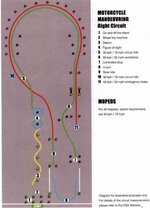
What is the Swerve test? there is a one element of the cone test here in Holland that you have to do a swerve at 50kph

Follow the green line in this case clockwise, round the bend, through the speed trap, throttle off, swerve right through cones and stop with front wheel within the box of 4 cones, it can be either right handed or left handed.

problems can occur if the student applies the brake before swerving through the cones and getting the bike upright.

The green line on this diagram shows a quite severe swerve, in reality it's not that bad at all.
 

Attachments

  • module_1_right_circuit (Small).jpg
    module_1_right_circuit (Small).jpg
    24.2 KB · Views: 466
Whilst I agree with everything you've said Mike, the incident you've mentioned 'could' have resulted from inadequate training.
My students progressively build up their speed and cones are progressively moved closer untill the course resembles that of the actual test.
They may have completed up to 50 attempts without incident.
(Of course we can never account for an individual's nerves during test).

But all this takes time and detracts from other training.
In many ways, much of the test does now result in riders having better control over their machines, we as intructors, are having to spend so much time 'training students' to jump through hoops.

The number of accidents I've heard of in Mod 1 is unacceptable:thumb

It seems the new test has meant schools have had to move away from training students to ride to training them to pass a test, which is not a good thing.
 
Devil's advocate

My sister recently passed her test and was pretty scared of 'the swerve' bit. Having ridden for a few months on the road she now wonders what she made a big fuss about.

I'll readily admit that I haven't tried this test and I'm horrified by the number and severity of some of the accisents, however if the test isn't as daunting as it first appears once you have some experience then isn't it a good test? :nenau
 
It seems the new test has meant schools have had to move away from training students to ride to training them to pass a test, which is not a good thing.

Before the 'new' test, north Wales was a notoriously difficult place to pass a test.
This was mainly down to the examiners personal take on things (he doesn't ride a bike himself btw:rolleyes:), which meant we had to teach students to meet his criteria, which sometimes bordered on the ridiculous.

So I wouldn't necessarily agree with your post since, in the process of developing the skills to pass this new test they also increasing other skills and building confidence.
We now spend a lot more time working on bike handling skills and I bet there aren't that many tossers here who could match their slow riding skills:D

My sister recently passed her test and was pretty scared of 'the swerve' bit. Having ridden for a few months on the road she now wonders what she made a big fuss about.

I'll readily admit that I haven't tried this test and I'm horrified by the number and severity of some of the accisents, however if the test isn't as daunting as it first appears once you have some experience then isn't it a good test? :nenau

Yes the number of accidents is unacceptable and has probably increased by around 400%!
Yet once you know how to take that part of the test, it's a doddle.:nenau

I really don't know what the answer is right now since EU legislation and the plonkers who design these tests need to liase with both examiners and instructors.
Since most instuctors at this level generally live in the real world as far as motorcycling goes, it makes sense to me, to ask them....
"How can we realistically ensure our new riders are safe and fit for the road"?
 
Before the 'new' test, north Wales was a notoriously difficult place to pass a test.
This was mainly down to the examiners personal take on things (he doesn't ride a bike himself btw:rolleyes:), which meant we had to teach students to meet his criteria, which sometimes bordered on the ridiculous.

So I wouldn't necessarily agree with your post since, in the process of developing the skills to pass this new test they also increasing other skills and building confidence.
We now spend a lot more time working on bike handling skills and I bet there aren't that many tossers here who could match their slow riding skills:D


Yes the number of accidents is unacceptable and has probably increased by around 400%!
Yet once you know how to take that part of the test, it's a doddle.:nenau

I really don't know what the answer is right now since EU legislation and the plonkers who design these tests need to liase with both examiners and instructors.
Since most instuctors at this level generally live in the real world as far as motorcycling goes, it makes sense to me, to ask them....
"How can we realistically ensure our new riders are safe and fit for the road"?

The problem is the amount of time being devoted to passing this part of the test when it could be better spent elsewhere, such as working on anticipation and hazard perception.

As for the slow riding skills of your students, how many of them will still have these skills in a few years time? How many people who had to do a u-turn as part of their test could do one to test standard now?
 
I really don't know what the answer is right now since EU legislation and the plonkers who design these tests need to liase with both examiners and instructors.
i completely agree - the opportunity and the relevant people from the U.K. authorities did have an opportunity - here;

http://www.cieca.be/template_events.asp?eve_id=21&lng_iso=EN

(i gave a small presentation - but apparently my name is 'Aline Delahaye' :D - she did her bit in French / i gave mine en Anglais )
Here's the interesting bit;
four countries gave demos of their interpretation of the directive.
so, we saw four entirely different interpretations of the same directive.
Irelands version is different again.
The U.K. could have added to the variety! :eek but chose not to.

this seems sadly fitting; :banghead:

better spent elsewhere, such as working on anticipation and hazard perception.
agreed!
precisely what my presentation was about
 
Denise took the "swerve" part of the test a while ago. Didn't have any problems with the actual swerve and stop in the box at all, which makes me wonder what the problem is. :nenau
Her problem has since been finding the time to actually take the "road" part, she is covering maternity leave for one of the other Osteopaths, and has very little time. She had to cancel one test herself, and the rescheduled one was then cancelled by the DSA, as they had double booked. :mad:
Her "training" by the company she was using has varied from very good, to reducing her to tears, depending on which instructor she had. (The worst one being the owner of the company concerned!)
Thankfully she has had some extra training from a friend who is herself an instructor, so hopefully sometime soon she can rip up the L-plates.
I was shocked to find how few test centres there are, and how long the wait is if you aren't booked through a recognised training school though. :rolleyes:
Mark
 
Another area of concern is both the shortness of time and costs involved.
Those who do CBTs will know all too well, some students won't even know which way to twist the throttle:blast

By the end of their first day they've hopefully become proficient enough to gain their CBT.

Day two on a 125cc doing lots of Mod 1 and 2 work.

Day three 500cc work doing the same.

Day three for us, a long ride through towns and fast dual carriageway to the test centre in Bangor covering Mod 2 stuff, and take their Mod 1 test. Return covering Mod 2.

Day four IF they've passed mod 1 is the same long ride to take mod 2.

There's a lot of pressure on many students and instructor to achieve 'their' goals depending on how natural a rider the student is.

Of course some of the above is theoretical since it's not always even possible to book a test or retest for several weeks:blast

The examiners (who are great in Bangor:thumb) do all they can to put students at ease and really want them to pass so it would be interesting to hear their views, even though they insist on calling the 'swerve test', 'cone avoidance':P
 
Having taken the the Mod 1 & 2 tests this year I really can't understand why so many people have a problem with the "swerve test" exercise at all.

This is not just be being smug but if you can't do that you really shouldn't be riding at all IMHO. I guess the number of accidents is down to attempting the test before the student is really ready for it. The answer? I really don't know.

In general I really don't think the test goes far enough. Certainly the DSA administration side needs lots of work. There need to be more test centres to reduce waiting times and cancelled tests.
 
Whilst I agree with everything you've said Mike, the incident you've mentioned 'could' have resulted from inadequate training.
My students progressively build up their speed and cones are progressively moved closer untill the course resembles that of the actual test.
They may have completed up to 50 attempts without incident.
(Of course we can never account for an individual's nerves during test).

But all this takes time and detracts from other training.
In many ways, much of the test does now result in riders having better control over their machines, we as intructors, are having to spend so much time 'training students' to jump through hoops.

The number of accidents I've heard of in Mod 1 is unacceptable:thumb

Tim, I agree, yes some accidents will be the result of inadequate training without a doubt. We are lucky as we are only 16 miles from the Garretts Green test centre in Birmingham and we use it at weekends to train our students. The benefit is huge as they get to train progressively, get used to the cone layout and we put them through a complete mock test on the actual test pad. Many training bodies do not have this benefit and have to train on car parks which are nowhere near the size of the test pad; as a consequence the first time a student attempts to reach the 50kph required may be on test day which is where the problems occur.

This is not the fault of the training body but a limitation that has been imposed on them by the flawed implementation of the EU directive and the failure to build enough test centres within easy reach of all students. Some instructors have more than a 100 mile round trip to get their student to a test centre and often on busy trunk roads - a ludicrous and dangerous situation.

If there is one change I would like to see it would be to remove the requirement to stop the bike in a predesignated spot after the swerve; this would eliminate the panic braking whilst the bike is still leant over which I'm sure is the cause of many of the accidents.
 
100 mile round trip thats nothing down this way it could be upwards of 200 miles, no fun then a test in the middle of that trip.
 
Follow the green line in this case clockwise, round the bend, through the speed trap, throttle off, swerve right through cones and stop with front wheel within the box of 4 cones, it can be either right handed or left handed.

problems can occur if the student applies the brake before swerving through the cones and getting the bike upright.

The green line on this diagram shows a quite severe swerve, in reality it's not that bad at all.


The whole test looks very similar to the dutch tests except you don't have to come to a stop in a set place afterward. ( and all the tests are done seperately not consecutively) maybe both of these contribute to the accidents? maybe the time line leading to the tests? I've not heard of any problems here? I will ask around.
 
Failed Module one today - hit one of the red cones before the speed trap! Felt like a complete idiot! In all the times I have spent practising, this was not something I have ever done before!

Oh well, try again on Friday
 
Unlucky! Best of luck Friday. It has been recently announced that we will be returning to a single test by the end of the year - it will retain some elements of the mod 1 test but the exact format is yet to be announced. :comfort


Back
Top Bottom