How could I fit a cheap LCD digital speedo?

Bob Jeffries

It's good to be back ..
UKGSer Subscriber
Joined
Jan 3, 2002
Messages
1,269
Reaction score
140
Location
Griffithstown, South Wales
When I test rode a 1250 one of the big improvements for me, being old with less than perfect eyesight, was the big digital speedo on the TFT screen.

I have a 2017 GSA TB and the analogue speedo is almost unreadable so in speed sensitive areas I use the Nav 6's big speedo screen. The only problem is when going through area's that I need to see both mapping and Speedo!

Has anyone fitted a permanent large easily read digital speedo to their analogue bike?
 
When I had the same bike as you I used a phone mounted. Map, speed, cameras, traffic. Was best solution for me even if I knew where I was going.
 
When I test rode a 1250 one of the big improvements for me, being old with less than perfect eyesight, was the big digital speedo on the TFT screen.

I have a 2017 GSA TB and the analogue speedo is almost unreadable so in speed sensitive areas I use the Nav 6's big speedo screen. The only problem is when going through area's that I need to see both mapping and Speedo!

Has anyone fitted a permanent large easily read digital speedo to their analogue bike?

Should do the job, I have one on Ebike works really good.

https://www.amazon.co.uk/s?k=ciclosport+navic&ref=nb_sb_noss
 
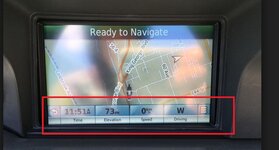
Analugue speedo is small but I assume (if it's anything like the Nav V) the Nav VI can display current speed at the bottom whilst navigating a route. It even turns red if you go over the speed limit.

The row along the bottom can be changed both in style & the contents.
 

Attachments

  • Capture.JPG
    Capture.JPG
    83.1 KB · Views: 677
Perhaps a new set of spectacles may do the trick?
 
1. As above, the Nav 5 (and I assume 4 and 6) can display the speed in the bottom line.

2. Have the digital speed displayed in the right side of the dash on your TB.

I do both of these on my 2017 non-TFT GS .
 
This.


+ generally an analog tachometer should be quicker to read than any digital (numbers) option.

It should be but if you need reading glasses the digits are too small and too close to focus on. I can't focus properly on anything closer than about 1.5 meters now without reading glasses, but have no problem reading number plates on cars the other side of the office car park. The digital speed display on the non-TFT dash is big enough to be readable without putting my reading glasses on.
 
This.


+ generally an analog tachometer should be quicker to read than any digital (numbers) option.

Worrying, isn't it?

I found it was not a question of not being able to read it at all, but how long it takes to re-focus sufficiently to get an accurate idea of your speed, particularly when in Europe and trying to read the even tinier km/h scale. So, no an analogue scale is not going to be quicker to read for many people and certainly not as easy to read accurately. As your eyes age they are slower to change focus and sometimes can no longer get fully focused on nearby objects without the aid of magnifying reading glasses which means some blurring - not a problem with a big digital display but makes all the difference with a small analogue scale. If you don't have this problem yet, don't mock, as you probably will eventually!

A larger digital speed display can be taken in at a glance with an accurate indication of speed, which means your eyes are off the road for a shorter time, whereas the very small scale on the analogue speedo is much more difficult, takes longer to read, and is very easy to misread, so given the demographic of GS buyers, I would say the analogue speedo is generally not fit for purpose in an age of ever increasing speed surveillance. The analogue tacho is a different case - you don't get fined for an excessively high tacho reading, you just occasionally like to know approximately how close to the redline you are, so accuracy of reading is not that important.
 
1. As above, the Nav 5 (and I assume 4 and 6) can display the speed in the bottom line.

2. Have the digital speed displayed in the right side of the dash on your TB.

I do both of these on my 2017 non-TFT GS .

Only problem with the bike's digital speed readout is that you cannot switch it to km/h for European trips. Unbelievably this can only be done by hooking up to the dealer's diagnostic rig so unless you have some alternative such as a separate GPS speedo, or the speed indicator on a NAV device, you can find it very difficult to monitor your speed in Europe, and this can potentially be very expensive!
 
I'm not mocking, I'm asking :)
My eyesight is certainly not improving, even though I'm still under 40ies.

I found it was not a question of not being able to read it at all, but how long it takes to re-focus sufficiently to get an accurate idea of your speed, particularly when in Europe and trying to read the even tinier km/h scale. So, no an analogue scale is not going to be quicker to read for many people and certainly not as easy to read accurately.

The point of the analog gauges is that you can quickly read the speed by seeing where the needle is, like when reading a watch.
You can quickly sense if you are within the 40mph area or not, at glance, then look for the smaller numbers. But I see your point. Especially the time it might take to readjust.

I have two bikes, an older GSA with the analog dashboard and another one with a digital dashboard that can be set with a big number for the speed. The big number is, yes, easy to read. Personally I still prefer (and find easier/faster) the normal gauges.

I would say the analogue speedo is generally not fit for purpose

That is a bit far fetched :)


What I can consider "worrying" is, given the vast number of people on motorbikes with multiple screens on their dashboard (GPS + TFT and other crap)... if one cannot read properly... all that stuff is then a massive attention-sink.
I'm not referring to OP here. Just an hypothesis as I see more and more people distracted from riding by all this stuff.
I had my own bad experience years ago by having problems reading the SatNav (screen glare) making me very distracted.

Only problem with the bike's digital speed readout is that you cannot switch it to km/h for European trips.

GS911.

or... generally:

30mph for 50kmh

55 for 90kmh on A roads

80 on most European motorways (130kmh)

not that much to remember.
 
I'm not mocking, I'm asking :)
My eyesight is certainly not improving, even though I'm still under 40ies.


The point of the analog gauges is that you can quickly read the speed by seeing where the needle is, like when reading a watch.
You can quickly sense if you are within the 40mph area or not. But I see your point. Especially the time it might take to readjust.

I have two bikes, an older GSA with the analog dashboard and another one with a digital dashboard that can be set with a big number for the speed. The big number is, yes, easy to read. Personally I still prefer (and find easier/faster) the normal gauges.

I would have agreed with you a few years ago, but these days with the eyes aging, combined with the proliferation of speed cameras, it is no longer good enough to know roughly what your speed is - just a few mph out and you get the dreaded brown envelope in the post! In the old days you would ride at what you judged to be a safe and sensible speed (or not in some cases!) but you didn't really need to accurately know your actual speed all the time.

A case in point - there are loads more average speed monitoring sections on roads now, and you literally have to be checking your speed every few seconds. I can't see that forcing people to do this is really adding to road safety, especially if their eyes are slow to re-focus each time. I have tried bifocal glasses to get around this, but while OK in the car, I find them unsuitable for the bike as they distort peripheral vision making shoulder checks and vision at junctions difficult.
 
I agree with you fred (increase in cameras, etc.) yes you have to look at your speed more. I find it annoying too. Also people don't look at the road and traffic is less "fluid" in some cases for that reason.

A case in point - there are loads more average speed monitoring sections on roads now, and you literally have to be checking your speed every few seconds.

My experience is different.
There is quite a few bits with average speed cameras in London and around.
I generally always ride a bit faster and happily overtake, never got a fine (touch wood) as 1) they calculate the average and 2) there seem to be a healthy "buffer".

Especially on the Hammersmith Flyover... I keep pushing everytime a bit more (40mph average, riding between 45/55 and faster when overtaking)... I might receive the dreaded brown envelope at some point. :D


In short: there is no need to look at the speedo every 2 seconds in those cases.
 
I agree with you fred (increase in cameras, etc.) yes you have to look at your speed more. I find it annoying too. Also people don't look at the road and traffic is less "fluid" in some cases for that reason.


My experience is different.
There is quite a few bits with average speed cameras in London and around.
I generally always ride a bit faster and happily overtake, never got a fine (touch wood).

Especially on the Hammersmith Flyover... I keep pushing everytime a bit more (40mph average, riding between 45/55 even faster when overtaking)... I might receive the dreaded brown envelope at some point. :D

Haha - could be an expensive way of finding out what the threshold is for issuing a speeding fine. :D

I read an article recently about a survey of police forces on speed cameras generally, and I would assume this would apply to average speed cameras too. Of those that responded (some refused) most allowed +10% + 3 mph - so for a 70 limit you could do up to 80 before triggering the cameras. Some used 10% + 2 mph, and the ones that refused to answer might be those police forces who have threatened to start fining for even 1 mph over the limit!

Used to be that most of the average speed sections only had front facing cameras, meaning bikes having only rear number plates could not be read, so you were effectively invisible. Sadly they are getting wise to that now, and returning from Portsmouth on Sunday I went through a section where the cameras were all reading rear number plates.
 
Yes, been through that bit of motorway recently.

Average speed cameras on the M4 and M3, same story (rear facing).
 
Only problem with the bike's digital speed readout is that you cannot switch it to km/h for European trips. Unbelievably this can only be done by hooking up to the dealer's diagnostic rig so unless you have some alternative such as a separate GPS speedo, or the speed indicator on a NAV device, you can find it very difficult to monitor your speed in Europe, and this can potentially be very expensive!

If you alter the units on the Nav VI then it will display KMH


Back
Top Bottom