Bateman said:
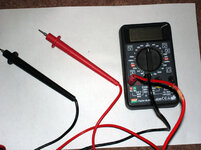
I want to test some of the electrics on my little serow. The Haynes book tells me what to test and what figures to expect, but having never used one before, I am not too sure what to plug where etc etc. for example, some of the instructions say "Set the Ohmmeter selector switch to the RX1 position" - where is that? And which of the 4 holes do I plug the red and black leads into? I don't have the manual for this either. This is what my meter looks like:
Your black lead should always go in the common port as shown in your picture. For Volts and restistance your red lead should go where it is shown in your photo (ie the port marked volts and Ohms). For measuring current swap your red lead to either the 300mA port or the 10Amp port dependant on what you are measuring. Obvioulsy for anything above 300mA use the 10Amp port.
Voltage is the volt drop across something (eg your battery terminals. If you try to measure voltage along a length of wire you won't see any drop. Basically to measure voltage on a bike nearly always the measurement will be taken with reference to earth which is anything metal on your bike connected to the negative terminal.
REsistance is what it says and a high or infinate resistance shows an open circuit. The RX1 i think refers to the scale of the read out. x1 will read directly in Ohms,
#Current is the flow of electricity along a wire and is measured in series. For higher currents put the red wire in the 10A fused port as this goes though a slightly different circuit in the meter. For smaller current put the red lead in the 300mA port. The dial on the meter should show a position indication if its for restistnce, current or volts and corresponding scales. For resistance there is often a picture of a diode and this has a audible beep if you have continuity and you can just check this by touching the 2 leads together.
To be honest its quite difficult to explain how to use a meter like this unless its for a specific task. If you have a friend or someone off the list lives close by it would be worth spending half an hour over a pot of coffee with a poen and paper or you will just get frustrated.
good luck.
remember red to red, black to black and blue to f*ck

AndyT
Oh by the way just remembered obviously the bike will be DC current as it is coming from a battery so use the Volts and amp settings shown on the dial for DC.
Never try and measure resistance of the power is on as the meter will give crazy readings and may even damage it