Le Mans to Berlin and a bit beyond

There is an ‘art installation’ project in Germany, that’s been going on for a few years, known as Stolpersteine or literally, ‘Stumbling stones’


I had seen the ‘stones’ elsewhere in Germany but, reading that there are four ‘sets’ in Seelow, prompted me to see if I could find them. I was successful for all but one set, so I’ll cheat for the last, which are situated at the ‘White House’ supposedly the grandest house in Seelow:

IMG_9610.jpegIMG_9612.jpegIMG_9615.jpeg

These stones were in pretty close proximity to each other, maybe 15 minutes walk apart.

The ‘White House’ is a little way outside of Seelow, down the hill a bit, past the railway station and the large Russian memorial.

Here a potted history on each:

Louis Reissner (born 1882, murdered in Warschau in 1942)
Martha Reissner (born 1887, murdered in Warschau in 1942)
Ruth Reissner (born 1915, murdered in Riga in 1942)

The Warsaw will, I assume, refer to the Warsaw Ghetto.

Adelheid Philippsborn (born 1879, murdered in Warschau in 1942)
Later a second stone was laid for Max Philippsborn (b. 1880, Schutzhaft 1938
KZ Sachsenhausen, released in 1938, died November 28, 1940).
Berthold Irmlig (born 1900, murdered in Sachsenhausen)
Julie Irmlig (born 1877, murdered in Treblinka)
Isidor Irmlig (born 1867, murdered in Treblinka)
Hildegard Wangenheim (born 1915, murdered in Warschau)
Karl-Heinz Wangenheim (born 1910, murdered in Warschau)
Mathel Cohn (born 1942, murdered in Auschwitz)
Elli Cohn (born 1919, murdered in Auschwitz)
Heinz Cohn (born 1914, murdered in Auschwitz)

I have found a picture of the Cohen family’s stones (who were wealthy and lived in the White House):

IMG_9630.jpeg

Given that Seelow is a very small town, it is inconceivable that these Jews’ fellow neighbours did not know what was going on.

That brought me to the end of the day. A long way on a push bike bike, but worth it for the reward:

IMG_9606.jpeg
 
Via a search on Google, I have found a lot more information. I have lifted it via Google translate from a German website:

The earliest mention of a Jewish resident in Seelow dates from the protective Jew Wolf Levin from 1737. Levin released Zobel Aron, a foreign Jew imprisoned in Seelow, on bail. According to the local chronicler Michael Schimmel, some historical sources mention the founding of a Jewish community in Seelow around 1830. A rule book of the Jewish community Seelow from 6. However, October 1841 suggests that the municipality was already well established at that time and had its own burial place at the end of the 1838 extended Hinterstraße.

The community grew over the years, so that in 1861 18 families, with 57 Jews, lived in Seelow. In 1866 they bought the old sacristan's house and set up her synagogue there. In the period from 1862 to about 1880, the community had its own religion teacher and fore-beer S. Lewenthal employed. In addition, she was able to use the municipal school building for Jewish religious education. Around 1880 was the heyday of the Jewish community of Seelow and its surroundings. There are 20 families with 67 members.

After 1880, the decline of the community began by emigration to Berlin and other cities. In the early 1930s, it had shrunk to only five families and the synagogue, which was now in poor condition, was sold. The remaining Jews were the Reissner family in Berliner Straße 20, the Philippsborn family in Berliner Straße 46, the Irmlig family and the Wangenheim family in the Kleine Kirchstraße 9 and the dentist Dr. Felix Abraham in the Küstriner Straße.

After the First World War, Hugo Simon, a well-known Jewish banker, bought the Schweizerhaus, but lived mostly in Berlin. According to a report by Joachim Reissner, his father Louis tried to persuade Mr. Simon to join the Jewish community, but he refused. After the synagogue was closed, the Reissner family visited the synagogue in Frankfurt an der Oder.

The Reissner family lived in Seelow since the 1860s, after Jakob married Henriette Wolff, who was born in Seelow. They started a family and ran a furry business in the village. Previous generations of her family, the Itzig / Irmlig family, lived since the early 18th century. century in Seelow. According to a conversation with Joachim Reissner, which Monica Lowenberg recorded in 1998, his grandfather Jakob Reissner was a fur seller and founded a company in the small town of Seelow around the 1870s. His sons and daughters, who were born in Seelow, remained active in the same trade and continued the business.

As a child, Joachim loved to jump around in the collected furs. They bought all kinds of skins from the butcher, in the slaughterhouses and from foresters of Frankfurt (Oder) and surroundings. Then these were prepared for resale so that furs could be made from the skins. In the 1930s, Jakob Reissner ran his business with two horses and half a dozen different carts. Therefore, the Reissner family was known and recognized in the district.

During the First World War, Joachim's father Louis Reissner had been a soldier of the German Army and, after his return, entered the same business as his father Jakob. Louis belonged to the local Rifle Guild, all of whose members had fought for Germany in World War I and were very proud of it. There were very few anti-Semitic statements in Seelow at that time. In 1930 everything was mixed, the Jewish children were also integrated and played, among other things, in the local football team as equal members.

When Joachim Reissner was 12 years old, he took the threat and persecution emanating from the Nazi state for the first time. Old customers secretly came to his father Louis Reissner after the 1936 Olympic Games to tell him that they were no longer allowed to be seen with him without ruining their own business. Joachim's older brother Willi was avoided by his classmates at the Friedrichs-Gymnasium in Frankfurt (Oder) right after Hitler took power. Many came to school in the uniform of the Hitler Youth. Likewise, Willi was ignored by his class teacher and never questioned by him again. He also gave him back the homework again and again without a grade. In answer to questions from Jewish students, the teacher said, "Go away, Jude!" reacts.

Many were afraid. After a shocking speech by Goebbels on the radio in 1937, Louis Reissner went to the mayor and complained about it, whereupon he told him: "You are right, Louis, but shut up." For Joachim Reissner, the great problems began with the destruction of the Jewish shops in Seelow and the arrest of his father Louis and other relatives on 10. November 1938. The day before, the postman had picked up the phones and thus announced the damage to the Jewish houses by the Nazis.

SA men beat on the 9th. In November 1938, the windows of the Jewish families were destroyed and the housing facilities were destroyed. Max Philippsborn complained about this to the mayor and was arrested because of it. He and Louis Reissner received an ultimatum: either they reported themselves as arrested or they were shot immediately. They were then deported to the Sachsenhausen concentration camp, physically abused and imprisoned for four weeks - but released prematurely due to their use in the First World War.

According to Joachim Reissner, their sons, the not yet 18-year-old cousins Willi Reissner and Heinz Philippsborn were taken into custody and locked up in Seelow prison. Joachim, on the other hand, was allowed to stay with the wife of the Seelow police officer, Mrs. Loose, who was friends with the Reissners, due to his young age. Karl Heinz Wangenheim was also sent to Sachsenhausen and released a month later.

The family struggled to recognize the differences between the people, but accepted the fact that well-known Nazis hated the Jews for some reason. They accepted that there was no future for them in Germany – and that is why Joachim should emigrate. Willi Reissner and Heinz Philippsborn fled to England in April 1939. Three days before the start of the war, i.e. at the end of August 1939, Joachim was able to flee to England with 111 boys and teaching staff as part of child transports and be rescued. Max's brother Georg Philippsborn and his wife Erna had already fled to Shanghai. Moritz Reissner was also able to flee to Shanghai with his wife Anna and daughter Ilse via the Trans-Siberian Railway and then emigrated to the USA, to San Francisco in 1947.

Willi and Heinz reported to the Pioneer Corps, a regiment of the British army, which consisted mostly of Jewish refugees. Joachim attended the O.R.T. Technical Engineering School, today in Leeds. With postcards and letters they maintained contact with their family, which they sent through a relative in Norway.

Such a letter reveals the dramatic changes, a last family reunion, before all their fate should change dramatically. It offers a microcosm of life, the situation of the family in Seelow and their desperate attempts to escape. Martha Reissner had written to him on 25. July 1939, just one month before the outbreak of war, to her son Willi in England: "On Sunday, Heinz and Hilde Irmlig and Aunt Julie, Uncle Max and Aunt Adel were all here together. That hasn't happened for a long time." Martha thought about the sad reality that her house would soon no longer belong to them and they were forced to sell it. She wrote to her son: "We still haven't found anyone for the house, we've even advertised it. Now we only have the administrators, but we will work to change this in the next few days.”

According to the city decree of 22. In September 1942, the property of the Reissner family was sold to Charlotte Buchholz, owner of the local hotel "Schwarzen Adler", and the property of the Philippsborn family to Deutsche Post. This was also reported by the Seelower Tageblatt on the 4th. January 1943. The status of the house of Irmlig is unclear, but already in February 1939 its operation was dissolved by the state.

The Last Jews of Seelow

On the 2nd April 1942, all the remaining Jewish citizens who had not been able to escape had to find themselves at the Seelow station forecourt with packed bundles: Among them were the spouses Louis and Martha Reissner, Bruno Garau, Hildegard and Karl Heinz Wangenheim as well as Adelheid Philippsborn. A day later they were deported from Frankfurt (O.) to the Warsaw ghetto, where their tracks were lost. On the deportation list of the XII. Transport to Warsaw, there were also three forced laborers, with Heinz Bran, Hans Jakobstamm and Chaim Rosenzweig. A letter from the German Red Cross proves that Adelheid and the Reissner family stayed in the Warsaw ghetto and disappeared. Julie and Isidor Irmlig were killed on 25. August 1942 from East Prussia via Theresienstadt to Treblinka deported and murdered.

Ruth Reissner (born 1915), sister of Willi and Joachim, looked after children in the Jewish orphanage in the Berlin district of Pankow. The home and the school existed until December 1940 and were then merged with the Prenzlauer orphanage to form the Jewish orphanage. Some of the orphans were able to escape with the help of their teachers. In August 1942, Ruth was deported together with 14 educators and 282 infants and children by the Gestapo via the assembly camp in the Levetzowstraße synagogue to extermination camp in the occupied eastern territories. The trains were destined for Riga, where SS members shot most of the deportees in the woods.

Berthold Irmlig, son of Isidor (born 1900), was a veteran of the First World War and awarded the Iron Cross. He was arrested and imprisoned in 1939 for a sexual relationship with Else Gruszcyk, a non-Jewish woman. In Brandenburg-Görden prison, he suffered from severe malnutrition. According to the family history, his father Isidor had obtained him a visa for the United States, but it was already too late. He was imprisoned on November 30, 1940 in the Sachsenhausen concentration camp under prisoner number 34382 and "shot on the run" on 5.12.1940. He was buried at the Weißensee Cemetery in Berlin.

Willi Reissner and Heinz Philippsborn both joined the British army and fought against the Nazis. In 1940, Willi wrote in a letter to his cousin Freidel Blumklotz: "I think it's right what I did [...] I always wanted to do as much against the Nazis as I could." Willi belonged to the interpreter pool of the pioneer corps of the 43rd. Division, served in 1940 and 1944 in France as well as in Belgium and Germany and reached the rank of a sergeant. Heinz was a cook and served in France and Germany.

The Legacy of the Seelow Jews

After the war, the three cousins founded their own families in Britain. Here, as well as in the USA and Canada, more than 45 descendants of the Reissner and Philippsborn families live today.

In the 1990s, Joachim Reissner managed to have his parents' house in Berliner Straße returned to him. He recalled, "What else can you say? It's good to be alive! The war killed us, they killed us [...] I am not an expectant person. I think the idea is that the reparations will one day be useful to make tzedakah (charity/justice).”

In 2011, Bryan Wood, great-grandson Max Philippsborn, with the other descendants of Willi, Joachim Reissner and Heinz Philippsborn, returned to Seelow to move Stolpersteine in front of the houses of the Reissner, Philippsborn and Irmlig families.

Sabine Franke, a former teacher from Rüdersdorf, was the driving force behind Max Philippsborn being honored with a stumbling block and thus became a catalyst for the renewal of the family bond with Seelow. She did a lot of research about Jewish citizens from the region and initiated the subsequent laying of Stolpersteineen, among others for Moritz Reissner in Herzfelde, who came from Seelow.

Since 2022, she has been working together with Bryan, the current rabbi, and his brother Benjamin to have Adelheid Philippsborn, born Reissner, also have a stumbling block installed for her husband Max Philippsborn. Because in 2011 he had not yet been recognized as a victim of National Socialism. During her research, Sabine Franke found the cause of Max's death and learned that after the pogrom night of the 10th. November 1938 was imprisoned for four weeks in the Sachsenhausen concentration camp. Under Block 40, the small warehouse, he had to perform the heaviest forced labor in the subcamp "Klinkerwerk". Max never fully recovered from this physically demanding work and the constant abuse and eventually died from its consequences. Further research was carried out as part of a student project at the Heinitz-Gymnasium in Rüdersdorf, which Sabine Frank also initiated.

Based on all this collected evidence, the municipal council of Seelow then approved the application for a stumbling block for Max Philippsborn in June 2023. On the 11th March 2024, his birthday, his descendants then placed this stumbling block next to his wife Adelheid in front of the common house in Berliner Straße 46 as part of an event of the VVN-BdA Märkisch-Oderland (Association of the Persecuted of the Nazi Regime - Federation of German Antifasciststs). After this important ritual, the relatives of Max and Adelheid Philippsborn visited the cemetery and put a banner on the entrance gate with the names of all the people buried there.

Even if there is no longer a Jewish community in Seelow today, we hope that future generations will actively participate in the maintenance of a restored Jewish cemetery and, as Joachim Reissner suggested, do good in their honor. We hope that with a future restored Jewish memorial park, with the new station museum and the Hugo Simon Foundation, these will not only be used as places to honor the memory of former Jewish Seelowers. They are also intended to be places of dialogue with the Jews living in Germany today, as well as with the younger generation who are engaged in Jewish life in Germany.

Benjamin Wood, Sabine Franke, Michael Schimmel

The website carries a picture of one of the sites, which matches my own:

IMG_9631.jpeg
 
I was just looking at the Cohn stones.

The three were killed in Auschwitz but on different dates.

The mother and daughter (Elli, aged 24, and her daughter, Methel, aged one) were both murder in 1943, the same year at least as their deportation. The father, Heinz, was deported in 1943 too, but was murdered in 1944, aged 30. I guess they were on the same transport?

One can only wonder if the mother and baby were ‘sorted’ on the offloading platform, to be herded straight to the gas chambers, as so many were. One wonders too of the torments of the father over the intervening months.
 
Monday evening and the sun is slowly setting to the west of Seelow:

IMG_9637.jpeg

Tuesday…..

It’ll be time to turn around and to start to make my way back home.

I’ve enjoyed my time on the Oderbruch, getting to see at least all the key places I wanted to see and had read about. Could I have seen a few more if I’d driven or ridden about, instead of bicycling? Yes, obviously. But, I enjoyed the cycling as much as anything else…. Even the bits that I thought would break the bicycle!

Next, it’s off to Halbe and the infamous Halbe Pocket.
 
Last edited:
I love parking my motorhome and riding on my emtb to remote places / up hills and mountains. :thumb2
I’ve been up to 30 miles away at times. I always have food / coffee / drinks and spares for my bike in a rucksack. Oh and my emergency Garmin beacon GPS jobbie. I love it. You can sneak up on wildlife too if you’re quiet. I’ve sat and made myself a coffee in some spectacular places. :thumb2

Great write up and trip so far! :thumb2
 
Monday evening and the sun is slowly setting to the west of Seelow:

View attachment 514875

Tuesday…..

It’ll be time to turn around and to start to make my way back home.

I’ve enjoyed my time on the Oderbruch, getting to see at least all the key places I wanted to see and had read about. Could I have seen a few more if I’d driven or ridden about, instead of bicycling? Yes, obviously. But, I enjoyed the cycling as much as anything else…. Even the bits that I thought would break the bicycle!

Next, it’s off to Halbe and the infamous Halbe Pocket.
It's the bits that would have broke me; like the 30ml pushbiking :clap i'am in awe of;; you could almost do this stuff for a living;; have a good journey home.:beerjug:
 
Richard, can / do you speak German?
Or is communication in arm waving, shouting and pointing? :D
 
It's the bits that would have broke me; like the 30ml pushbiking :clap i'am in awe of;; you could almost do this stuff for a living;; have a good journey home.:beerjug:
From my experience the distance travelled on the pushbike sounds worse than it is.
If you’re doing a couple of miles at a time, stopping, taking photos, walking round for 10 mins or so, having a cafe stop, piss then back on the bike for another few miles it doesn’t feel as bad as doing it all in one hit.
From the pictures and description most of what Richard is doing sounds fairly flat too. Some isn’t though.

Still, blooming good going though. :thumb2
 
From my experience the distance travelled on the pushbike sounds worse than it is.
If you’re doing a couple of miles at a time, stopping, taking photos, walking round for 10 mins or so, having a cafe stop, piss then back on the bike for another few miles it doesn’t feel as bad as doing it all in one hit.
From the pictures and description most of what Richard is doing sounds fairly flat too. Some isn’t though.

Still, blooming good going though. :thumb2
We did a charity mountain bike ride from the fire station I worked at to Sarajevo at the end of the Balkan war. 2100 miles in 21 days. The days became a little tedious after a week or two. Averaging 100 miles per day for 3 weeks was tiring. No back up, no following vehicle just 3 of us on 3 mountain bikes. We stayed at fire stations all the way. It kind of put me off cycling. Well that ride and the fact that many of the modern cyclists are pretty fecking stupid expecting everyone else on the road to look out for their safety. They also have no though for their safety themselves.
 
Richard, can / do you speak German?
Or is communication in arm waving, shouting and pointing?

Not in any meaningful way at all, much beyond counting to twelve, ordering a beer and food. ‘“Thank you”, “Hello” and “Goodbye “ also feature.

That said, it’s never bothered me, too much. I take the view that, if you are stood in a bakery, the owner of the shop probably knows you are not there to buy paint. A lot of stuff on display is labelled, so I have a go at pronouncing it when asking for something. Sometimes it works, sometimes it doesn’t.

As much as anything else, it’s fun (at least to me) to be out of one’s immediate comfort zone and ‘meeting with the locals’ as it were. A German client of mine explained that many people treat Germany as a transit country. In other words, people go through the place to get somewhere else. He’s probably right. Or, if they do go, it’s generally to the same few places. I too hardly scratched the surface of the country, before I did my lap of the outside. I realised then, I had not made the effort before to see too much of the country as a whole. I found (or created) an excuse to see a chunk by the Oder, to tie in with some books I’d read. I’d still like to do the 8,000 miles of the German ‘Motorcycle Route’… I can see no good reason why it shouldn’t work in a camper van, too.
 
From my experience the distance travelled on the pushbike sounds worse than it is.

That’s probably correct, especially when it’s predominantly flat and / or you have electrical assistance.

On the long straight, flat cycle paths, I used to look at a spot and guess how long it would take me to get there. Likewise, if I got tired, I used to pick a spot in the distance and say to myself: “I’ll not stop until I get there”. It was surprising how often I went past it without realising.

As you say, stopping to take a picture or to look at something, even at a tree or some bird hopping around, breaks up the journey and, before you know it, 10 miles have gone by.
 
Not in any meaningful way at all, much beyond counting to twelve, ordering a beer and food. ‘“Thank you”, “Hello” and “Goodbye “ also feature.

That said, it’s never bothered me, too much. I take the view that, if you are stood in a bakery, the owner of the shop probably knows you are not there to buy paint. A lot of stuff on display is labelled, so I have a go at pronouncing it when asking for something. Sometimes it works, sometimes it doesn’t.

As much as anything else, it’s fun (at least to me) to be out of one’s immediate comfort zone and ‘meeting with the locals’ as it were. A German client of mine explained that many people treat Germany as a transit country. In other words, people go through the place to get somewhere else. He’s probably right. Or, if they do go, it’s generally to the same few places. I too hardly scratched the surface of the country, before I did my lap of the outside. I realised then, I had not made the effort before to see too much of the country as a whole. I found (or created) an excuse to see a chunk by the Oder, to tie in with some books I’d read. I’d still like to do the 8,000 miles of the German ‘Motorcycle Route’… I can see no good reason why it shouldn’t work in a camper van, too.
You have to point and use phonics in many of the corner shops in Sheffield;; works for me; :D
 
Tuesday…

I did all of my packing-up on Monday evening, so it was just a matter of having a spot of breakfast, a cup of tea and raising the vehicle’s levelers and I was off:

IMG_9641.jpeg

I haven’t got so far to go today, retracing the line taken by the retreating German Ninth Army from Seelow, in their efforts to escape from the Russians and to (hopefully) surrender to the Americans, parked on the river Elbe.

Many of the villages I passed through carried evidence of the fighting, not in the houses (they were destroyed) but often on the war memorials from the Great War, bullet and shrapnel scarred.

My first stop was actually not far from my destination of Halbe. This was at the small town of Märkisch Buchholz, outside of which is the ‘Hammer Forestrei House’ which became the German General Busse’s headquarters in the retreat:

IMG_9642.jpegIMG_9649.jpegIMG_9650.jpeg

Unfortunately, it was shut due to ’Technical reasons’, probably much as it was in the spring of 1945:

IMG_9643.jpeg

Much is made in the books on the battle of the woods and forests. It is hard for a basic camera to capture how closely spaced the spindly pine trees are:

IMG_9644.jpegIMG_9645.jpegIMG_9648.jpeg

The masses of soldiers and refugees tried to go through the woods, where it was so easy to become disoriented with no sight of the sun and no compass.

In turn, the Russians burnt the forests and / or set their high explosive shells to burst in the treetops, where wood splinters would scythe through to the ground below.
 
IMG_9651.jpeg

The town is separated from Halbe to its west by a quite wide canal:

IMG_9652.jpegIMG_9653.jpeg

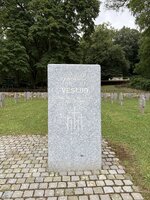
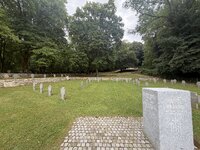
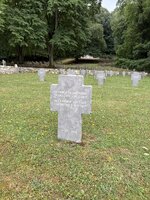
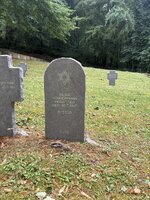
Close by the canal, there is a small military cemetery, some of the graves being in the form of a small coffin:

IMG_9654.jpegIMG_9655.jpegIMG_9656.jpegIMG_9657.jpegIMG_9658.jpeg

IMG_9661.jpeg

IMG_9659.jpegIMG_9660.jpeg

Again, the dates of death are largely concentrated around the months of March and April 1945.

To be continued….
 
Last edited:


Back
Top Bottom