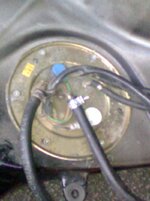
Pastic Fuel Tank - Earthed?

oilcan

Registered user
Joined
Mar 27, 2009
Messages
105
Reaction score
0
Location
evesham. england
I read a post here once recently that said when removing the plastic tank from an 1100, before finally lifting the tank clear once the fuel lines, breathers and connector block has been disconnected, reach up and disconnect the earth wire to the sender base plate.

I took my tank off over the weekend and after much feeling under that tank for said wire, realised it didn't have one! Once I got the tank off and emptied I could turn it over and take a closer look to see if there was an earth wire but just wasn't connected but there was nothing, and no sign that one has ever been fitted.

Is this the norm? Is it dangerous to ride without an earth wire? If yes why when my bike has been managing fine without?
 
Well, if your bike's dangerous, so's mine! No sign of any earth wire - '96 plastic tank.
 
DISCLAIMER:

I'm not an electrical engineer.

But how on earth (sorry) do you ground a plastic tank?

Or is it just the gubbins (pump etc) inside it?
 
The only reason I can think of for earthing a plastic tank is because of static electricity that can be caused when plastic and another object are rubbed together.

Think back to your 'O' Level physics days - god that is a long time ago:eek
 
Earfs

It needs an "earth" as this forms part of the circuit, nothing to do with safety
must nt confuse bike / car electrics with electrical installations in buildings,
entirely different.
dave GS
 
It needs an "earth" as this forms part of the circuit, nothing to do with safety
must nt confuse bike / car electrics with electrical installations in buildings,
entirely different.
dave GS

If you read first post - 'it did not have an earth fitted' - so the electrical circuit was completed using normal wiring techniques
 
My plastic tanked '94 1100 has an earth.
This is a single brown wire with a connector near the big multi pin block which feeds the fuel pump / level sender etc. It is connected to the metal access plate which holds the tank internals, attaching via one of the access plate fixing screws - I knew I had a pic somewhere - you can see it on here:

<a href="https://picasaweb.google.com/lh/photo/yGPgIFQUDKs3N32oE4YNzUOOAeJkWHiivqDz0FeWdvU?feat=embedwebsite"><img src="https://lh6.googleusercontent.com/_SSn2CtCOKnU/TYCKe3GGsJI/AAAAAAAAE3A/BIcil_S1Jos/s800/IMG_3422.jpg" height="562" width="800" /></a>

I'm not sure why it needs this extra earth as the multi connector has its own earth in the block (also visible in the picture above). It's also a heavy gauge cable (much thicker than required for the in-tank equipment loads). My guess is that it could be some sort of 'belt and braces' anti-static earthing for the plastic tank for refuelling safety (remember plastic tanks were still not that common on road bikes in the mid 90's - BMW might have been a bit paranoid).

It's also not shown on the wiring schematic.

I'd say if your bike works fine without it, then don't bother about it. If you really want to add one it couldn't do any harm - just a piece of cable, a connector and a spade eye (run it to a good frame earth).
 
Sensible and thoughtful response,as ever, Matt.

Before the jet-refuelers get to work, they always hook up the earth cable.
As you say, in this instance, fitted as an insurance
 
And you couldn't get them by saving up Kellogg's Cornflake packets.:D

Re the earth question, only the earlier bikes had them. Neither my 96 1100RS (plastic tank), nor my 2000 850GS (metal tank) has ever had an earth connection. The only difference is the method of fixing the plate to the tank - one has nyloc nuts, the other has allen bolts.
 
If you read first post - 'it did not have an earth fitted' - so the electrical circuit was completed using normal wiring techniques

I did read the post and if you do likewise you will see that he was worried about the danger of having no earth, obviously confusing it with a mains electrical appliance I just put his mind at rest.
dave GS
Approved electrical contractor.
 
Having seen Matts tank, I've just taken a picture of mine and as you can see, no earth. The bikes a 95 German Import (if that makes any difference) and as far as I'm aware this is the original tank.

I see also I have the Allen bolts, any tips or advice when undoing them? Are they more/less prone to problems?
 

Attachments

  • Image0257.jpg
    Image0257.jpg
    110 KB · Views: 81
I see also I have the Allen bolts, any tips or advice when undoing them? Are they more/less prone to problems?

Well you can't snap the stud off the tank (happens occasionally on steel tanks which have studs rather than the screws used on plastics) ;)

Just don't force anything and go easy when refitting the screws - make sure the threads are clean and nothing binds.

You'll need to either by a new o-ring or wait for the old one to shrink (leave it on a radiator for a couple of hours) - they swell and a lot of people have trouble immediately refitting them (although with some manipulation and WD40 you can often get them to go back ok).
 
Well you can't snap the stud off the tank (happens occasionally on steel tanks which have studs rather than the screws used on plastics) ;)

Just don't force anything and go easy when refitting the screws - make sure the threads are clean and nothing binds.

You'll need to either by a new o-ring or wait for the old one to shrink (leave it on a radiator for a couple of hours) - they swell and a lot of people have trouble immediately refitting them (although with some manipulation and WD40 you can often get them to go back ok).

I've got a new "O" ring on order (2 actually in case I bugger the first one up!) There's confidence for you!

So, is there a torque setting for these allen keyed bolts or is it a case of doing them up as tight as you dare?
 
I've got a new "O" ring on order (2 actually in case I bugger the first one up!) There's confidence for you!

So, is there a torque setting for these allen keyed bolts or is it a case of doing them up as tight as you dare?

According to the book, the torque is 6Nm but even though my 1/4" wrench will (just) go that low, I don't trust a torque wrench at such small numbers - a dirty thread or slightly damaged fastener could affect the torque to the point of snapping something or stripping the internal threaded bosses in the tank. Depends how good your 'feel' is really.

So the answer is to do them up as un-tight as you dare - the o-ring needs hardly any force to make it seal - you can feel as the o-ring compresses and the plate makes contact with the tank. I did them by feel, gently easing them tight working across the plate cylinder head style - they really only need finger-tip pressure on an allen key.

Edit: - oh yes - mark the plate and tank with a marker or pen something, so you get the plate back in the right orientation ;)
 
If memory serves me right the additional earth was put on as some fuel guages were giving spurious readings and this was a fix for said item.

Nice to see how fuel guages have improved over the years since this :augie:augie:augie
 
If memory serves me right the additional earth was put on as some fuel guages were giving spurious readings and this was a fix for said item.

Nice to see how fuel guages have improved over the years since this :augie:augie:augie

In that case probably more of a 'ground' to prevent signal noise problems rather than an 'earth' for safety reasons.
Not much point to an 'earth' anyway. You would need to use conductive plastic and then there's the small matter of the tyres.


Back
Top Bottom