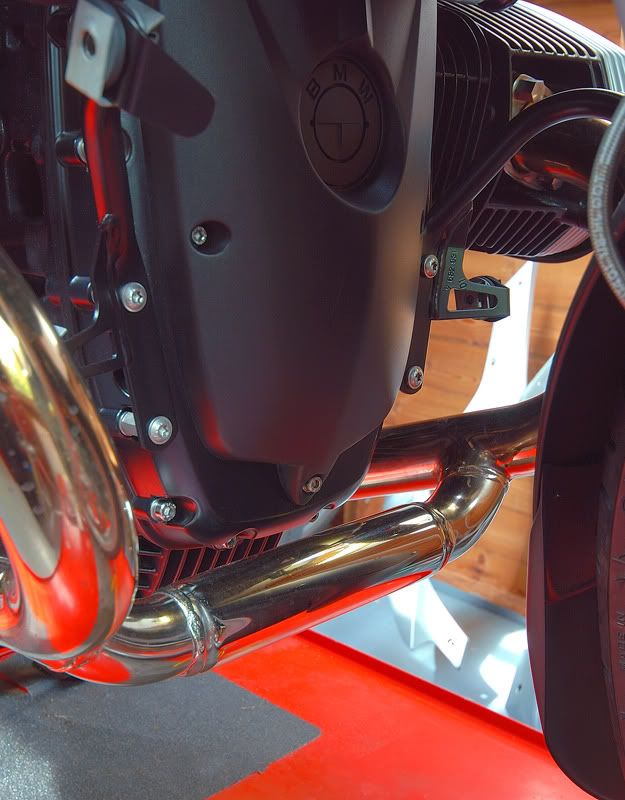
powder coating engine casings

So far on the engine cases, I've just begun to disassemble and mask off the bearing carrying surfaces and machined surfaces for media blasting...
IMG_2026.jpg

IMG_2027.jpg

IMG_2029.jpg


The engine will be soaked overnight in a parts cleaner bath prior to blasting to remove most of the old chain lube, grease and crud.

I'll try to post some pics of the masked off engine cases prior to blasting after I get it done later today.
 
Once again you are leaping to conclusions and making guesses.

You don't know what use my bikes get, nor do you know what experience I have of powder-coat applied by specialists.

Stick to what you do know about your experiences and give up speculating.

well why dont you tell us your experiences?:blast,
doesnt seem a lot if you think thats typical of coating in your other thread..
back up your claims, tell us what this bikes done in however many years, over what roads and what weather,
all im requiring is proof , ie maybe a bike thats done 2 or 3 years in the winter or maybe 10,000 miles in all weather without the paint being touched,
(like my coated kawasaki)
 
well why dont you tell us your experiences?

Fair question, come on Mike, why so coy?
I tend to agree with others re; durability of Hammerite. If there is something I am doing wrong it would be useful to know, surely thats what these forums are about?
 
Here are some before and after pics, of painted finishes (Simoniz Tough Black) the 1200RT done 3 years 2 winters (That includes winter rallies like Rhino & Hippo with salt laden roads, plus continental touring, there is 10,000 miles between those photos.


front-cover-finnished-1.jpg


frontcover_zps88a68107.jpg


This R1100RT was a state under the fairing, I don't have detailed close ups like the R1200RT but the story is similar and the condition currently is holding up well with no degradation of the finish.


R1100RTbefor.jpg


R1100rtafter-1.jpg


Save repeating it all the full story including materials ect can be found here;


http://www.ukgser.com/forums/showthread.php?t=136102


Cheers, Mark
 
Fair question, come on Mike, why so coy?
I tend to agree with others re; durability of Hammerite. If there is something I am doing wrong it would be useful to know, surely thats what these forums are about?
Why is it a fair question? I have simply stated my preference for paint on an engine and why I don't rate powder-coat for that job.

Elsewhere, I've said what it is about powder-coat generally that I don't like. I've also shown in some detail what I do when I apply paint.

By contrast all I've seen here is some people who prefer powder-coat basically calling me a liar all the while offering nothing but their word for how good their particular experience of powder-coat is. Now on top of that you and D6 want me to start listing my experience of powder-coat. No doubt if I did it wouldn't be believed or it would be owing to it being done by a cowboy or something. Or, like the suggestion that the 1150 Paralever-arm isn't even powder-coated but painted (it is powder-coat when new).

So no. I don't feel like listing all the problems I've experienced with powder-coat in detail, I've said why I prefer paint.

I don't rule out using powder-coating for some applications in the future, I just don't rate it as highly as paint.
 
At the risk of starting another argument :hide. My cylinder barrels and front engine plate would welcome a spruce up so i have been reading this thread with interest.

One question i have about the Hammerite route is does it hold its colour even with the heat in such hot locations? Does it yellow after time? Anyone got experience of this?

My choice would be powder coating every time, but that is a flippin nusance for someone who uses their bike daily through all weathers. I'd need 2 bikes and i would NEVER get away with that back at home :D. So the Hammerite or other spray alternatives are of interest, for some locations on the bike.

Cheers
 
Why is it a fair question?


By contrast all I've seen here is some people who prefer powder-coat basically calling me a liar all the while offering nothing but their word for how good their particular experience of powder-coat is. Now on top of that you and D6 want me to start listing my experience of powder-coat. No doubt if I did it wouldn't be believed or it would be owing to it being done by a cowboy or something. Or, like the suggestion that the 1150 Paralever-arm isn't even powder-coated but painted (it is powder-coat when new).

So no. I don't feel like listing all the problems .

sorry that you dont FEEL like listing anything,:comfort
easyriders posted some pics anyway, thankyou,(id still like to see a front engine plate after 10,000 thats more exposed ie a mudguard without a flap, hammerited)
tough blacks a good paint, i find that to be more resilliant than most paints.
and it doesnt seem to keep water under it, sticks better, but perhaps thats why hammerites been re formulated recently?

my suggestion the front para isnt coated (and your experience of coating ?)is down to the way you describe how it cracks,peels and flakes, i didnt say it WASNT coated , i said it certainly isnt coated CORRECTLY ,
or by the right product,and thats a fact,i DID actually thought it was paint, it was that thin..but you learned me something,BMW couldnt coat, i get why people moan they rust too much now...
this place is a forum, its a great place for asking questions, and comparing experiences,products etc, so when some one posts 2 pics of a paint product,
why not ask how long its been on/how its been treated etc, ??????
and if someone shows me a great/better product, ill be the 1st to use it as i dont like having to paint n polish, i prefer riding,,
anyway, dont matter, you dont feel like it,,,,,
oh, and NO ONE called you a liar, anywhere,:thumb
 
sorry that you dont FEEL like listing anything,:comfort
As I said, you'd just come out with stuff like this:
D6 said:
easyriders posted some pics anyway, thankyou,(id still like to see a front engine plate after 10,000 thats more exposed ie a mudguard without a flap, hammerited)
tough blacks a good paint, i find that to be more resilliant than most paints.
and it doesnt seem to keep water under it, sticks better, but perhaps thats why hammerites been re formulated recently?
Where Easyrider's examples are not enough either - you now want examples that have been painted and have covered 10,000 miles without any additional protection. You will just keep moving the goalposts (without providing a scrap of similar proof yourself, apart from your word of course). :rolleyes:

D6 said:
this place is a forum, its a great place for asking questions, and comparing experiences,products etc, so when some one posts 2 pics of a paint product,
why not ask how long its been on/how its been treated etc, ??????
I can't speak for others but I posted more than two photos and each was accompanied by how long ago the job was done. Now what exactly constitutes "normal use" will vary and I'm not really interested in trading distances covered and in what conditions.

D6 said:
oh, and NO ONE called you a liar, anywhere,:thumb
That's the implication of this:

D6 said:
it shows a bike that was painted a while ago, then barely used, not a good example really, is it?

Funny isn't it? You want me to detail the use of my old 1150 after I painted the parts and yet all we get from you is "I've done 10,000 miles on my coated Kawasaki :blagblah " We are expected to take that at face value and I do but somehow you think that everyone else is fibbing unless they prove otherwise.

Here, I'll spell it out again why I don't rate powder-coat for most applications:

Powder-coat is a heavier pigment than enamel paint which is in turn heavier than acrylic and water based paints.

Powder-coat bonds to the surface by an electrostatic means and then the thermoset polymer has to be baked to alter its properties. In effect, powder-coat works by sealing the item to be coated in an unbroken polymer and to be most effective, it needs to be completely sealed.

In the simplest analogy; it's like a vacuum pack. Damage to the coating can weaken it to a much greater extent than is apparent (just look at the wishbone on Easyrider's 1100RT as an example):

R1100RTbefor.jpg


The reason why it has peeled and flaked off in great scabs is that the coating split and allowed moisture under it. The resulting oxidisation works away beneath the still intact areas of the coating and steadily lifts it away because it doesn't actually bond to the metal as much as it bonds to itself. That's why it's called powder-coat not powder-paint. It has very different properties to paint.

It is more chip resistant than paints. A painted surface will chip whereas the powder-coat will fracture. The fractures are too small to see at first but they are enough for moisture to penetrate and begin the oxidisation process beneath the coating. You cannot do local repairs to powder-coat, the whole part needs re-coating.

Paint on the other hand is more likely to chip and reveal the damage quickly allowing repair before the corrosion gets too bad (unless the owner believes that riding is more important than repair. That's a matter of personal choice).

Powder-coat is most at risk of splitting on sharp edges but at least that's more likely to reveal itself than when it fractures in the middle of a larger flatter surface (like the timing chain cover of a Boxer engine).

Then there's the process itself. Few people have access to their own powder-coating facilities. That leaves you in the hands of others. Many are very good. They will remove all the old coating (whatever it may be), they will make certain that any corrosion has been removed, they may mask areas that need to be free of coating but few people can be certain and it's often quite a while before they find out one way or the other.

Now let's deal with one of powder-coating's greatest weakness for bikes: The need to remove the coating on bearing or mating surfaces.

As one of the properties of powder-coat is that the thermosetting process changes the dry powder to make it bond to itself in order to provide a complete coating this means that machining surfaces clear of the coating and even masking leaves an edge where it is compromised. It may take a year or so but at those edges it will allow moisture beneath the coating. It will begin to corrode under the coating. It's just a matter of time.

For all the above reasons, I prefer paint and now that I've set-out in more detail why I prefer paint, perhaps you'll add reasons why your preference is powder-coat and we can just leave people to make their own choices taking or leaving our opinions as they choose.:nenau
 
wow you,v got the handbag out havnt you?your still ignoring the fact iv said what your calling coated and what i call coating is different
your still going back to bmw coating, which is crap , its like the old schoolground
swing type coating, its brittle and unbonded....
modern stuff is flexible and every bit bonded to the metal, if not more than paint,
it doesnt allow moisture in at the edges etc, its why they use it on some deep sea stuff,
didnt ask about normal use, i asked about the history of the vehicle,
easyriders pics were very good, BUT,not hammerite, i believe we was discussing hammerite not tough black?

what i suggest to people is that they talk to a good plastic coater,
before they decide, dont base it on your pictures of that badly applied rubbish
and if anyones near me bob in and look at my many years ago PROPERLY coated springs,frames etc, and make there own mind up based not on your limited knowledge of
bad coating processes,
and you still havnt told us what mileage your bike done on the paint, i can prove mine with reciepts and past mot,s would that be enough, or have i made false ones up ???


consult the professionals


, dont listen to us lot on here, thats the best answer,
thats the last ill say on the subject, so you can wind your neck back in now,
and go polish your bike:beerjug:
oh,
and i still didnt call you a liar, if i wanted to do that, trust me, i would;)


Back
Top Bottom