Good thread.
I'm just in the process of rebuilding the wheels of my ST.
Getting the wheels to pieces:
STOP - Take photographs, sketch out the spoke pattern. In my case looking n/s on, R,L,R,L in blocks of 4. Spoke lengths measured and equal length on both sides of the hub. Front and rear followed the same pattern.
Used bolt cutters to cut odd spokes in order to reduce 'stress' in the rim.
The nipples were corroded into the holes in the hubs, the worst being the rear. Had to use a drift to 'punch' them out.
So in answer to the OP question about replacing 1 at a time - I think that would be quite difficult. Also, you would still need to check the wheel for run out.
Had the hubs vapour blasted. Each hole in the hub and rim was 'cleaned out' using a drill of the correct diameter of the spoke/nipple. Even after blasting, this process removed 'burrs' and corrosion still remaining down the hole. MB for stainless spokes. Used 500 g wet and dry wet followed by 1200 g followed by solvol on the rims. Good result after a lot of effort.
I had already made my mind up to do the whole rebuilding job myself having used CWC in the past for Brit bike wheels.
I've built many bicycle wheels in the past, and felt comfortable to tackle the BMW wheels.
The lacing up was easy following the sketch and photographs. Copper slip on the spoke threads and under the nipple head. Once the spokes were hand tightened, I then used a cordless drill/driver set to mid range on the torque settings - whatever that equates to in lb/f (or Nm). The nipples were all about equal on the threads with about 4 - 5 threads showing. (Looking at the photographs, this was the approximate general position of the nipples from the original build).
An e-bay purchase was made - wheel balancer, which I have 'modified' to a truing jig by using magnetic DTI (clock) stand. Using 2 with rods as markers (with tubing over the ends to prevent scratching of the polished rims), I have been able to adjust for roundness/ovality and side to side run out.
Each spoke was tapped with the spoke key and all appeared to have the same 'ring'.
Difficult to tell really - An engineer I am, but a musician I am not!
So, the results
Starting from the rim that had run out of 1/4":
Roundness - 0.020" (0.5mm).
Run out - 0.035" (0.9mm).
Anybody care to comment on the results - Should I be achieving better figures, or will the tyre 'absorb' this and give a greater ovality and run out if measured on the outer circumference of the tyre?
Shows the magnetic base holding the rod, with rubber tube on the end for comparing roundness.



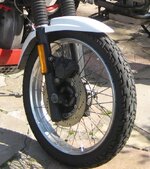


 so if you go that route do it now or your summer riding could be a late starter.......
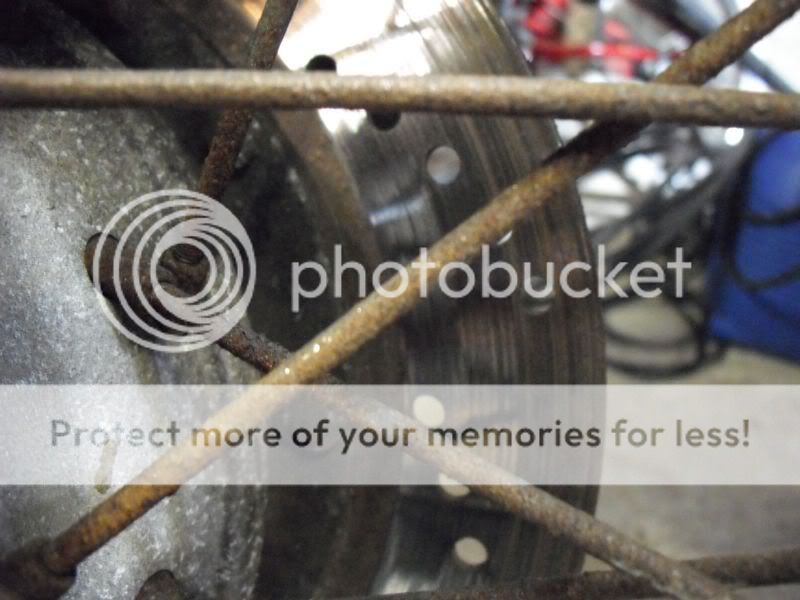

 Your best bet is to loosen (assuming none are seized) all the spokes right back to about two threads first. This will make it much easier to change them over. Be careful not to bend any though, you'll never get them straight again.



