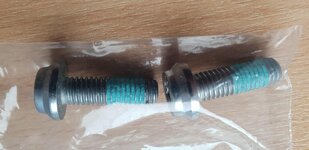
Rear Caliper Bolts micro-encapsulated - Thread Lock

Status
Not open for further replies.

Warlord

Not Ranked 3rd Most Ignored Member
UKGSer Subscriber
Joined
Mar 24, 2017
Messages
29,825
Reaction score
5,762
Location
Walsall, West Midlands
Hi all,

I've read on here that new rear caliper bolts on a R1200GS are micro-encapsulated with Thread Locker.

But the question is, are they micro-encapsulated with an ACTIVATOR (to speed up the cure speed) or with actual THREAD LOCK.

It's important to know which, obviously.
 
When I last bought micro-encapsulated brake disc screws, I asked a mechanic (technician?!) at Rainbow why they were supplied like that. His answer was that they have ready-applied threadlock on them to save time on the assembly line and to ensure that each screw had exactly the right amount of compound applied, which makes sense. Most folk put way too much on when diy-ing. So you don't have to apply anything else to what's already on the fastener - if that's what you're asking! :confused:

Pete
 
It sounds a very clear answer, but...

Threadlock has a life span. To be used within a certain date, usually within 1 year of manufacture.

It takes up to 24 hours to cure properly. So application to critical bolts (caliper bolts, temperature sensitive) should ideally be left alone for some time.

In time critical environments, like a dealership, they can spray the bolt with Threadlock Activator (which then has to be allowed to dry) to speed up the cure process once threadlock is applied.

Hence my question. Do the bolts have threadlock applied, or just the Activator... then ready for threadlock application and to speed up the curing process (which would be ideal for a dealership).

It seems odd to me that a bolt with threadlock applied, does not have a 'expiry date' as would a bottle of threadlock. Nor any temperature storage requirements like a bottle of threadlock.

However, I could understand this if only Activator has been applied....

Do you see where I'm going with this?
 
The fucking shite that you find to worry about.

Shouldn't you be checking your tyre pressures for a 2psi variance ?
 
The fucking shite that you find to worry about.

Shouldn't you be checking your tyre pressures for a 2psi variance ?

I'm not going to respond to you in my usual manner.

PUT ME ON YOUR IGNORE LIST
 
Stop worrying ; just mark the bolts with anti tamper paint and visually check them as part of your pre ride ‘power’ check . These bolts were historically not thread locked and there’s no evidence that there’s a caliper issue . (I’m in the loose spoke camp for suspicion )
 
Stop worrying ; just mark the bolts with anti tamper paint and visually check them as part of your pre ride ‘power’ check . These bolts were historically not thread locked and there’s no evidence that there’s a caliper issue . (I’m in the loose spoke camp for suspicion )

Agree 100% exactly what I done to mine, and I have alloys, so no worry about spokes, but it is a really good idea, I got this below, great stuff thanks to a member here pointing me towards this paint.

https://www.ebay.co.uk/itm/Dykem-Cr...hash=item463dffab78:m:m70W86aNFAMp_HMhnfEUWEg
 
It sounds a very clear answer, but...

Threadlock has a life span. To be used within a certain date, usually within 1 year of manufacture.

It takes up to 24 hours to cure properly. So application to critical bolts (caliper bolts, temperature sensitive) should ideally be left alone for some time.

In time critical environments, like a dealership, they can spray the bolt with Threadlock Activator (which then has to be allowed to dry) to speed up the cure process once threadlock is applied.

Hence my question. Do the bolts have threadlock applied, or just the Activator... then ready for threadlock application and to speed up the curing process (which would be ideal for a dealership).

It seems odd to me that a bolt with threadlock applied, does not have a 'expiry date' as would a bottle of threadlock. Nor any temperature storage requirements like a bottle of threadlock.

However, I could understand this if only Activator has been applied....

Do you see where I'm going with this?

No.

Do you think BMW might, just might, have specified a compound that does the job properly. Just a thought. :rolleyes:

Pete
 
I bought a couple for my RS as I removed a rear hugger that had longer bolts and no factory OEM bolts were present. As I understand it they are micro-encapsulated with thread lock - which I take to mean thread lock applied plus a sealant on top that breaks when you use it for the first time. This may explain no shelf life and also why they’re single use (the threadlock will come off inside the screw hole as you remove and would need to be re-applied). Mine has never moved since fitting - and I’ve checked it by marking them up once fitted.
 
No.

Do you think BMW might, just might, have specified a compound that does the job properly. Just a thought. :rolleyes:

Pete

What like fork stanchions, wheel spokes, paint application, switchgear, engine cam timing, heated grips, and on.... and on....
 
Anyways, I've bought some new bolts today from BMW Dealer.

They do have threadlock applied, looks like the high temperature permanent fix stuff.

So question answered... this thread is now locked :thumb2
 

Attachments

  • Bolts.jpg
    Bolts.jpg
    180.7 KB · Views: 377
Status
Not open for further replies.


Back
Top Bottom