Remote aerial for Kenwood TK-3310?

Bobbin-Man

Well-known member
UKGSer Subscriber
Joined
Nov 2, 2011
Messages
1,645
Reaction score
30
Location
Chester
I've seen various threads and a good write-up on Bikers Oracle regarding butchering a TK-3210 in order to fit an external aerial, but has anyone managed to fit one to the later TK-3310? My radio is currently positioned horizontally in the tool tray (R1200GS) which obviously isn't ideal, but the install is tidily wired, powered from an Autocom SPA and works well ... just lacking in range. I have no intention to increase the radio power above the standard regulated 0.5w but would like to get the aerial vertical and positioned better. Am I correct in thinking that and aerial swap in itself doesn't increase the power (I'm not particularly radio techie!)?
I try to avoid riding with a top box if I don't need it so relocating the complete radio to the back is not really an option, I have considered fitting it in the tank bag but vertical orientation may still be a challenge ... and the current install is almost fit and forget which I prefer!

Stu.
 
The earlier TK3201 had, inside the case, the metal chassis has holes to mount the antenna base off a VHF model which takes a removable antenna with a SMA connctor. This base was/is available as a spare part. A mate of mine converted his, thread here.

Quite likely yours is similar, sharing parts with a VHF commercial radio. You need to find someone who can supply the parts, they should be able to advise you further. I can ask my mate who he used if you like.
 
Bumpkin, if you can get the supplier details it would be a big help :thumb2 I'll open up the radio and check if it has the same metal chassis as the earlier model, I suspect it will.

If it is similar and I can fit a socket, what specification do I need to look for to get both an antenna and a replacement aerial for use as a hand-held? I'm seeing all sorts of information such as UHF/VHF/Dual band/SMA ... it's all foreign to me! I assume that the aerial swap will not affect the ability for the PMR to be Autocom powered?
 
I'm in!

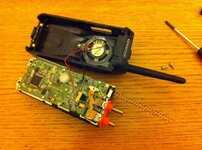
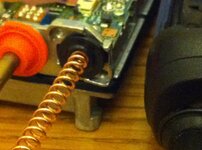
The TK-3301 looks very similar inside to the internals if the TK-3210 and importantly has the locating holes for a socket already in the chassis :thumb2 Just need the relevant parts to make the modification. Apologies for the lousy iPhone pictures!
 

Attachments

  • Kenwood PMR 1.jpg
    Kenwood PMR 1.jpg
    73.3 KB · Views: 1,500
  • Kenwood PMR 2.jpg
    Kenwood PMR 2.jpg
    61.5 KB · Views: 1,406
Bumpkin, if you can get the supplier details it would be a big help :thumb2 I'll open up the radio and check if it has the same metal chassis as the earlier model, I suspect it will.

Have sent him a text, will let you know.

Bobbin-Man said:
If it is similar and I can fit a socket, what specification do I need to look for to get both an antenna and a replacement aerial for use as a hand-held? I'm seeing all sorts of information such as UHF/VHF/Dual band/SMA ... it's all foreign to me! I assume that the aerial swap will not affect the ability for the PMR to be Autocom powered?

I've just looked it up and the TK-3310 is a CB band radio but, it appears, for the Australian market, not PMR446. It's possible that you're talking about the TK3301 which is a PMR model and supersedes the ever popular TK3201. Your mention of 0.5W power output suggests that yours is a TK3301.

So for the time being I'm going to assume that you did mean the TK3301...

The Bikers Oracle kit will work fine, it's a PMR tuned, i.e. it's the correct length for the frequency (445MHz + 20MHz range). I have one and get decent real world range of 2-5km, obviously depending on terrain between my and a similarly equipped bike. Admittedly this is using Puxing PX888 radios at 4 watts, though the higher power doesn't increase the range by anywhere are much as you might think. The inverse square law dictates that, theoretically, you'll need four times the power to double the range and even then in the real world there are other factors that reduce this further still.

The Autocom will still power the radio OK. It's the higher output radios, i.e. the 4 and 5 watt business radios, that draw too much current for the Autocom to cope with, or so they say. The BO antenna won't make the 0.5 watt radio you have draw any more that it was before. The advantage it will give is making the antenna vertical, removing it from under the seat and putting it in a better position, you should be impressed with the improvement. I've now done away with the BO number plate mounting plate and have the antenna higher up near the grab rail of my VFR. Someone I was touring with last year had a set-up like this and it worked well. The BO number plate mount works fine but I thought I'd try for just a little more... I also melted an antenna in the hot exhaust gasses with the BO plate...

If you can convert the radio as suggested then you will probably wind up with a male SMA connector. You will need to buy an SMA to BNC converter to use the BO antenna (they sell one, it's an option in the kit). For a hand-held antenna you will need a PMR tuned UHF (400-470 MHz) antenna with a SMA-F (female) connector (assuming that your conversion leaves the radio with an correspond SMA-M, i.e. male, connector). There are plenty on eBay, go for the regular length, rather than the stubby ones, IMHO.

If you're riding with others with radios and standard antennas horizontal under their seats you're not going to improve the comms situation much, they should be able to hear you a bit better but you wont hear them any further away than you already do. The real gains are when both parties have the BO kit installed.

VHF = Very High Frequency
UHF = Ultra High Frequency (where the PMR bands are)
Dual Band = Equipment that will cover both of the above frequency ranges (there are radios as well as antennas). The TK3301 is UHF, not dual band.
SMA and BNC = These are antenna connectors; SMA screws together, BNC has a bayonet type fastening.

HTH

 
Fantastic information :thumb2

I continued reading the thread you linked to and later on Muttley gives details of a supplier and part numbers needed to do the conversion - when I get the bits I need I'll post the details here.
I might give the BO kit a miss and look for a suitable antenna that can be positioned a little higher at the rear of the GS without using such a long antenna, the added advantage being that it might be available with a fitted female SMA connector. Antennas seem to be quite inexpensive so it might be that I try a couple, maybe one installed on/in the top box for when it's fitted would be useful.

Yes you are correct, my radio is the TK-3301 not the TK-3310:blast I've edited it in my previous post but I've been unable to edit the title of the thread! If a moderator can edit the title it might prove helpful in any future searches?

Stu.
 
Dual Band = Equipment that will cover both of the above frequency ranges (there are radios as well as antennas).
I read the duel band (inc 400-470 MHz) Puxings fail badly to reach the upper range of the PMR frequencies, and have been getting bad reviews.
But I understand there`s a newer (400-480 MHz) range model on the market
I might give the BO kit a miss and look for a suitable antenna that can be positioned a little higher at the rear of the GS without using such a long antenna
The BO antenna is 365mm long. with another 15mm of connector to cable
 
Glad you found the details yourself Stu. He did reply to my text last night but you now have them anyway.

Re. Using other antennas; ensure the one you use is Group Plane Independent (GPI) otherwise you'll need a large flat metal area which is hard to find on a bike. I do believe that the rubber antennas that come with the radios are GPI, can't see it any other way, even with the alloy chassis. An SMA-F to SMA-M extension would do the trick, ensure that it's fit for purpose though, most of these on eBay are for WiFi antennas and probably not up to the task. All you would need at the other end is a bracket of some sort to hold the antenna. I think a company called Interide did a full kit like this, might be worth a search for a one stop solution.

When people say that it's illegal (i.e. against OFCOM regs to use an external antenna) they aren't correct. There's an official OFCOM document out there (on phone ATM so difficult to link to) that states that it's OK to adapt a radio to take an external antenna so long as the ERP (Effective Radiated Power ISTR) does no exceed 0.5 watts. The BO antenna has a high gain which, I'm lead to believe, in itself might exceed this with a 0.5 watt radio.

Leave it where it is and increase the power.

Regrettably this is incorrect. Whip antennas radiate their power in an approximate doughnut shape. Not with a hole in the middle but certainly dimples... So with a radio on it's side under the seat and inline with the axis of the bike, you might get reasonable Tx to each side, fore and aft it would be poor. Similarly, across the axis fore and aft would be reasonable, side to side poor. Added to which you have lots of gubbins in the way and are iradiating you testies, prostate etc...

Having the antenna vertical and away from objects that can interfere with the signal will give appreciable improvement in consistent range and usability.

Sent from my GT-I9505 using Tapatalk
 
I read the duel band (inc 400-470 MHz) Puxings fail badly to reach the upper range of the PMR frequencies, and have been getting bad reviews.
But I understand there`s a newer (400-480 MHz) range model on the market

Dual band radios cover VHF and UHF, 400-470/480 MHz is UHF. I believe that the Puxing PX777 and early PX888 are 400-470 MHz, the majority of PX888s are 400-480 MHz. I have three 888s of varying ages, all are 400-480 MHz.

I'm sceptical, without any hard evidence though, that dual band equipment is going to be a compromise against either a dedicated VHF or UHF radio.

I haven't heard that the earlier models of Puxing with 400-470 MHz frequency range are any worse than the later ones over the PMR frequencies. Do you have a link. I have ridden with others who have PX777s and didn't experience any issues. Not that we were looking for them mind you.

Sent from my GT-I9505 using Tapatalk
 
I don`t have any specific link, however while looking for new equipment I did consider the older 400-470 MHz duel band Puxings, as I`d recently picked up a VHF Puxing which was sold to me as duel band, but turned out I was sold a pup.
I finally decided to discount the idea of buying duel band Puxing radios because as you say "dual band equipment is going to be a compromise against either a dedicated VHF or UHF radio". With 1 reviewer saying that towards the higher end, they don`t seem to perform as well, and there can be some issue with them locking into the lower spectrum
 
I did consider the older 400-470 MHz duel band Puxings

I'm a bit confused. the 400-470 MHz Puxings are the older UHF only radios. The dual band ones, the PX888K being an example, are a fairly recent addition the the range. These are switchable between VHF (136-174 MHz) and UHF (400-480 MHz) and are thus dual band.

I'm not sure why Puxing changed the upper end of the frequency range of their UHF radios from 470 to 480 MHz. Maybe it's a part of the spectrum that they decided was needed to be included? The PMR range of frequencies (446.00625 MHz to 446.09375 MHz) falls very neatly near the middle of the UHF range.
 
Re. Using other antennas; ensure the one you use is Group Plane Independent (GPI) otherwise you'll need a large flat metal area which is hard to find on a bike. I do believe that the rubber antennas that come with the radios are GPI, can't see it any other way, even with the alloy chassis. An SMA-F to SMA-M extension would do the trick, ensure that it's fit for purpose though, most of these on eBay are for WiFi antennas and probably not up to the task. All you would need at the other end is a bracket of some sort to hold the antenna. I think a company called Interide did a full kit like this, might be worth a search for a one stop solution.
This might seem a bit of a compromise ... if I sourced a suitably short GPI flexi-antenna to refit to the radio to use when handheld, I guess a matching male SMA connector could be fitted high up at the rear (rack height?) and the same antenna could thereby be discretely mounted and be removable? This should have a similar performance capability to standing the radio vertically on the rear rack which would be a vast improvement over my current setup? My riding buddy has a K1200LT with his radio mounted vertically inside his top case so making big performance gains over his setup wouldn't give any benefits anyway ..... unless we modify his as well :D
 
I think a company called Interide did a full kit like this, might be worth a search for a one stop solution.

Here you go, bottom of this page, not that expensive either.

Bumpkin said:
When people say that it's illegal (i.e. against OFCOM regs to use an external antenna) they aren't correct. There's an official OFCOM document out there (on phone ATM so difficult to link to) that states that it's OK to adapt a radio to take an external antenna so long as the ERP (Effective Radiated Power ISTR) does not exceed 0.5 watts.

Here's the document I refereed to above (it's a PDF), see 'Converted radio equipment' on page 6.
 
This might seem a bit of a compromise ... if I sourced a suitably short GPI flexi-antenna to refit to the radio to use when handheld, I guess a matching male SMA connector could be fitted high up at the rear (rack height?) and the same antenna could thereby be discretely mounted and be removable? This should have a similar performance capability to standing the radio vertically on the rear rack which would be a vast improvement over my current setup? My riding buddy has a K1200LT with his radio mounted vertically inside his top case so making big performance gains over his setup wouldn't give any benefits anyway ..... unless we modify his as well :D

Apart from losses in the coax cabling you would be correct. I reckon, if your riding buddy's set-up is inside a plastic top case then, yours would be comparable. He might see an improvement by mounting the antenna on the lid, both outside the case (marginal improvement) and higher up. Doing both might see a significant gain, best to try what you propose first and take it from there. He might want discretion which having it all inside the case achieves.

The issue with having a SMA-F (radio end) to SMA-M antenna end is that I have yet to see a panel mount SMA-M connector as part of a lead, the connectors do exist but aren't that common. It's a case of finding someone to make up a lead for you, making one yourself or going with adapters as in the Interide set-up I've linked to above.
 
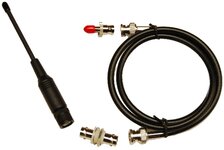
Okay, getting a plan together. Is this the kit you're referring to? This appears to be a BNC female base to the antenna therefore I assume an alternative antenna would be needed to use as a handheld?
 

Attachments

  • Antenna%20kit%20K.JPG
    Antenna%20kit%20K.JPG
    83.9 KB · Views: 425
... this one?
 

Attachments

  • 803%20antenna.JPG
    803%20antenna.JPG
    42.7 KB · Views: 423
Okay, getting a plan together. Is this the kit you're referring to? This appears to be a BNC female base to the antenna therefore I assume an alternative antenna would be needed to use as a handheld?

That's unless there's a part for the Kenwood that has a BNC connector rather than SMA.

The alternative might be to get a cable made up with the ends that suit you. Not sure where though.


Back
Top Bottom