Removing a Meta alarm, R1150RT

KMD

Well-known member
UKGSer Subscriber
Joined
Jan 7, 2007
Messages
5,647
Reaction score
5,669
Location
North Yorkshire
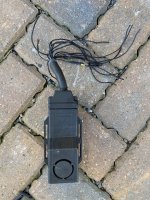
There is a Meta alarm fitted to my R1150RT which while still functioning, is probably now of an age where it will fail just when I’m least prepared to deal with it. The alarm is a M357T, I think V2 and I intend to remove it. Now there are two ways I could go about it.

1. Is to trace each wire to where it is spliced into the loom, remove them and re-connect the wires that they interrupted.
2. Is to simply remove the alarm unit, and bridge the contacts on the main connector block to reinstate the connections there.

The second option would involve the least amount of work but requires that I know beforehand which pins to bridge. My research so far has indicated that the two wires of the small connector bridge with each other, and that pins 2&4 of the main block are bridged. The problem with this method I’m guessing would be sending a live feed to the wrong place if the wrong pins are connected.

Anyone out there done this job, and able to recall which pins to bridge?

Best,
KMD.
 

talk to these guys , they can probably make you a plug to just plug-in .
i haven't used them for ages , but they were very helpful .
seems their shop is shut ATM , try this below

 
  • Like
Reactions: KMD
I had the same alarm on a 1100GS and week by week less indicators would flash when armed which it eventually wouldnt start at all. Although I bought the bike from BWM as a approved bike as it wasnt a BMW wasnt covered under warranty. So I simply traced the wires and reconnected the ones capped off which took about an hr and half and it worked perfectly. Honestly was too easy and took little time
 
  • Like
Reactions: KMD
There is a Meta alarm fitted to my R1150RT which while still functioning, is probably now of an age where it will fail just when I’m least prepared to deal with it. The alarm is a M357T, I think V2 and I intend to remove it. Now there are two ways I could go about it.

1. Is to trace each wire to where it is spliced into the loom, remove them and re-connect the wires that they interrupted.
2. Is to simply remove the alarm unit, and bridge the contacts on the main connector block to reinstate the connections there.

The second option would involve the least amount of work but requires that I know beforehand which pins to bridge. My research so far has indicated that the two wires of the small connector bridge with each other, and that pins 2&4 of the main block are bridged. The problem with this method I’m guessing would be sending a live feed to the wrong place if the wrong pins are connected.

Anyone out there done this job, and able to recall which pins to bridge?

Best,
KMD.
Option ONE every time !! If you do it at the alarm plug then you have multiple joins

It is not a hard job I used to fit these and they were very good but they are all over 20 years old now

If you need advice please ask I won't post it up in an open forum NOt that 1100s / 1150s are so sought after now
 
I did this recently on my Ed80 Rockster.

it looks scary :
53700732578_7f94000295_c.jpg


But it's actually very easy to just trace each alarm loom cable back to it's join, and fix the original loom. My only "problem" with it was that it's cold in my shed, and I'm crap with a soldering iron - but I got it all working. :) To be honest, I was a bit surprised that it was only a few wires that actually interfaced with the bike's loom. There's at least 6 wires that just lead to minor components of the alarm: the LED light, a fuse, and the security switch on the fuse-box lid (if fitted: mine was glued to the top of a relay).

53631542216_e3ef97b8f7_c.jpg


oh yeah - it's also messy and sticky:
53700517896_e9cb4bb8fd_c.jpg


but not hard.

(phnarr)
 
it used to take me about 3-4 hours to fit an alarm , nicely done, hidden away .
a vfr came in to have one removed , badly fitted , i had it off in 20 mins . whoever fitted it was a monkey .
and yes only 4 wires do the stopping bit , the rest do inds,led,earths,siren , seat switch , permanent power and a loop for helmet or panniers.
 
  • Like
Reactions: KMD
My advice? When fitting an alarm just use the - and+ wires. Most modern bikes have an immobiliser built in. Alarms are not built to as high a standard as oe electronics in my experience. Mess up something and you’re in for a big bill. I’ve seen many alarms going off with no one paying any heed. I’ve recovered broken down cars with the alarm screaming without anyone asking me what I’m doing. JJH
 
As stated above, you insert the two interruptor circuits into the ignition power supply and fuel pump power supply (on an FI bike).

The most time consuming part is tracing those four wires back from the control unit through the sub-looms to the main loom under the tank.

If the job was done correctly, there will be plenty of black insulation tape to cut away to find the two locations where the fuel and ignition feeds are spliced.

I did this on an elderly Pan 1100 a few years back, let me check what info I have.
 
Safest way as already said it to trace the wires and remove them and resolder the original loom , takes a bit time but quite straightforward

IMG_1537.jpeg
 
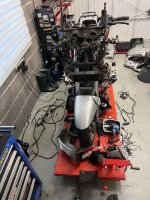
Thanks to all for your advice. I removed the alarm today after it failed to respond and disarm. The most difficult part was finding it, all fairing panels came off, tank etc, and it was secured in the nose section near the headlamp. All wires traced, original connections reinstated with soldered and sealed joints and the bike fired up first time.IMG_3436.jpeg
 
They generally just cut off the starter relay. You just need to trace back, cut out and re-join the old loom. And cut out any feeds to lighting.

I'm not a fan of soldering motorcycle looms. Soldering is for PCBS and solid sealed connectors. Most motorcycle manufactures don't allow it at for a genuine repair. The problem with soldered wiring is that it's brittle. And wiring looms often flex, vibrate and move. You often find failures at soldered joints.

The only time I would entertain a soldered is if that cable is in a long straight run. Supported by multiple strands. All all clipped up correctly.

Crimped connectors with heat-shrink wrap is what you should use on a wiring loom.


Back
Top Bottom