Something for 2026 perhaps - Seelow Heights and Battle of Halbe

Wapping

Well-known member
Moderator
Joined
Oct 21, 2005
Messages
91,012
Reaction score
15,981
Location
Wapping, London
Following on from my plan to see the Hurtgen Forest, I might well think about seeing another of the less visited sites, or rather two of them.

The Seelow Hights were the last natural obstacle, standing in the face of the Russian armies, in their drive to first encircle, then subdue and capture Berlin. It might be interesting to see the places where things happened.

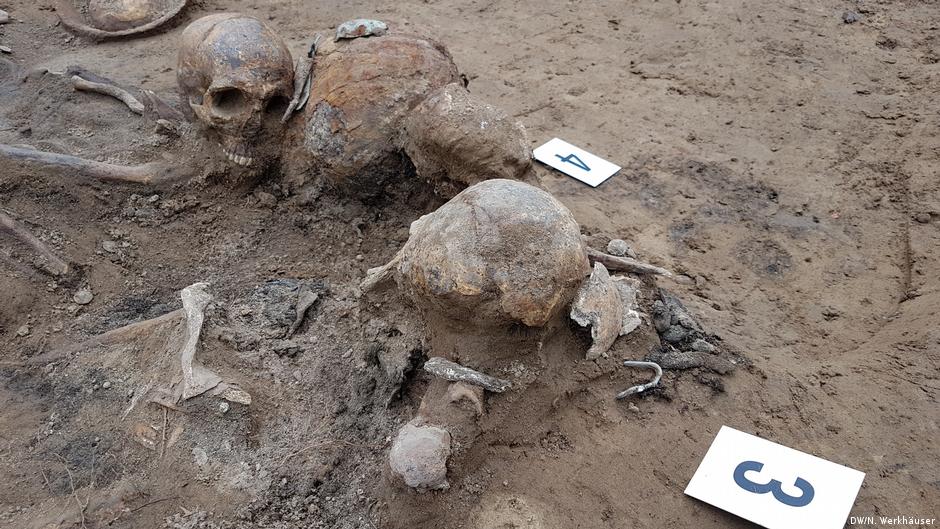
Likewise, a bit south of Berlin, is the site of arguably the last great battle of the war - outside of Berlin itself - (it was a slaughter really, for both sides) as the beleaguered Germsn 9th army attempted to disengage from the Russians and breakout westwards in the hope of surrendering to the Americans, halted at the river Elbe. The battle takes its name from the town of Halbe, the epicentre of the horrendous fighting.
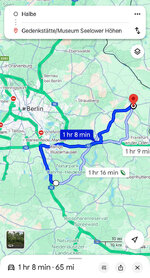
IMG_4746.jpeg
It’s a long way from London to Berlin, so maybe a fly drive is the way to do it. Or, find some things to see and do along the way.


Last edited:
I have taken a look at an alternative to a fly-drive.

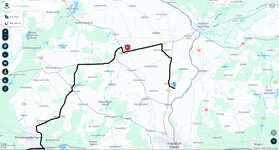
Taking predominantly D roads, it’s 890 miles from Calais to the Seelow Heights. I have roughed out a route. Whilst it’s certainly not final, I have put in the yellow overnight stops roughly every 160 miles. I can certainly ride further than 160 miles a day, but I probably don’t need to, not least as it gives me an opportunity to stop at something I might see of possible interest along the way.


The route passes pretty close to the Mittelbau-Dora museum, which’ll probably be worth an excursion for a day.

Staying in Seelaw itself, or maybe better, Frankfurt (Oder) rather than Berlin, might make sense, I guess. If I then wanted to go into Berlin for a day, it’s an hour on the train from Frankfurt (Oder) into the middle of the city.

I’d maybe also like to see the lakes and waterways to the west of Berlin, between Potsdam and roughly Brandenburg. Potsdam in itself is worth a day, to see the palaces and, of course, the place of the signing of the Potsdam Treaty. Orienenburg, is on a possible list, too.

 
Last edited:
This is an excellent programme for seeing what Berlin was like in 1945 without seemingly being biased.

I've just been to Berlin, flew there, and some of the buildings scars are still there, many not. I went up the Siegssaule, and was interested to see it in a couple of clips of the third episode:

 
A really interesting area. We only spent a couple of days just SE of Berlin but the difference between the new build and life there now compared to seeing some of the old Eastern Block era buildings is stark.
 
Thank you, both.

I’ve read several books on the fall of Berlin and several which deal with the fate of Germany in the last parts of ‘44 thro’ to say the 80’s and its rebirth as a fully rehabilitated member of Europe. German pre-war(s) history is also interesting. A complicated place, at best.
 
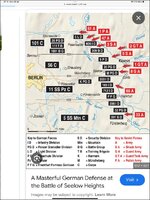
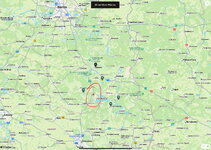
I found a good enough basic map of the battle front along the Oder river:

IMG_1142.jpg

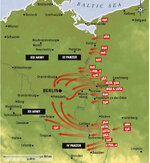
And this as a wider view of the encirclement:

IMG_1143.jpeg
 
Last edited:
The places I'd recommend "doing" Berlin would be the Topography of Terror, the Berlin Wall Memorial and a guided tour of the Bundestag, more commonly known as the Reichstag, to get a feel for the last 150 odd years of how Berlin has been at the centre of Europe's history.

 
Having a vague look at my diary, September would seem as good a time as any. A week or so get there. A week or so there and a week back…..
 
Wittenberg, home of Luther and pretty much untouched by the war, is not far away. Notable for its role in the early days of printing, too. Worth a detour, I think. It’ll work if I go to Halbe first. It’ll probably mean an extra day / night on the way out but probably worth it.
 
Last edited:

Not a bad outline piece on the Battle of Halbe:


And a reasonable amateur historian’s video:


As with most things these days, there’s enough ‘Out there’ on the internet, which (when backed by a couple of decent books) gives a pretty good base from which to create a visit.
 
I’d maybe also like to see the lakes and waterways to the west of Berlin, between Potsdam and roughly Brandenburg. Potsdam in itself is worth a day, to see the palaces and, of course, the place of the signing of the Potsdam Treaty. Orienenburg, is on a possible list, too.

Whilst up on the north west side of Berlin, I should also stop to see the point in Tangermünde, where many German civilians and retreating defeated soldiers, crossed the Elbe, seeking the sanctuary of the American lines.


The video shows the ragtag state of much of the German army, with very old and very young ‘soldiers’, thrown into face the Red Army onslaught:

 
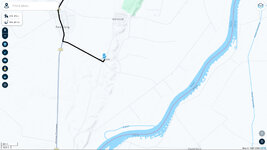
I wanted to find just one particular spot (out of many) which might be visitable and sum up at least a part of the battle for the Sellow Heights. I think I might well have found it, at Klessin, just to the western side of the river Oder. It should fit in well:

IMG_1144.jpeg

I can probably get pretty close to the river Oder and / or ride across into Poland and see where the Russian soldiers would have crossed the river to attack westwards towards Klessin, which might well be an interesting thing to do; seeing the scene from both sides, as it were:

IMG_1145.jpeg

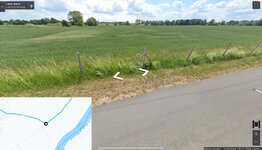
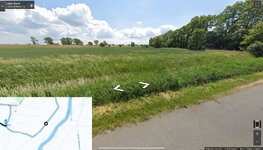
This is pretty much the view eastwards from the village of Klessin, towards the river Oder. You can well imagine what a killing ground the flat terrain towards the river would have made:

IMG_1146.jpeg


IMG_1147.jpeg


AI’s summary:

The Battle of Klessin, which took place in February and March 1945, was a fierce struggle for control of the German village of Klessin during the final stages of World War II in Europe. Located near a strategic Oder River crossing, Klessin was a key point for both sides as the Soviet forces advanced towards Berlin. German forces, including soldiers, officer cadets, and Volkssturm militia, were tasked with defending the village against a larger Soviet force. The battle resulted in heavy casualties and the near-total destruction of the village, including the castle and estate. A memorial now stands at the site, marking the location of the former knightly estate.

Here's a more detailed breakdown:
  • Strategic Importance:
    Klessin was situated near a pontoon bridge over the Oder River, making it a crucial point for Soviet forces to cross during their advance.

  • German Defense:
    German forces, including a mix of regular soldiers, officer cadets, and the Volkssturm (a home guard militia), were ordered to defend the village.

  • Soviet Assault:
    The Soviets, with a significantly larger force, launched a fierce assault on Klessin.

  • Heavy Fighting:
    The battle was characterized by intense, often close-quarters combat, with the Soviets firing a large number of artillery shells and mortar rounds.

  • Destruction:
    Klessin was heavily damaged during the fighting, with the castle and estate completely destroyed.

  • Aftermath:
    The village was never fully rebuilt, but a memorial and memorial site, "War Theatre Klessin Castle," was established in 2023 to commemorate the events of the battle.

  • Memorial Site:
    The memorial site includes exhibits about the battle, viewing platforms, and remnants of the castle and trenches.
 
Last edited:
The battle takes its name from the town of Halbe, the epicentre of the horrendous fighting.

I’m reading a small book on the battle at Halbe *. It was slaughter on a monumental scale, for both the Germans and the Russians, with many hundreds and more of civilians mixed into the bloody mire.

In short, the German Ninth Army, was tasked with moving to join another German army, with the aim of defeating (or at least delaying) the Russian armies seeking to encircle Berlin. It was a hopeless and ridiculous order. Besides being woefully out gunned and vastly understrength, it required the German army to disengage with the Russians, then about face and fight their way out of a massive encirclement. It was the very same problem, forced on the Russians in 1941 as the Germans marched headlong into Russia. The boot was now on the other foot, with devastating consequences.

The German Ninth Army was itself already surrounded and had no choice but to seek to breakout westwards, hoping to reach the Elbe river and the American lines to surrender there. The town of Halbe was already held by the Russians, but the Germans (civilians and soldiers of all arms) were obliged to pass through the town, with its long central street and small railway station. Not only was the town held by the Russians, the exit road was blocked by a barricade, built by the Germans when they had sought to slow the Russian advance days earlier. This trapped the retreating German soldiers and civilians in the town and in the surrounding boggy land, forests and open fields. They were shelled, rocketed, mortared and shot at without end.

The plan, such as it was, was for the retreating masses to form ‘a caterpillar’, lead by the heavy German tanks, to fight through the town, the caterpillar’s ‘tail’ being composed of ever slower units as it lengthened. The tank trap and heavy fighting through the town, cut off the caterpillar’s head, with inevitable consequences. As one German soldier put it: “We had to disengage, turn around, fight / retreat through a bottlenecked town, occupied by the Russians. Then, if we made it through, fight with the rear of the huge Russian encirclement and then probably have to fight the Americans, to try to cross the Elbe. But we had no choice”.

Largely unknown, the battle is overshadowed by the fall of Berlin itself. Post-war, the Russians had no interest in revealing the slaughter that took place. It was lost to history; though I can see that new interest is being taken in it and other broader tellings of the final days of the self proclaimed, Thousand Year Reich. It will be interesting to stand on the spots mentioned in the book and to visit some of the other small towns and villages mentioned in the account.


* Predominately, it is a record of verbal accounts from the very few German survivors.
 
Last edited:
Doing some digging around, I can add in a visit to Zossen. This became a major target for the Russians, as it housed the HQ (General Staff) of the entire German army.

They were housed in immense bunkers, code named Maybach I and II. Somewhat rediculously, as Hitler had taken over the running of the army, this required the generals of the General Staff to trek to central Berlin and back again to be abused and harangued. More ridiculous too,the so called, Fuhrer Bunker in Berlin, possessed only only one telephone switchboard and only one aerial, suspended from a balloon. So much for German know how and technology.

 
Richard
Mittelbau-Dora museum is well worth a visit we called there when staying in the Harz mountain region a few years ago, and also Walpersberg, near Kahla, its where the underground aircraft factory, used during World War II for producing the Messerschmitt Me 262 jet fighter is located if its on your way it may interest you..
 
Thank you, Lee.

I am slowly but surely mapping out places to see. I’ll add both in.

As I am not planning on doing big mileages on any one day, neither on the way to Berlin nor back. Hopefully, I will have time to see plenty.
 
Last edited:
Thank you and thank’s for the link. Zossen, is on the list, so it’s very useful.
 
I do enjoy reading about an event or place and trying to find out if it can be found on a map today. Of course it is easy to find somewhere like Berlin, but towns and villages change greatly over nearly 100 years.

To a degree, the fighting armies from both sides had the same problem. Where do you put your HQ’s on a moving battlefield, covering 100’s of miles, especially when you are losing? You can’t put it in a town or village, as those are overrun or have been blasted out of existence. Outside of towns and villages, just about the only solid buildings left, were the ‘Forestry wardens’ lodges’, used as rallying points or as senior officers’ HQ’s.

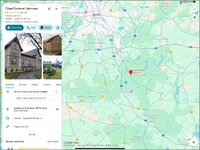
One (the so called ‘Hammer forest warden’s lodge’) became very important, as the HQ of the 9th Army, trapped in the Halbe pocket. I wanted to see if it still existed and, if so, could I find it. After a lot of digging around in Google, I did and it does:

IMG_1180.jpg

I’ll add it to the list of things and places to see.

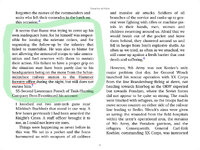
Here’s the relevant extract from the book I’m reading:
IMG_1179.jpeg


Back
Top Bottom