Speed sensor interface? Which of the twain?

boundless

Well-known member
UKGSer Subscriber
Joined
Sep 26, 2003
Messages
2,380
Reaction score
1
Location
Albion
Boundless is now toying with the 2650 Garmin as against possibly the 2610.

One of the selling points of the 2650 is the 'dead reckoning' feature.

But by my own 'reckoning' this feature is only enabled when the unit is connected to the "CAN bus interface" of the vehicles speed sensor. I take it this is the deep in the gubbins signal generator that drives an electronic digital speedometer on most vehicles.

Does a GS have such an animal?

Is it within the wit of a boundless to plumb?

Is 'dead reckoning' a worthy feature?

What other (if any) worthy features of the 2650 justify the extra money over the 2610?

Sorry about all the questions but I'm getting ready to go into 'froth' purchase mode. "Time and tide wait for no man. A pompous and self-satisfied proverb, and was true for a billion years; but in our day of electric wires and water-ballast we turn it around: Man waits not for time nor tide." - - - Mark Twain

(I've already construed Pan the man's comments on the favourable tourer friendly ergonomics of the 26xx series
generally.)
 
Boundless:

Whooo-boy, this could be fun.

I have, I think, the only motorcycle in the world with a 2650 that has the speed-sensor hooked up. I think it's great, especially here in Switzerland, with all the tunnels and stuff we have. However - you need to know, right up front, that the dead reckoning (DR) feature in the 2650 was not designed to work on motorcycles. Cars don't normally lean when they go around corners. Having said that - I have found that the DR function works just great on my moto, which is a Honda ST1100, even when I am deep in the mountain twisties.

If your GS has an electronic speedometer, that's all you need to have a speedsensor input. You don't need a CAN bus. In fact, my understanding of SP 2650 installation in cars is that the speedsensor does not pick up a signal from the CAN bus, it picks up a signal from the "aux speed signal" bus that is present on most cars. This is the same bus that provides speed information to the intermittent wipers, radio volume control, door lock circuit, and other components that need speed information. Typically, this signal is supplied out of the instrument cluster, after the instrument cluster has done the processing of the raw signal from the vehicle speed sensor.

Anyway - if you have an electronic speed sensor on your GS, then that's all you need. You just tap into it, or find an aux speed signal bus (unlikely on a moto), and connnect it to the appropriate wire. The 2650 will then self-calibrate to the pulses from the speed signal as soon as you drive it in a straight line for a mile or two at a constant speed.

If you don't have an electronic speed sensor on your moto (meaning, if it has a cable speedometer), I suppose you could hook up an electronic speed sensor to the front or back wheel by using a bicycle speedometer. Whether or not this would give you the granularity you need for an accurate speed signal, I don't know. Most automotive speed sensors provide one pulse per second per MPH. My moto has a speed sensing ring on the front wheel that provides 120 pulses per front wheel revolution, which is way higher than the average car, but the 2650 handles it OK.

You must not, under any circumstances, tap into wheel speedsensor signals that are used as part of the ABS system on your moto (or car), if your moto has ABS on it.

The GPSR also needs to know if the vehicle is moving forward or backward. This is accomplished on cars by tapping into the reverse light (backup light) 12 volt signal. On my moto, I tapped into the sidestand warning light signal, my rationale being that I usually have the sidestand down if I am pushing the moto backwards. This might sound like overkill, but an error introduced at any point of the DR process will stay with the GPSR until it next picks up the satellite constellation.

If you have the electronic VSS signal, and really want to go ahead with this, I'll help you as much as I can, as long as you accept up front that the Garmin guys can't support you with the moto installation.

PanEuropean

PS: FYI, apart from the DR feature, the 2650 is functionally identical to the 2610 and 2620.
 
2650 sounds like the direction to go

Thanks Pan:-

Does the 2650 have a fluxgate built in or is it just taking up and running with the direction from 'last known heading'.

Being as how it can 'see' the map, I suppose it can also make a fairly safe assumption that you'll not be making a bee-line straight off road as soon as you drop below the critical sat horizon...not so safe an assumption with GS's !

Assuming I can link up the speed sensor, is the 2650 worth the extra money over the 2610 or indeed the 2620?

PS I also have an older 195MAP Garmin for GA (microlight) use but the Jeppeson database is proving pretty bike clunky and I don't bother with it much nowadays!
 
On high-end in-car GPS systems a few years ago (Alpines and similar) they used to hook up the sped sensor as a matter of course....most cars have an electronic rather than cable driven speedo system so it wasn't a problem......but we did used to do an adaptor kit for cars without them.....

This consisted only of a pair of magnets and a bit of wire.....you stuck a magnet inside a tyre or on the inside of a wheel rim and the partner to it as close as possible inside the wheel arch....you put the rolling circumference of the wheel into the unit and the software used this with the EM pulses it recieved from the pair of magnets to provode a speed based dead reckoning signal to corroborate and enhance the accuracy of the GPS.

TBH I'd suspect that unless you're doing lots of tunnels like Pan European, or driving a lot in central london where you lose signal a lot because of satellite visibilty, the average user probably won't get any real benefit from the feature.
 
Boundless:

I kind of agree with Fanum's conclusion.

Having the DR function is really, really nice here in CH, where we are in and out of tunnels and snowsheds all the time, and where the mountains and forests often block a good part of the satellite constellation from view. DR would also be very useful if you spent a lot of time downtown in big cities with "urban canyons".

I honestly am not sure if it is worth the incremental cost to put it on a moto unless, like Fanum said, you spend a lot of time in one of the two previously mentioned environments. The incremental cost is pretty big - not only the price difference, but you can only buy 2650's from authorized installers, so you are looking at their charges to install the system in (presumably) your car as well. You would probably get more bang for your buck if you bought a 2610 and installed an external antenna on your bike. External antennas really speed up satellite acquisition times, and greatly decrease the number of "satellite reception lost" messages that you see.

The 2650 does not use a flux valve. It contains an acoustical gyroscope (angular rate sensor) that senses ∆ yaw. This, together with the speedsensor input (for velocity) and the reverse light input (for direction) allow the device to compute position purely by dead reckoning (mathematics). I have got to admit it works amazingly well. I covered the antenna with metal one day, to totally block satellite reception, and rode around Zürich and the surrounding twisties for a few hours, just giving it hell and scraping the pegs. When I came back to the hotel and parked in the same space, the GPSR indicated that I was about 8 feet to the left of where I actually was. That's really awesome performance.

You are correct that the DR software assumes that you generally stay on the road, and some really superb programming by the Garmin guys compares velocity and heading with the map database, sort of providing a self-correcting mechanism to offset gyro drift. If you do venture off road (about the closest I come to that is travel on airport aprons and taxiways), it still keeps track of where you are, and shows you in the correct spot when you re-enter the road network. It's even smart enough to ignore yaw inputs when the motorcycle is stopped - for example, I have it mounted on my handlebars, and I can't fool it by twisting the handlebars when I am not moving.

Fanum, no need to enter wheel circumference on the 2650, this unit just self-calibrates during the times it has a good position fix from the satellite constellation.

PanEuropean
 
Thanks Pan

It's spiffy to get the low-down so quick from a high-up (almost celestial).

Pretty much certain that the extra investment in the 2650 would be lost off the edge of the spreadsheet.

So now it's the 2610 up against the B*W Navigator II in the final round.

Any takers going to slug this one out for me?
 
I made a post yesterday reporting on my last two months' experience with the remote control attached to the handlebars. It's at this link: Using the SP 26xx Remote Control on a Motorcycle.

I think the BMW Nav II would be the right choice if you really value the audio guidance, especially if you own a BMW motorcycle, because BMW supplies Nav II wiring harnesses for all their different motos (at extra cost). Whether you find the extra button pad to be worthwhile is really a matter of personal opinion. Truth is, so many of the choices are really a matter of personal opinion - by example, I never listen to audio guidance, but others think it is just great.

To be fair to BMW, they do give you a bigger CF card than Garmin does in the SP 2610, and of course the bracket and parts to hold the GPSR on the moto, so be sure to allow for the value of those when making price comparisons.

PanEuropean
 
BMW Navigator II has an antenna port?

I've looked all over this device in the dealers. Can't actually see a port for plugging in an external antenna. I know the 2610 has one such from whence Pan highly recommends the increased functionality obtained over the inbuilt antenna .

Can anybody point to the external antenna port on the BMW Navigator II?
 
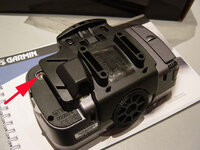
It should be there, Boundless - look for a little, tiny connector (MCX format) about one inch above the connector for the USB cable on the back of the GPSR, same end as the power switch. It might be possible that BMW has incorporated the antenna connection into their custom wiring harness, but I would be very surprised if it was so.

The external antenna connectors used on the SP 26xx series (which I assume includes the BMW Nav II) are much smaller than the BNC format connectors used on the SP III, GPS V and others. it's about 1/8 of an inch diameter, maximum, and flush mounted on the back of the GPSR.

The photo below ain't the greatest, but it's the only one I have handy that shows the connection for the external antenna. The black plastic part around the back of the GPSR in the photo below is the Garmin motorcycle bracket. This picture is good for showing the 4 mounting holes, where you attach the Garmin motorcycle bracket to a RAM backing plate.

PanEuropean
 

Attachments

  • antenna.jpg
    antenna.jpg
    73.1 KB · Views: 71


Back
Top Bottom