Spending money on exhausts? Read this first.

comberjohn

Registered user
Joined
May 9, 2014
Messages
789
Reaction score
0
Location
Downpatrick, N Ireland
Don't mean to sound like a smart arse but thought I would share for the benefit of the newer owners of a GS.
In the year that I've had a GS and mooched around this forum, I've noticed that one of the first big cost accessory is to change the exhaust system. Then they start to worry about how weak the fuel mixture is and it's hands in pocket time again.
A sports exhaust, with or without de-cat headers, will bring you a modest increase in performance at the higher end of the rev range but you MIGHT also lose a bit of mid range.
It will also do your head in with the noise on a long run, increase vibration and you may use more oil because you are using more revs.
I've just been down the same road.

I'd recommend getting your fuelling sorted first.
Get a remap, Hilltop, of course, or a Power Commander or fit AF-XiED units.
The downside, of course, is that no one can see (or hear) how cool and fast your bike now is.
This is where most of them end up anyway. You may find that the original system is not that bad anyway.
If you still want to be an anti social git that shouts at people because his hearing's gone, at least the bike will run better with that £500 exhaust if the fuelling is already sorted.
Just an observation from one who has been there. :)
 
Waaaay too much logic...

And some of it is incorrect. I've had '04, '07, '09, '11 and '13 GSes. The first two I fitted with full Remus systems. The '09 got only the Remus can because its exhaust gas temperatures were already melting things and i didn't want to run it even leaner. The '11 had an Akrapovič can. My current WC has just an Akrapovič can on the original headers.

The first two bikes were actually smoother on the full Remus system and the Remus can shifted the vibration to a different rev band on my '09. The '11 twin cam vibrated quite badly at c. 4.5K rpm and I believe that most if not all of them do that regardless of which exhaust is fitted. I've not noticed any difference in vibration between my WC fitted with its Akrapovič can and the other two, fitted with standard cans, which I've ridden. I might point out that I'm more sensitive to these things than the princess who couldn't sleep on a feather bed with a pea under the mattress..... :augie
 
But that's my point.
I can only speak for my TC but sorting out the fueling makes the engine smoother and more flexible, regardless of the exhaust system.
So why not get it running right with the re-map, etc. first before spending hundreds on an exhaust?
For most, that's the next step after the exhaust anyway. It just a question of what you do first.
Since sorting the fueling on my TC, it's really smooth and flexible across the rev band even with the standard exhaust.
 
So why not get it running right with the re-map, etc. first before spending hundreds on an exhaust?

Because if you're going to get it remapped, it makes sense to fit a new exhaust, especially if you're going for a full system, first. You'll then get a map that's correct for your bike with a more free-flowing exhaust fitted. Getting it remapped and then fitting an exhaust contains the possibility that the parameters of the map + trims won't be enough to cope with your new exhaust, especially if you choose to run it without a baffle.
 
If you use a PCV then there's some logic in what you say. (There's that word again.)
A PCV uses a 'fixed' fuel map, overriding the stock map and changing say, an exhaust would mean changing a fuel map. Takes maybe ten minutes to do on a laptop.
A re-map from Geoff at Hilltop utilises the adaptability of the standard ECU and makes adjustments to the fueling in the case of changes to exhausts, filters, etc. At least, thats what the Hilltop devotees are given to understand.
I use the AF-XiED units which work slightly differently but also use the ability of the ECU to 'learn' different fueling needs of a modified engine.
Fitting a sports exhaust to a stock engine will mean that the ECU will compensate for it over a couple of tanks of fuel, but you'll still be stuck with similar characteristics to standard. Such as the harshness at 4500 rpm on your TC. A common complaint with them.
4-5000 rpm is now the sweet spot on my TC.
 
A re-map from Geoff at Hilltop utilises the adaptability of the standard ECU and makes adjustments to the fueling in the case of changes to exhausts, filters, etc. At least, thats what the Hilltop devotees are given to understand.
.

See my comment above about the parameters of the map + trims. :)
 
Don't mean to sound like a smart arse but thought I would share for the benefit of the newer owners of a GS.
In the year that I've had a GS and mooched around this forum, I've noticed that one of the first big cost accessory is to change the exhaust system. Then they start to worry about how weak the fuel mixture is and it's hands in pocket time again.
A sports exhaust, with or without de-cat headers, will bring you a modest increase in performance at the higher end of the rev range but you MIGHT also lose a bit of mid range.
It will also do your head in with the noise on a long run, increase vibration and you may use more oil because you are using more revs.
I've just been down the same road.

I'd recommend getting your fuelling sorted first.
Get a remap, Hilltop, of course, or a Power Commander or fit AF-XiED units.
The downside, of course, is that no one can see (or hear) how cool and fast your bike now is.
This is where most of them end up anyway. You may find that the original system is not that bad anyway.
If you still want to be an anti social git that shouts at people because his hearing's gone, at least the bike will run better with that £500 exhaust if the fuelling is already sorted.
Just an observation from one who has been there. :)

Comberjohn, I share your sentiments entirely. The lean mixtures of the stock bikes don't consume all the air (Oxygen) that's being pumped into the engine, therefore they're not making full power at all throttle angles. So first, add fuel and do it in the easiet way that brings your engine closer to best power mixture. Then borrow an exhaust and see if there are gains beyond what the fueling added. Btw, at a lambda of 0.92 (AFR 13.5:1) my bike produces a throatier exhaust note than when it was stock but I'm not sure if all models do.

And some of it is incorrect. I've had '04, '07, '09, '11 and '13 GSes. The first two I fitted with full Remus systems. The '09 got only the Remus can because its exhaust gas temperatures were already melting things and i didn't want to run it even leaner. The '11 had an Akrapovič can. My current WC has just an Akrapovič can on the original headers.

...

A point about exhaust gas temperature (EGT) ...

The hottest exhaust, peak EGT, occurs at about lambda 1.00 (14.7:1 for gasoline without ethanol), which is where our bike run most of the time when stock. If you richen the mixture or make it leaner (say by adding an exhaust you think lets more air into the engine) the EGT is cooler.
 
Do people actually fit after market exhausts expecting a significant increase in performance, I think not?

The main reasons for fitting one seem to have been forgotten here. Most people fit them to;

a) Change the sound of the bike
b) Lighten the bike
c) Improve (subjectively) the looks of the bike

Discussions about AF ratios and power increases are for the less than 2% of owners who care about (or even know about) such things and are normally reserved for internet forums ;)

Andres
 
I fitted my aftermarket exhaust with the intention of having it Hilltopped because I wanted the look and found the OEM system too clunky. I was then offered a Power Commander V from a bike with the same spec as mine so I fitted it and it does the job. It runs too rich with two baffles but is fine with a baffle in one can and the other one as nature intended. It's an Akraprovic 2-1-2 system.

Power Commanders run open loop so have to be adjusted for every system change. The ECU is designed to run closed loop with O2 sensors and will adapt to a range of system changes. Remapping changes the fuelling parameters but not the ability of the system to adapt.

Geoff of Hilltop told me that these bikes run very lean especially at low throttle settings. He's seen 19:1 fuel air ratio. Gently cruising along can really cook the exhausts (and valves).
He said, the ECU can tolerate a free flow exhaust but can't tolerate a free flow air filter (or modified intake tube) AND a free flow exhaust. He also said its worth using posh petrol. It allows the engine to use more of the heat energy and exhaust gasses are cooler as a result.

To be fair the ECU is already pretty adaptable. A decatted exhaust will flow a lot more freely than the OEM catalyst system so this is quite a big gas flow difference for the ECU to deal with.
 
I fitted my aftermarket exhaust with the intention of having it Hilltopped because I wanted the look and found the OEM system too clunky. I was then offered a Power Commander V from a bike with the same spec as mine so I fitted it and it does the job. It runs too rich with two baffles but is fine with a baffle in one can and the other one as nature intended. It's an Akraprovic 2-1-2 system.

Power Commanders run open loop so have to be adjusted for every system change. The ECU is designed to run closed loop with O2 sensors and will adapt to a range of system changes. Remapping changes the fuelling parameters but not the ability of the system to adapt.

Geoff of Hilltop told me that these bikes run very lean especially at low throttle settings. He's seen 19:1 fuel air ratio. Gently cruising along can really cook the exhausts (and valves).
He said, the ECU can adapt to a free flow exhaust but can't tolerate a free flow air filter (or modified intake tube) AND a free flow exhaust. He also said its worth using posh petrol. It allows the engine to use more of the heat energy and exhaust gasses are cooler as a result.

To be fair the ECU is already pretty adaptable. A decatted exhaust will flow a lot more freely than the OEM catalyst system so this is quite a big gas flow difference for the ECU to deal with. This will be why people find the bike is so much nicer to use when the can the catalyst.
 
Way to technical....... fitted an Akrapovic header. Improved performance, sounds better, lighter...... 'feels' better.

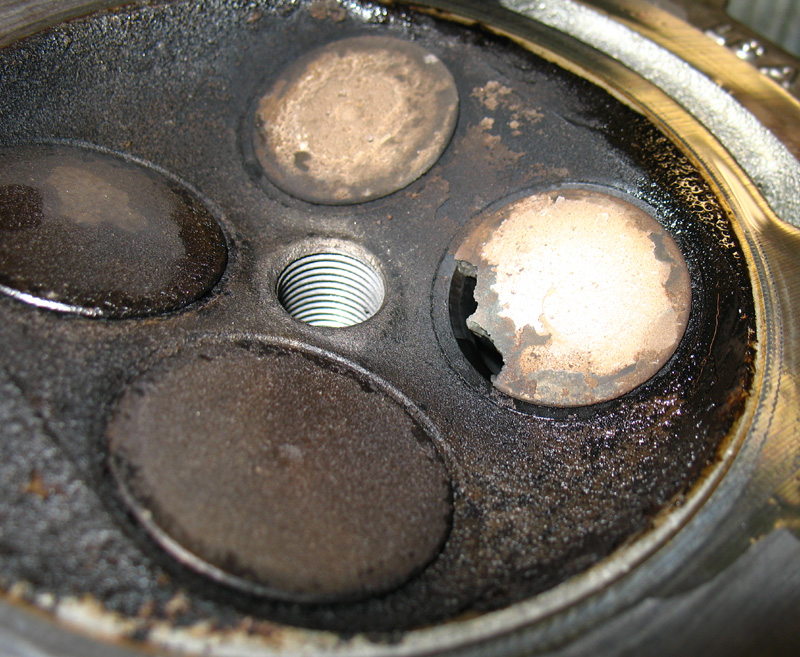
No disrespect to Akarprovic but this is a real risk when the mixture is too lean. (Pic is not an R1200)

burnedvalve.jpg
 
No disrespect to Akarprovic but this is a real risk when the mixture is too lean. (Pic is not an R1200)

burnedvalve.jpg

This failure usually happens when a bit of carbon holds the valve slightly open and is not due to mixture leanness. Notice the carbon deposits in this engine.

The hottest exhaust gas temperature (EGT) occurs at the stoiciometric fuel ratio, lambda =1, which is 14.7:1, which is where our bikes cruise. Either a leaner mixture or a richer mixture results in COOLER EGT. The leaner you make the engine, CHT (cylinder head temp) and EGT both drop, you get a cleaner burn, and better gas mileage to a point (called best power mixture). These considerations are well known to pilots who first lean their engines to peak EGT and then continue leaning until the EGT drops 50-100 from peak. (The process is usuall to lean until thhttp://classiccarwashverobeach.com engine runs rough and then add a bit of fuel to smooth it out.)

With an lc-1 controlling my lambda setting, as an experiment) I've leaned lambda to 1.1, an AFR of 16.2:1, and run hundreds of miles. Better gas mileage and cleaner burning and only little less smooth than stock. Plugs come out very clean.

Btw, If you make the mixture leaner by allowing more air, the Motronic or bmsk adapts and adjusts the the AFR back to stock on the 1200.
 
I think Andres hits it on the head when he makes his observations on the real reasons why us, so called adults, have to justify spending large amounts of cash on that fantastic exhaust system.
It is for the noise and the (subjective) looks. Weight? Really? When you add up the weight of farkles, never mind the fat git holding the bars, is a few pounds going to make that much difference?
And I include myself in the above, except for the fat git bit, of course, having been down the decat headers and sports exhaust road in the search for the ultimate performance. Stuck it for a day and two hundred miles before I took them all off again.
Couldn't stick the racket and, if I'm honest, didn't help the performance either. Vibrated more, too.
My TC now pulls like a train from just over tickover and is very strong in the mid range, with no surging or flat spots anywhere. Will spin up to the red line easily, but rarely needed. Top gear roll ons when overtaking are awesome. Engine runs really smooth, too.
I now have the complete standard TC system, including the cat and the flappy bloody valve. :eek:
Only other mod is a pair of AF-XIED units which, after a couple of thousand miles have it fuelling pretty damn good.
The number of times we read that it's a must to remove the cat and the flappy valve, if you have one, because they restrict the engine. Done it myself.
Do we have any hard evidence that it's true?
Does anyone on this forum really know if the cat restricts exhaust gases or what the flappy valve really does?
My OPINION is that considering the restrictions placed on them, BMW has built a very efficient exhaust system, providing the fueling is good. Aftermarket manufacturers seem to struggle to even equal the performance of the standard system despite making more noise.
Subjective looks apart, of course.
Back to my original point, particulary aimed at newcomers to the GS. Spend the money on fuelling first if you are after real world improvements in engine enhancement.
Still want that sports silencer?
Here's something that might be of interest. It's a comparison of silencers on a TC done by a German magazine a couple of years ago. It's in German, but there's pictures, too.
http://www.sc-project.com/prodotti/...DUKTTEST_Schalldaempfer fur BMW R 1200 GS.PDF
 
Well my experience on this is as follows.

Had the previous TV remapped by Geoff at Hilltop = smoother on throttle, more low down torque making it easier to punch out of conners and significantly better roll on in higher gears.

Second TC BUT with Keihan headers, plus flappy thing and standard end can. A bit more noise BUT more grunt (front wheel lifts where didn't before). Tried with a akro end can. No change in performance but way too much noise. Back to the standard can. More vibes at the 4-4500 revs suggesting even leaner (this is where the "emissions" dip occurs). Remap bought back to a very smooth TC and much more punch than I seem to recall than the previous TC.

So, conclusion is that straight through headers = good and worth the cost of the Keihans....no need to spend significantly more on Akro headers. A bit noisier but easy to live with on long distance.
Straight through headers plus Akro end can = bad....just too noisy for touring/distance with no performance gain
Remap = Good for grunt and smoothness.

If i had to go for one only it would be the remap....but the remap plus the headers = MUCH punchier and smoother. All for the cost of an Akro that adds nothing other than noise.
 
Baffles can be cut to give the right amount of noise control without plugging the system. Get a long baffle and keep sawing the end off until you have a noise that suits your needs.
 
I think Andres hits it on the head when he makes his observations on the real reasons why us, so called adults, have to justify spending large amounts of cash on that fantastic exhaust system.
It is for the noise and the (subjective) looks. Weight? Really? When you add up the weight of farkles, never mind the fat git holding the bars, is a few pounds going to make that much difference?
And I include myself in the above, except for the fat git bit, of course, having been down the decat headers and sports exhaust road in the search for the ultimate performance. Stuck it for a day and two hundred miles before I took them all off again.
Couldn't stick the racket and, if I'm honest, didn't help the performance either. Vibrated more, too.
My TC now pulls like a train from just over tickover and is very strong in the mid range, with no surging or flat spots anywhere. Will spin up to the red line easily, but rarely needed. Top gear roll ons when overtaking are awesome. Engine runs really smooth, too.
I now have the complete standard TC system, including the cat and the flappy bloody valve. :eek:
Only other mod is a pair of AF-XIED units which, after a couple of thousand miles have it fuelling pretty damn good.
The number of times we read that it's a must to remove the cat and the flappy valve, if you have one, because they restrict the engine. Done it myself.
Do we have any hard evidence that it's true?
Does anyone on this forum really know if the cat restricts exhaust gases or what the flappy valve really does?
My OPINION is that considering the restrictions placed on them, BMW has built a very efficient exhaust system, providing the fueling is good. Aftermarket manufacturers seem to struggle to even equal the performance of the standard system despite making more noise.
Subjective looks apart, of course.
Back to my original point, particulary aimed at newcomers to the GS. Spend the money on fuelling first if you are after real world improvements in engine enhancement.
Still want that sports silencer?
Here's something that might be of interest. It's a comparison of silencers on a TC done by a German magazine a couple of years ago. It's in German, but there's pictures, too.
http://www.sc-project.com/prodotti/...DUKTTEST_Schalldaempfer fur BMW R 1200 GS.PDF

I swapped the OEM headers for a used Remus header. It was minimal cost and I could easily swap back to OEM or re-sell the headers. I kept the OEM silencer can. I was a bi more noisy but always use ear plugs so noise had zero effect on how I used the bike. It all sounded the same to me. There was an immediate improvement in performance and fuel consumption improved. I would defy anyone to not notice the difference. MPG soon dropped as I got used to the additional performance.

I always liked the looks of the Akraprovic 2-1-2 twin silencer system. When a used titanium system came up, I swapped the lot and sold the Remus headers for what I paid.

The Akra system IS ENTIRELY about the looks and maybe a little about the sound - its a higher note than the Remus. It might make a touch more power but how likely am I to use everything a 1200 twin has got to offer?

It's bling - nothing more nothing less.

The TC flappy valve is all about noise suppression at low throttle settings. It's not a power valve. It opens at larger throttle settings and offers no restriction but the pipe is more noisy.
 
Just fitted a akrapovic 2-1-2 system to a 2005 gs. Lots better low down with a stronger hit at 4500 rpm. Was thinking of a power commander to sort out the low down power but don't think I'll bother now. This is the first bike I've been able to notice a significant difference from fitting a aftermarket exhaust


Back
Top Bottom