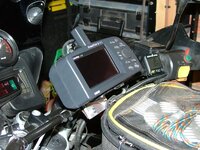
Hello Everyone:
Some replies to questions on page 2:
CoolCarbon: Altitude displays on any GPSR - even one that you spend $40,000 on, such as an aviation model - are the weakest part of the whole system. The biggest part of the altitude problem comes from the geodesy side of things - the mathematical description of the ellipsoid used for the globe.
As you may recall from Sunday school, God was in a hell of a hurry when he created the world (only 6 days), and God did not have ISO 9000 Quality Control certification. The result of this is that the surface of the earth is not perfectly consistent - doesn't matter how you try and describe it mathematically, it's not going to conform. So, the best you can ever hope for in terms of altitude accuracy - with or without augmentation - is about 50 feet. In certain places and under certain conditions, the error can be as high as 80 feet.
It is very easy to resolve GPS errors on the 'X and Y' (latitude and longitude) axes, this can be nailed down to about 10 feet or so with augmentation, but it is a bitch to resolve the Z axis (altitude). It is technically possible to define altitude to 10 feet accuracy if you are willing to accept altitude from the middle of the earth, but that's not what most people want, they want altitude from the (irregular and sloppily constructed) mean sea level in their area.
For what it's worth, in aviation work, we never use an altitude input from GPS for any purpose at all. We send altitude inputs to our GPS from an old fashioned aneroid barometer, technology that has not changed much in 150 years, but is generally accurate to about 20 feet.
Bean Machine: No huge worry even if you do have a little bit of moisture inside your SP III. Just remove the battery cover and the batteries, leave the GPSR sitting in the sunlight, face down (battery compartment up) for a whole day, ideally with a slight breeze over it (outdoors, or near an air register) and it will be drier than a nun's fart at the end of the day.
If you don't have any sunlight handy, then go to a camera store, get a bag of desiccant from them (should be free), heat the desiccant up in a conventional oven to dry it out (15 minutes at 150° F), when the desiccant bag cools down, put it in the battery compartment, put the battery cover back on, leave the thing alone in a warm area (room temperature) for 24 hours, that will dry it out. My SP III often got a little moisture inside it after riding all day in heavy rain, it never hurt it. The moisture gets in via the battery compartment due to temperature changes (you don't need to worry about a leak), and there is nothing you can do to stop it.
The super-easy and super-fast way to dry it out is to take the battery cover off and take the batteries out, then mount it on your bike and go riding for a couple of hours on a warm dry summer day.
Rob Farmer: Are you located anywhere on a line between the Dover-Calais ferry and Manchester? If so, maybe I'll drop by and see you sometime this summer. I'm air-freighting my ST1100 to Europe in mid April, for a summer's worth of riding.
PanEuropean