Hi JN,
Just read your post properly, I have no doubt that Tony Foale has a tremendous amount of knowledge in frame theory and design. However, as I currently work in a Business School, I am well aware of the difference between what some theoreticians pontificate and what is actual practice.
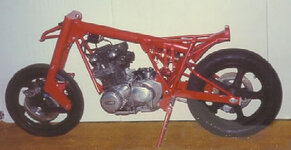
As you can see in the above picture, the engine is slung in a spine frame. The front down-tubes are bolted on just under the steering head with one through bolt. The engine is then mounted at the front with the two original Yamaha mountings. (hold that thought) The engine is fixed at the rear mount with one through bolt.
The original Yamaha also had a head steady mount. Crucially, the Tony Foale DIDN’T. This meant that under acceleration, dependant on crank rotation, the engine tries to move. In the Tzeds case this was upwards. In the genuine Yamaha frame the head steady stopped this movement. No head steady meant that, in the Tony Foale frame, the engine tried to lift under the torque reaction from racing acceleration. When this happened, the front down-tube mounts (remember them) would snap off. Which happened…… the only thing stopping the engine from pivoting around the rear mount and falling on the floor was the fairing belly pan. Eeek.
I had little option but to remove one of the front engine bolts and allow the engine to pivot. I know…. I was quite insane in those days. So there I am trying to race this bike and be competitive, when every time I accelerate the engine is jumping about underneath me. I eventually perfected a technique of slamming the power on so hard exiting a corner that the engine would jump up and hit the underside of the spine. This would then make the engine stable. Then I could try and get on with cornering the damn thing.
Damned exciting I tell you. Don’t ask me what it did under braking. That’s another ten pages worth.




 Some local Bay Area sport riders group is paying for him to come over and give a lecture series. If you can tell me more about how bad his frame was I will bring it up with him at the meeting.