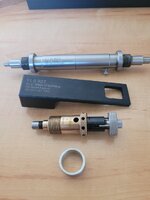
Tools

So I have spoken to BMW Motorrad and asked about the cam chain tool part number 83 30 0 444 292
I was told it was on back order and it would be around May time. So i have placed an order for one.
Will return the one i brought from MotorWorks.
 
Part from waiting for the tensioner spacer for the 1250.
I now have all the tools to do from 2014 onwards 1200 & 1250 timing.
All genuine BMW Motorrad tools
 
I brought this lot off ebay for just under £105 so i'm very happy with that.

BMW TOOLS.jpg
 
You got the camchain tensioner tool from ebay, jammy sod!
I bet that would be £££££££££ from BMW....
Was that new, and UK ebay?
 
You got the camchain tensioner tool from ebay, jammy sod!
I bet that would be £££££££££ from BMW....
Was that new, and UK ebay?
The tools were used, but all look new. Got them off eBay UK. The tensioner new from BMW is £109.80 on its own, but there on back order.
I have got one on order with Cotsworld, but will ring up monday and cancel the order now as i dont need it.
 
I think it's only recently that The BMW Club bought R1250 valve clearance change tools from BMW. It's worth checking the valve timing if you have access to these tools. The tool hire service run by Mike Delacoe is excellent and efficient - I've got a feeling Mike is also a subscriber on here.
As far as I remember, it's not possible to check that the timing is correct, without fully following the procedure to set the timing - hope that makes sense. It's a convoluted procedure but then you're likely only doing it once.
 
Ok, I have been told by Boxflyer that the Cam Chain Tensioner i got from MotorWorks will not give the right tension on the cam chain to be able to get the timing right.

So can i ask if any other member has brought and use the tensioner from MotorWorks.
He would say that . . .
The exact tension is not that important and I would have no hesitation using the tool from Motor Works but why bother when the OEM factory tool is available for the same money . . .mine arrived this morning. I will post separately
 
Yes, I would say that.

The factory tool setting for tension IS important.
It's not worth risking using a tool for something so important that is not exactly the same as what the procedure call for.
 
The factory tool is not spring-loaded and so unlike the actual tensioner itself, there is no give in it - in this sense, it is the same as the tool from Motor Works.
Where it differs is the factory tool incorporates a spring which serves as a clutch and torque limiting device so that the tool can only be screwed home with a predetermined amount of force. This is quite clearly more to prevent damage to the tensioner blade than anything else. As long as the upper chain run has no play when tightening the cam bolts, the precise amount of chain tension is actually unimportant.
In reality, the most important part of the chain to be kept tight is indeed the top run and arguably, a more accurate result could be achieved by using the engine turning tool with the engine locked at TDC and using it to pull the top run tight whilst tightening the end cam bolts m, rather than the tensioner tool. This method might require a spare set of hands but would in fact more accurately replicate the running condition of the engine and would be completely independent of how much slack existed in the lower run during the procedure . . . . the tensioner tool would thus become redundant.
I recently purchased the factory tool as it’s only £70 from BMW and will likely use it but having now had chance to see how it works, I can clearly see there are other methods that negate its use and with a little care, would work equally well, if not better. 👍
 
Last edited:
The factory tool is not spring-loaded and so unlike the actual tensioner itself, there is no give in it - in this sense, it is the same as the tool from Motor Works.
Where it differs is the factory tool incorporates a spring which serves as a clutch and torque limiting device so that the tool can only be screwed home with a predetermined amount of force. This is quite clearly more to prevent damage to the tensioner blade than anything else. As long as the upper chain run has no play when tightening the cam bolts, the precise amount of chain tension is actually unimportant.
In reality, the most important part of the chain to be kept tight is indeed the top run and arguably, a more accurate result could be achieved by using the engine turning tool with the engine locked at TDC and using it to pull the top run tight whilst tightening the end cam bolts m, rather than the tensioner tool. This method might require a spare set of hands but would in fact more accurately replicate the running condition of the engine and would be completely independent of how much slack existed in the lower run during the procedure . . . . the tensioner tool would thus become redundant.
I recently purchased the factory tool as it’s only £70 from BMW and will likely use it but having now had chance to see how it works, I can clearly see there are other methods that negate its use and with a little care, would work equally well, if not better. 👍
As a footnote to the above . . . .neither the factory tool or the MotorWorks tool are spring loaded and are simply screwed into the housing and butt up against the tensioner blade. This is why it is very important NOT to rotate the engine with the tensioner tool in position. Any tight spots in the camchain could increase the tension and thus damage the tensioner blade. I believe Boxflyer's tensioner tool is spring-loaded and like the tensioner itself, will move inwards when subjected to increased force from the chain. Thus, it is at least possible, when tightening the cam bolts, the friction between the bolt head and the individual cam gear could impart a turning moment on the main cam gearwheel causing it to want to turn. If the tensioner tool is spring-loaded, it will move inwards to accommodate the movement and thus allow the gearwheel to rotate slightly and cause the timing to be incorrect by the same amount. This is the primary reason why the Factory Tool and the MotorWorks tool are not spring-loaded but tighten into a fixed position which will not and does not move, regardless of the force applied to it by the camchain.
I'm sure the argument is somewhat academic as any errors are likely to be very small and likewise, I suspect the cam timing itself has a degree of tolerance built in . . . I don't know for sure but wouldn't mind betting that when the shift-cam activates, it alters not only the lift but also the timing . . .and probably quite significantly. If so, this would also lend weight to the argument that the cam timing isn't highly critical but needs to be within a "tolerance". Of course, we don't know what the tolerance is and we all like to fiddle . . me included. When I eventually get around to doing this job, I will post on youtube and explain the above as it's always clearer and easier to understand when demonstrated.
 
In reality, the most important part of the chain to be kept tight is indeed the top run and arguably, a more accurate result could be achieved by using the engine turning tool with the engine locked at TDC and using it to pull the top run tight whilst tightening the end cam bolts m, rather than the tensioner tool. This method might require a spare set of hands but would in fact more accurately replicate the running condition of the engine and would be completely independent of how much slack existed in the lower run during the procedure . . . . the tensioner tool would thus become redundant.
The method of turning the engine over on these bikes - via the valvegear - is rather odd because it is opposite to what happens when the engine is actually running and doing it this way will potentially move any slack in the camchain to the top run/un-tensioned side....
Normally the crankshaft `pulls` the camshafts round by the camchain (keeping the top run tight) but the factory way of setting the camshaft timing `pulls` the crankshaft round via the valvegear putting all the load on the bottom run including the tensioner blade..
I suppose it has to be done this way as there is no facility built in to turn the crankshaft directly.

As you have noted it could be possible for the top run of the camchain to have some slack imparted in it (affecting cam timing) and i expect the special tool is primarily to ensure any slack is taken up on the bottom run ensuring the top run is tight.
I was aware of this possibility when i did my 1250 timing earlier this year but the reality was that there was no additional slack in the top run and a moderate pull on the turning tool in the opposite direction (once the engine was locked) to ensure it was tight resulted in no movement.
I didn`t use the tensioning setting tool when doing the cam timing as - if i have read it correctly - there is no requirement to do so when checking valve clearances or camshaft timing according to the factory manual.
The only times the tensioning setting tool is mentioned is when the camshafts are to be removed or for when adjusting valve gap when a new shim is required.
Did you get a copy of the factory manual, what is your interpretation?
 
The method of turning the engine over on these bikes - via the valvegear - is rather odd because it is opposite to what happens when the engine is actually running and doing it this way will potentially move any slack in the camchain to the top run/un-tensioned side....
Normally the crankshaft `pulls` the camshafts round by the camchain (keeping the top run tight) but the factory way of setting the camshaft timing `pulls` the crankshaft round via the valvegear putting all the load on the bottom run including the tensioner blade..
I suppose it has to be done this way as there is no facility built in to turn the crankshaft directly.

As you have noted it could be possible for the top run of the camchain to have some slack imparted in it (affecting cam timing) and i expect the special tool is primarily to ensure any slack is taken up on the bottom run ensuring the top run is tight.
I was aware of this possibility when i did my 1250 timing earlier this year but the reality was that there was no additional slack in the top run and a moderate pull on the turning tool in the opposite direction (once the engine was locked) to ensure it was tight resulted in no movement.
I didn`t use the tensioning setting tool when doing the cam timing as - if i have read it correctly - there is no requirement to do so when checking valve clearances or camshaft timing according to the factory manual.
The only times the tensioning setting tool is mentioned is when the camshafts are to be removed or for when adjusting valve gap when a new shim is required.
Did you get a copy of the factory manual, what is your interpretation?
Hi,
thanks for your very interesting reply. I thought I was out on a limb somewhat but was convinced I had it clear in my head. You very obviously thought it through too.
I haven't yet done the job and so my understanding is based largely through watching videos and reading various manuals etc in order to work out what is going on.
I had realised that cranking the engine via the cam gear effectively loads everything in reverse and potentially exerts significant forces on the tensioner blade which it isn't designed to take. For this reason, I had already decided that I would most likely remove both spark plugs, engage top gear and simply bump the engine around until the TDC lock engaged - either it works or it doesn't.
My confusion stemmed from the fact that BoxFlyer has always maintained it is important the tensioner tool exerts a precise amount of force on the camchain but at the same time, I believe his tool is spring-loaded and free to compress when subjected to additional force; I can see how this could theoretically result in potential errors, as mentioned above.
I am a little confused by your last paragraph . . . .
1. I can't see any reason why there would be a need to use the chain tensioner tool and/or reset the timing when adjusting valve clearances - I may be wrong of course. . . . . .
The valve timing is surely a function of the relationship between the various driven gears and the crankshaft - this will only change if either of the cam gearwheels are altered via their securing bolts or if the camchain/guide wears significantly? After shim replacement it is clearly a prerequisite to return both cam gears to the same position as prior to removal and this can be checked either by marking the gears to ensure the same teeth mesh as before or by ensuring the flat base on the end of each cam is parallel with the top of the cylinder head.
The OEM manuals were never basic PDF manuals and indeed, I possess one for the 2017 R1200R. It is a very sophisticated piece of software that takes account of the build status of each individual bike, either by entering the VIN into the software or by selecting the various optional extras or accessories fitted so the manual is tailored to the bike. Thereafter, you enter the bikes first registration, date and mileage of last service, today's date and mileage and the manual generates a schedule with every required service item listed. You merely click on each one and it takes you to the relevant section in the manual. All the preparatory work required is hyperlinked and it is just a superb piece of software BUT . . . . BMW won't play ball with us any longer
Whilst 90% of my OEM Manual is still relevant, there is a certain amount which is out of date and in particular, the introduction of the shift cam and for that, I am relying on a PDF for the 1250R which I purchased off eBay - it's better than nothing but only just.
It seems evident that somewhere along the line, someone with access to the OEM interactive software , has used this to compile a pdf manual but nothing is hyperlinked and there are significant sections where information is simply missing.
For example . . . you state "the only times the tensioning setting tool is mentioned is when the chamshafts are to be removed for for when adjusting valve gam when a new shim is required." . . . . this is because the sections which do mention it, along with all the preparatory work have been omitted by the person who compiled the PDF.
It would seem that a number of manuals were created in this way and then subsequently sold on by any number of folks on eBay who having acquired a manual for themselves were then looking to make a quick buck. I wouldn't mind betting that all the manuals available on eBay are fundamentally the same. Indeed, one kind gentleman on the 1250R forum forwarded me his manual and whilst it had been slightly altered, it was in essence the same pdf document that I already had.
Anyway . . .my interpretation -
The engine tdc lock tool and chain tensioner tool are theoretically required when adjusting the cam timing but I think the latter is to all intents and purposes redundant. My suspicion is that it would be more than acceptable to lock the engine at tdc, loosen off both cam bolts and attach the alignment jigs and then retighten both cam bolts while having someone apply a rotational force onto the intermediate gearwheel in order to keep the upper chain run under tension whilst the bolts are tightened. . . Whatever is going on in the lower run and whether or not the factory tensioner tool is used matters not one jot - just my thoughts.
For checking valve clearances, rotate engine until it is at tdc, confirmed by the crank locking tool but again, no requirement to use alignment jigs or tensioner tools at all
For changing shims, both cams need to be removed and so I would expect the engine to be locked at tdc, the various ancilliaries removed such as the shiftcam solenoid, axial fixation bracket etc before removing the cam caps and simply lifting out the camshafts. Again and as far as I can see, no need to use jigs or tensioner tool if only the clearances are being adjusted but clearly vital to return cams to the same relationship with their driven gears.

For now at least, I'm just hoping that someone releases the interactive software so that we have all the information we need to work on our bikes. It seems that BMW are just choosing to alienate their customer base :-(

 
I chickened out and only got my valves checked at 45K. Using an independent chap. A very cheap(ish) bill as all valves were within spec.

Still running sweetly at 55K.

I've done all the simple basic servicing myself since 2016. Can't change tyres.

The money saved (on dealers) has been spent on fuel and hotels.
 
I chickened out and only got my valves checked at 45K. Using an independent chap. A very cheap(ish) bill as all valves were within spec.

Still running sweetly at 55K.

I've done all the simple basic servicing myself since 2016. Can't change tyres.

The money saved (on dealers) has been spent on fuel and hotels.
I’ve cracked changing tyres . . . I can’t say it’s fun.
I’m now better at it than I was when I made this video!! 😂
 
I’ve cracked changing tyres . . . I can’t say it’s fun.
I’m now better at it than I was when I made this video!! 😂
Hit fast forward or you’ll need to take a week off work. . . . guaranteed to out you off changing your own tyres!! 😂😂😂
 
Isn’t all this over complicating the issue, when i did mine all i did was remove the rocker covers and the plugs, 6th gear and rotate the rear wheel in the direction of normal forward travel to find TDC on one side, check the valve clearances, do the other side and put it back together - job done cos it’s very unlikely that you’ll find any out of spec.

If you’re very unlucky and find one out of spec, then if you don’t know what you’re doing or don’t have the tools, find someone who does.

Just don’t turn the engine backwards, I don’t know if it’s an issue with the BMW boxer but it can get you in trouble with some engines so just don’t do it and you’ll never have an issue.
 
Isn’t all this over complicating the issue, when i did mine all i did was remove the rocker covers and the plugs, 6th gear and rotate the rear wheel in the direction of normal forward travel to find TDC on one side, check the valve clearances, do the other side and put it back together - job done cos it’s very unlikely that you’ll find any out of spec.

If you’re very unlucky and find one out of spec, then if you don’t know what you’re doing or don’t have the tools, find someone who does.

Just don’t turn the engine backwards, I don’t know if it’s an issue with the BMW boxer but it can get you in trouble with some engines so just don’t do it and you’ll never have an issue.
To clarify, there’s no suggestion of turning the engine backwards but turning from the cams transfers the tension from the upper run to the lower run of the camchain.
If all I need to do is check valve clearances, I will do exactly the same as you 👍
 
Hello all, I have the official BMW tools for cam timing, and the aftermarket version from Spankraft
https://www.spankraft.com/product/r...led-2013-onwards-series-engine-special-tools/

I ordered the BMW ones first because I needed them to replace cams and followers, but it took too long to get them so i bought the spankraft ones which were available immediately. a couple of years later (literally), and the BMW ones turned up, so now I have both.

The spankraft ones appear to be much the same as the Motorworks ones. The CCT tool has a bolt that you finger tighten.

I have performed numerous cam timing adjustments with both. I have found that the outcome is the same, despite what boxflyer claims about the factory and his CCT tools providing a specific force on the cam chain. Using only your fingers on the bolt of the Motorworks/spankraft one works fine.

A couple more comments on what I've read above:
* you don't need the tools for valve checks.
* you don't need the tools for valve adjustment, but it makes it easier, not having to mark the teeth of the cams and getting them right when installing them back.
* you need all the tools to perform cam timing checks and adjustments. without the CCT tool, the cam timing will appear slightly out when it's in fact correct.

Given my time again, I would just buy the spankraft tools.

Just my experience fwiw.

cheers


Back
Top Bottom