Touring Tool Kit Idea

We Make Life A Ride

Active member
UKGSer Subscriber
Joined
Jul 13, 2019
Messages
261
Reaction score
28
Location
South Wales
Hey all,

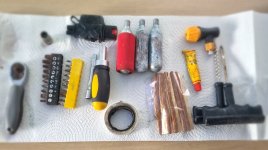
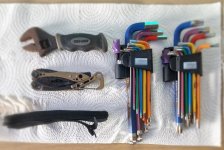
Interested to know what you all keep in your touring toolbox. Here is what mine looks like. In addition to whats in the pictures I carry:

- battery booster (doubles as a usefully large battery pack for charging items)
- electric tyre inflator (so thinking of removing the co2 to save space as not really needed)
- 3 small tyre bars
- hi-viz


Thoughts, tips and idea welcome as always. Too much? Too little? Wrong tools?

My next trip kicking off on 1st August takes me on a 3,000 loop around Europe taking in France, Belgium, Netherlands, Germany, Czech Republic, Slovakia, Slovenia, Croatia, Italy and Switzerland that makes a difference.

Regards,

Marc


20230720_121403.jpg20230720_121409.jpg
 
Do you plan on removing the tyres yourself at some point? If no, discard the tyre levers, not least as you do not seem to have any inner tubes or inner tube patches but do have tyre plugs, as used on tubeless tyres. You’ll also need a tyre pressure gauge (a simple pencil one will do) to sit alongside your compressor pump.

Do you need ALL the Torx and Allen keys? My simple bet is no. Likewise, all those bits, which are maybe pretty crappy quality anyway. Do you need them all?

Look at your bike and look what you might realistically expect to do by way of service (arguably none - beyond maybe adjusting a chain * - over 3,000 miles in Western Europe ) and by way of simple roadside repairs. That should tell you what you need to know.

The most useful thing you seem to have forgotten is a simple but decent LED torch, preferably one that also shows a red light.

PS The fuse connector on its own is not particularly useful without:

a. Probably some lengths of wire to bridge it in with.

b. Some method of connecting the bridging wires to whatever you wish to connect it to.

c. Presumably, a cross section of fuses.

What did you have in mind doing with it?


* Even that is maybe unlikely if it’s in decent nick / properly adjusted on day one and you keep it lubed each evening.
 
Last edited:
As I am sitting at home with a ruptured Achilles, I have given it some thought.

Is it safe to assume that you have no tool kit at home, that you can lift a few tools out of?

If so, why not start to build one, based on something sensible? When you have looked at your bike and worked out the (really very few) tools you’ll need, then take yourself to Halfords or look online and buy yourself the best version of the tool you can realistically afford. Why? They might well last you a lifetime and will definitely last well beyond the duration of your next holiday. You don’t need to spend a fortune buying the ‘Professional’ range, just something good enough to spanner away on the very few times you’ll actually really need to do something.

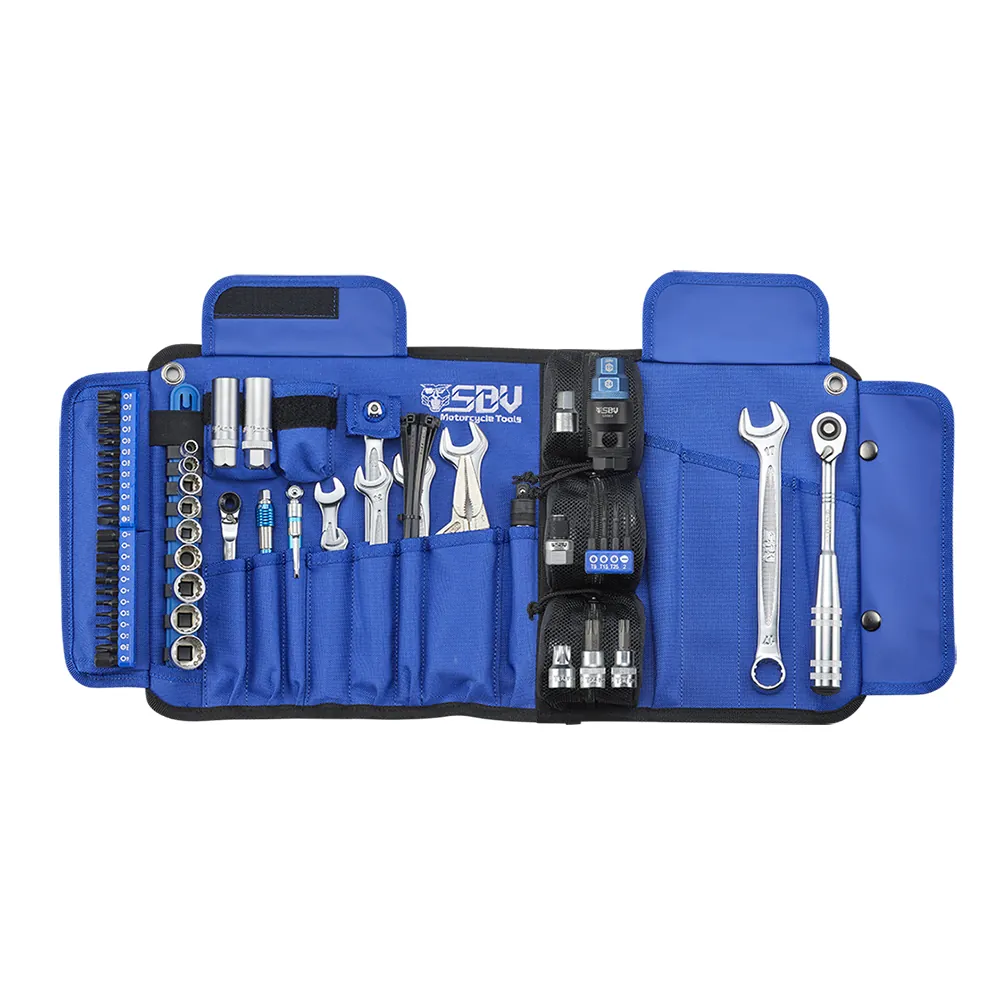
This fellow listed about everything for a 1200 GS. It’s bloody overkill but he is American. You can though look at it, as the bike is pretty much the same (tool wise) as any other in the BMW range. Then, from his long list, pick the few things you actually need.


As a very simple example, I have a good quality Snap-On (probably stolen) screwdriver I found being flogged locally for peanuts. It is nothing more than a decent handle and two screwdriver blades, each with a different head at each end. The four heads cover every screw I am likely to find on any bike at the roadside or at home. Being one handle and two blades, it takes up less room than your T-thing and all those little bits in their plastic cases, the bulk of which you’ll never use. Find yourself something similar.

From memory, the only odd Torx bolt on my 1200’s was the male Torx, which clamped the gear lever onto its spline, all the other bolts were female Torx, I think. Why did BMW use a male headed Torx bolt there? I have no idea. I swapped the male Torx bolt out and the world kept turning.

Remember, that necessity is often the mother of invention. I snapped the left hand mirror off my 1200 GSA in Spain. Riding on the right, means that the left mirror is important, when overtaking. The mirror arm was OK and the glass / round glass holder was OK. But I had no easy means to join them….. I pinched a fork from a restaurant (I’ll go to hell, I’m sure) and gaffer taped the fork handle to the stem. The round glass holder I gaffer taped to the prongs of the fork, they being the perfect curved shape. It worked and got me home. No tools involved, as such.

:beerjug:
 
Last edited:
It was a long time ago when I did physics, but I seem to recall that no matter how many CO2 canisters you use, the tyre will only inflate to the pressure in the canister. I stand to be corrected.

I use a Ring rechargeable pump, and a tubeless tyre plug kit. You haven't said what bike you have, so if you have tubed tyres that plug kit probably isn't a lot of use.
The only torx I have ever used is the one to undo the battery cover and use the jump pack.
 
the tools to take the front/rear caliper off
tools to be able to adjust chain
can of tyre sealant
bulbs although with led irrelevant


touch wood apart from one flat on the road in 20 years never needed the other tools but they have helped others when theyve been come across

have only needed breakdown cover twice in 30 years once cos of the bike (pos shoulda known better) one not (fucked tyre and couldnt see in the dark)
 
I carry my breakdown kit except the puncture repair kit in a Kriega Tool roll this keeps everything together and stops it rolling about too much in my tail pack.
I normally include a very compact multi meter in the pouch this has proven useful on a couple of occasions (for me and others) in the last 20 years, along with a few cable ties and a tiny tube of super glue for those plastic breakages . I would add a compact LED torch to your set.

https://www.wickes.co.uk/Cat-II-Compact-Digital-Multimeter---300V/p/276109?_br_psugg_q=multi+meter (available in lots of other DIY shops)

First aid kit, foil space blanket and plastic poncho (for those times when recovery is 6 hours away and its peeing down), puncture repair kit, 500mm x 500mm plastic tarp and compact hand bicycle pump are also there.
 
The post #6 above, though well intentioned, is starting to drift into the American website’s territory. Multimeter, used on a couple of occasions over 20 years. I make that once every 10 years. Foil blanket and poncho, if it pees down. It it’s raining or threatening to rain, you’ll (hopefully) have your waterproofs.

The simple tool roll is an excellent suggestion though. I use a tough fabric zipped pouch but a roll is just as good. The decent LED torch? A must.

Three tips, OP.….

1. You don’t say how you’ll power your compressor. If you intend to run it from a standard BMW factory fit power socket, give it a test run pumping up a tyre, just to make sure it doesn’t draw more amps than the socket is limited to. It’ll be a very frustrating thing for you to discover on the roadside. If it does trip, fit a suitably fused flying lead to the battery. Some compressors come with crocodile clips, as opposed to a plug. Just check that you can clip the clips onto your battery terminals. The position of some batteries, make this simple task, less simple.

2. Make sure that the power lead attached to the compressor is long enough for you to place the compressor near the tyre valve. Some models have a lead that is a touch short, which is (no doubt) very frustrating. For example, if the socket is up by the beak of the bike, it’s quite a long way to the back wheel. I put an extension lead in with mine, used when I pump someone else’s tyre up, as it means there can be a working space between the two bikes. Anything to make life easier, I guess.

3. Make sure you know how to use the tyre plugs. On the side of the motorway in the teeming rain (your space blanket having blown away and your poncho flapping) or in the baking heat of a French D road, is not the time to start learning. Trust me.
 
Last edited:
A North Face wash bag is a superb tool roll holder.

Rugged and strong zips.

Mine has been carried and used for way over 20 years and it’s still spot on
 
In my emergency kit
Hi Vis
Nest of Allen keys in my pouch, the important one's are marked with a ring of tape
Battery
Panels
etc

Puncture repair outfit
Cable ties - lots (varying lengths & sizes)
Electrical tape 2 rolls

I've used a screwdriver before to make a throttle lever, ;)

You never know what you can do until your in situation that you need something you dont have
 
You never know what you can do until your in situation that you need something you dont have…..

A friend, who snapped a front brake lever in the wilds of Lincolnshire on the way to Louth, had one made by some farm lads, who (purely by chance) found him at the side of the road. They stopped and said, ”We can fix that”. They fashioned one out of some old bits of iron and a couple of washers, spot welding it up in a barn. Within an hour he was on his way again. Where there is a will, there’s a way.
 
To be honest I have used my on board kit as much for other riders as for myself, it sits there unused for 99.99% of time but when you need it you really need it.
There is a tendency to add stuff cos its a "good idea" I went through a rationalisation exercise a few year back and pared back to just the stuff I had atcually used in the last 20 years.
 
It was a long time ago when I did physics, but I seem to recall that no matter how many CO2 canisters you use, the tyre will only inflate to the pressure in the canister. I stand to be corrected.
The pressure in the canister is apparently c 800psi (one will pump up a MTB tyre to 40+ psi)
 
It was a long time ago when I did physics, but I seem to recall that no matter how many CO2 canisters you use, the tyre will only inflate to the pressure in the canister. I stand to be corrected.

Fast forward to 2:23


In short, they will (if you have enough) fill a motorbike’s bike tyre. The problem is not the pressure (they are roughly 800 psi) but the volume of the tyre versus the volume of the CO2 canister. Medium to long term, you are better off with a compressor.

Don’t want to spend decent sized wedge on a ‘specialist’ motorcycle compressor or cart a large box around? Then don’t. Buy the cheapest compressor you can find on the net or any any motor factor and take the compressor out of it. Then run it naked. Be careful, as the compressor will get hot in use.


PS The tip of hanging the compressor on a piece of wire is handy.
 
Last edited:
Some interesting replies. And all taken on board.

Answers to some of the question:
  • No spare tyres and/or innertubes so in reality although listed the tyre irons will be staying at home
  • Co2 canisters also staying at home, not required when I carry the compressor
  • Yes, I know how to use the tyre plugs having travelled extensively by bike and land rover and has to use them a good many times in the past (though to data never on a bike)
  • My toolkit covers mine and the other half's bike. Namely 1x R1250 GSA and 1x F850 GS Sport
  • Compressor is battery powered and has a long enough lead to reach the valves - both tested. In fact the compressor, has pumped up two car tyres and still had around half battery life left in it so is a handy little unit to have and of course having a digital screen doubles as accurate tyre pressure gauge too
  • Will also be adding cable ties (plastic & metal) and some gaffa tape

I like the idea of looking to ensure I have something for every roadside repair by literally checking what size fits where and only taking that piece. If anyone knows of a list of sizes that would be really helpful.

Thanks again all.
 
1x R1250 GSA and 1x F850 GS Sport

I like the idea of looking to ensure I have something for every roadside repair by literally checking what size fits where and only taking that piece. If anyone knows of a list of sizes that would be really helpful.

There will not be any significant difference in the tools needed to carry out ‘Every roadside repair’ between the two bikes.

You are going to Western Europe, on a three thousand mile holiday (a distance that is only half the standard annual service interval) not away for three years riding around the globe. For the two bikes combined, that is still only 6,000 man-miles or one full annual service interval.

Think about it; come on YOU can do it.

a. Look at your bikes for yourself. You’ll very quickly discover which Torx size fits what bolt and what screwdriver(s) fits which screws. When looking at the bikes, you’ll get a good opportunity to check everything. Or just take the bikes to your nearest BMW dealership and ask them to give them the once over maybe getting them serviced before you go.

b. To carry out ‘Every roadside repair’ will, I assume, require you to carry ‘Every part’ whether that be brake and clutch levers or indicators, to name but a few. If you want to cart that lot around, dump your (possibly) eighteen pares of shoes.

c. If you really believe you MUST take the lot, you can see the tools listed in the website kindly linked in post #7.


Go to the website and click on the tabs. Then scroll down and tap on ‘Specs’. You can either buy the whole kit (with the additional bits, if you want them) or save a bit of money, assembling them yourself.

Then spend a few minutes ensuring you know how to use the tools. Lots of bods take lots of tools, without any clear idea of how they’ll make a repair on the roadside. That is just carting around heavy and shiny things to look (and maybe feel) good. The vast majority will never ever be called into use.

PS Don’t forget to buy decedent Travel and Breakdown insurance. Way more useful than a spark plug cap puller, trust me.
 
Last edited:
There will not be any significant difference in the tools needed to carry out ‘Every roadside repair’ between the two bikes.

You are going to Western Europe, on a three thousand mile holiday (a distance that is only half the standard annual service interval) not away for three years riding around the globe. For the two bikes, that is still only 6,000 man-miles or one full annual service interval.

Think about it:

a. Look at your bike(s) for yourself. You’ll very quickly discover which Torx size fits what bolt and what screwdriver(s) fits which screws. When looking at the bike, you’ll get a good opportunity to check everything. Or just take the bike(s) to your nearest BMW dealership and ask them to give them the once over.

b. To carry out ‘Every roadside repair’ will, I assume, require you to carry ‘Every part’ whether that be brake and clutch levers or indicators, to name but a few. If you want to cart that lot around, dump your (possibly) eighteen pares of shoes.

c. If you really believe you MUST take the lot, you can see the tools listed in the website kindly linked in post #7.


Go to the website and click on the tabs. Then scroll down and tap on ‘Specs’. You can either buy the whole kit (with the additional bits, if you want them) or save a bit of money, assembling them themselves.

Then spend a few minutes ensuring you know how to use the tools. Lots of bods take lots of tools, without any clear idea of how they’ll make a repair on the roadside. That is just carting around heavy and shiny things to look (and maybe feel) good. The vast majority will never ever be called into use.

PS Don’t forget to buy decedent Travel and Breakdown insurance. Way more useful than a spark plug cap puller, trust me.
Thanks I'll check out the link, that's useful.

As I say fairly experienced travelleer albeit on 4 wheels more so than 2.

Interestingly, on the service front my bike is on service number 3 in less than 12 months. I do a fair few miles on it!

Travel and breakdwon insurance is an absolute must, I couldnt agree more.
 
Some excellent tips in there. I work logically when it comes to what i carry ie. if it doesn't fit anything on my bike then it doesn't go, if it does fit and i am likely to use it then it does go.
Something in the OP's post that caught my eye, he mentions a booster pack which can double as a usb charger to charge stuff up, why would you want to do that and risk discharging
the booster battery to the point where it's no longer up to the task it's taken along for ie. starting your's or your mate's bike.
 
Some excellent tips in there. I work logically when it comes to what i carry ie. if it doesn't fit anything on my bike then it doesn't go, if it does fit and i am likely to use it then it does go.
Something in the OP's post that caught my eye, he mentions a booster pack which can double as a usb charger to charge stuff up, why would you want to do that and risk discharging
the booster battery to the point where it's no longer up to the task it's taken along for ie. starting your's or your mate's bike.
sorry I should have been clearer on that point:

'as a last resort if all our other usb battery packs are flat i.e. in an emergency if we break down and both phones have died'

extremely unlikely I know but good to have the option if required :)


Back
Top Bottom