Unexplained fuel fire on 2002 1150GS Adventure - clipped from Mike O's ride report

I reckon there are two problems here:

1) the problem that caused the bike to run on one cylinder
2) the problem that caused the fire

It is obviously possible that both are linked.

One theory:

The right hand QD connector has worked slightly loose and sealed itself which stops fuel getting to the right cylinder. Bike stops firing on that cylinder. You stop and investigate. In removing the panel the loose connecter is disturbed and separates. High fuel pressure due to the engine running at max throttle overwhelms the QD connector seal and fuel leaks causing the fire.

The cause of the QD connector working loose becomes the main point of interest. It could be a heat/cool cycle, a bad connector, vandalism etc and may possibly never be known.

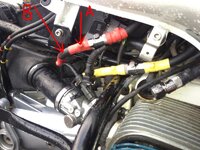
Not sure how the injector cable can also have been disconnected and it's not very clear from the picture. Possibly it has melted already from the intense heat?

Another theory:

The injector cable has worked loose causing the bike to fire on one cylinder. You stop to check, removing the side panel and inadvertantly snagging & detaching the fuel QD connector. Excessive pressure from full open throttle etc etc.
 
IThe right hand QD connector has worked slightly loose and sealed itself which stops fuel getting to the right cylinder. .

The Q/D's aren't left or right sided. One is fuel supply, the other is fuel return.
 
The temperature of the catalysator is high

A suitable mixture of petrol-air will ignite in a low temperature.
I think the catalysator is the reason for the fire after some petrol has dropped on it.
In the picture is also visible a burning "route" down to the calalysator
i-LWskNtD-L.jpg


Pekka
:rolleyes::rolleyes::rolleyes:

From Wikipedia:

Flammability

Like other alkanes, gasoline burns in a limited range of its vapor phase and, coupled with its volatility, this makes leaks highly dangerous when sources of ignition are present. Gasoline has a lower explosion limit of 1.4% by volume and an upper explosion limit of 7.6%. If the concentration is below 1.4% the air-gasoline mixture is too lean and will not ignite. If the concentration is above 7.6% the mixture is too rich and also will not ignite. However, gasoline vapor rapidly mixes and spreads with air, making unconstrained gasoline quickly flammable. Many accidents involve gasoline being used in an attempt to light bonfires; the gasoline readily vaporizes after being poured and mixes with the surrounding air.[
 
The temperature of the catalysator is more than 250° C

A suitable mixture of petrol-air will ignite in a low temperature.
I think the catalysator is the reason for the fire after some petrol has dropped on it.
In the picture is also visible a burning "route" down to the calalysator
i-LWskNtD-L.jpg


Pekka
:rolleyes::rolleyes::rolleyes:
From Wikipedia:

Flammability


Like other alkanes, gasoline burns in a limited range of its vapor phase and, coupled with its volatility, this makes leaks highly dangerous when sources of ignition are present. Gasoline has a lower explosion limit of 1.4% by volume and an upper explosion limit of 7.6%. If the concentration is below 1.4% the air-gasoline mixture is too lean and will not ignite. If the concentration is above 7.6% the mixture is too rich and also will not ignite. However, gasoline vapor rapidly mixes and spreads with air, making unconstrained gasoline quickly flammable. Many accidents involve gasoline being used in an attempt to light bonfires; the gasoline readily vaporizes after being poured and mixes with the surrounding air.[

Sorry, I don't buy it - not without a source of ignition under these conditions. Remember this was a sudden (and new) smell of petrol immediately followed by a fireball (as per the pic). The flame travelling downwards is burning fuel dropping - the seat of the fire was around the throttle body area...

You could pour petrol over your catalytic converter all day long - there's no way it would catch fire without a spark to set it off (although once a spark appeared, the results would be pretty violent).

I'm still convinced some fairly major failure happened around the TB - I'm more and more thinking in terms of some mischievous tampering the night before...

However - we can speculate until the cows come home - we'll never know for sure...

Mike :cool:
 
The Q/D's aren't left or right sided. One is fuel supply, the other is fuel return.

Yep - if that were the case it would have affected both cylinders. When I stopped the bike, I was thinking in terms of a blocked injector.

Of course I had experienced the ticking noise (which I still think may have been HT arcing - it's what it sounded like) for a few days before this (post in Oilhead section). I'd run the engine in the garage with the lights off (often the best way to spot an HT lead arcing), but hadn't seen anything. Of course I didn't remove the head guard and the plug cover, so it could have been happening under there - certainly a possibility for the source of ignition...

Mike :nenau

EDIT: Sorry Neil - hadn't spotted your earlier post mentioning this...
 
Paul G (BHT) has just pointed out that there seems to be some activity in the area of the helmet lock / rear shock...

i-t4XqMbt.jpg


Is that a flame, or a red-hot shorting wire?
confused.gif

isnt that where the Bleeder is for the clutch , otherwise there is nothing behind there significant that could go up so quickly .

i think Neil is close to the mark on the black fuel line to the injector , these do get Brittle and im assuming the injectors run under a fair amount of pressure.

but it still does not aswer the question of the QD being disconected , they still take some releasing if seated for a while.

if some miscreant was fiddling with the bike to get at the fuel i cant see them bothering to screw the panel back on etc:confused:

you have a proper mystery on your hand here mike.
 
isnt that where the Bleeder is for the clutch , otherwise there is nothing behind there significant that could go up so quickly .

i think Neil is close to the mark on the black fuel line to the injector , these do get Brittle and im assuming the injectors run under a fair amount of pressure.

but it still does not aswer the question of the QD being disconected , they still take some releasing if seated for a while.

if some miscreant was fiddling with the bike to get at the fuel i cant see them bothering to screw the panel back on etc:confused:

you have a proper mystery on your hand here mike.

You don't need to remove the side panel to fiddle about with stuff...

i-VQpBKpN-L.jpg


Anyone screwing around with the injector could do some damage (although the injectors are pretty hardy - I would've though you'd have had to run over one to damage it)...

Mike :nenau
 
It's possible your side panel, (which you screw on??) presses against A forcing the pipe at B against the plastic fuel line causing a fracture which sprays fuel directly into the injector plug.
 

Attachments

  • i-Ptsx27g-L.jpg
    i-Ptsx27g-L.jpg
    77.2 KB · Views: 166
You don't need to remove the side panel to fiddle about with stuff...

i-VQpBKpN-L.jpg


Anyone screwing around with the injector could do some damage (although the injectors are pretty hardy - I would've though you'd have had to run over one to damage it)...

Mike :nenau

fair point , and Tims observasion is quite good looking at your pic it seems as if the red section (heatshrink?) is pushed down towards the plastic fuel pipe.

having said that you dont strike me as a cram it in and bolt it up type of guy:thumb2
 
DSCN1992.jpg


I'm pretty sure I've seen a photo of one on fire from shorting out as well.

That's where my money is.
 
I'm pretty sure I've seen a photo of one on fire from shorting out as well.

That's where my money is.

I think that would be the obvious cause if it were a twin spark, but is it?


Back
Top Bottom