WAAS satellite coverage In Europe

Guys:

A while back (March 4th), I posted a note here on this thread asking for some help - feedback - about WAAS reception in Europe. I have not heard much from anyone since then.

Perhaps this was because the thread got hijacked (ahem...), or maybe no-one has been out riding with a 2610 yet.

Anyway, my interest in getting some feedback is still there - if anyone starts picking up the augmentation satellites, or notices their GPSR going into 3D differential mode, please post your comments here, OK?

Many thanks,

PanEuropean
 
Quote from the Garmin site

WAAS consists of approximately 25 ground reference stations positioned across the United States that monitor GPS satellite data. Two master stations, located on either coast, collect data from the reference stations and create a GPS correction message. This correction accounts for GPS satellite orbit and clock drift plus signal delays caused by the atmosphere and ionosphere. The corrected differential message is then broadcast through one of two geostationary satellites, or satellites with a fixed position over the equator. The information is compatible with the basic GPS signal structure, which means any WAAS-enabled GPS receiver can read the signal.

Currently, WAAS satellite coverage is only available in North America. There are no ground reference stations in South America, so even though GPS users there can receive WAAS, the signal has not been corrected and thus would not improve the accuracy of their unit. For some users in the U.S., the position of the satellites over the equator makes it difficult to receive the signals when trees or mountains obstruct the view of the horizon. WAAS signal reception is ideal for open land and marine applications. WAAS provides extended coverage both inland and offshore compared to the land-based DGPS (differential GPS) system. Another benefit of WAAS is that it does not require additional receiving equipment, while DGPS does.

End of quote

So as I read it, you might pick up a signal, but it won’t make it any more accurate in Europe…yet

Anyone here used GPS before selective availability was switched off back in May 2000, now that was fun, you could be driving down a road and indicating a street away on the GPS, such is progress!
 
Ebbo:

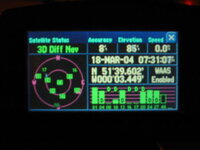
Please read my post on the first page of this thread (the fifth post down from the top, dated March 3) - it explains the status of SBAS (Satellite Based Augmentation Systems) in Europe. Further down the page you can see a picture of a European Space Agency augmentation satellite as it appears on a Garmin GPS in Switzerland... :rolleyes:
 
PanEuropean said:
A while back (March 4th), I posted a note here on this thread asking for some help - feedback - about WAAS reception in Europe. I have not heard much from anyone since then.

Only just got my 2610 installed - I'll have a go tonight!

:thumb
 
Sorry Pan, truth is when I see your long posts I tend not to read them, the first one was 997 words, the second was 888; I still haven’t read it all :hide
 
Sorry Ebbo, that was inconsiderate of me, it must be tiring to read posts of that length, especially when you have to move your lips as you read.

Let me provide this abstract for you:

"WAAS works in Europe."

PanEuropean
 
That’s ok Pan, I tend to loose concentration after... er what was that you said? ;)
 
:)

Sorry, not a very sharp picture - and I couldn't wait 10 mins for 44 to light up!

Greg
 

Attachments

  • img_1262.jpg
    img_1262.jpg
    38.2 KB · Views: 136
Hi Greg:

Thanks a lot for posting that picture, much appreciated. It's interesting to note that satellite 44 is just on the very edge of the horizon, if you are in the UK.

This suggests to me that UK based users might not have much luck with SBAS (3D differential navigation) until the ESA starts transmitting correction data on satellites 37 and 39, which are the ones over the Congo. I have no idea when this will happen, but I presume soon, since the system is due to be commissioned for aviation use this summer.

PanEuropean
 
Ebbo:

Apropos of your comment about losing concentration when reading - I sure believe what you say. Just two paragraphs below what you quoted above (about WAAS only being available in North America), Garmin goes on to say:

"Other governments are developing similar satellite-based differential systems. In Asia, it's the Japanese Multi-Functional Satellite Augmentation System (MSAS), while Europe has the Euro Geostationary Navigation Overlay Service (EGNOS). Eventually, GPS users around the world will have access to precise position data using these and other compatible systems."

Here's the link: What is WAAS?

PanEuropean
 
Hi Pan, perhaps you should send Garmin an email for publishing incorrect information.
 
Ebbo:

I don't think you caught the drift of what I was saying.

WAAS is the brand name of the American SBAS (Satellite Based Augmentation System) that is operated by the US Federal Aviation Administration.

SBAS is the generic name that describes all such systems. For example, WAAS is a SBAS. The upcoming EGNOS system (the brand name for the European system) will also be a SBAS.

Garmin is correct in their statement that WAAS is only available in North America. If you read a bit further down the same page, you will see that they elaborate on plans for other SBAS systems in other parts of the world. Right now, the American WAAS system is the only one that is fully up and running.

As for the ESTB (EGNOS System Test Bed, the forerunner of the European SBAS system), that will be going through quite a few changes during the month of April 2004. Anyone who is interested in getting SBAS augmentation in Europe should have a look at the new satellite broadcast schedule - that way, you'll know ahead of time why it might not be working for you during April. Here's the link: ESTB satellites broadcasting plan - 2004

PanEuropean

PS: For reasons discussed at length in another post here, turning on SBAS ("WAAS Enabled") in Europe will result in a degradation of the performance of your SP 26xx GPSR. If you want to turn it on to observe the capability of the system, fine, turn it on and have fun with it. But if you want your GPSR to operate at peak performance, leave it turned off until EGNOS is fully operational, sometime in the second half of 2004.
 
PanEuropean said:
For reasons discussed at length in another post here, turning on SBAS ("WAAS Enabled") in Europe will result in a degradation of the performance of your SP 26xx GPSR. If you want to turn it on to observe the capability of the system, fine, turn it on and have fun with it. But if you want your GPSR to operate at peak performance, leave it turned off until EGNOS is fully operational, sometime in the second half of 2004.

Yes, I can now confirm that my 2610 did not lose satellite reception on a 100+ mile journey with WAAS unabled.

Greg
 
Dont know if its any use but I get satelite 44 on my GPS 60C on the ride home from work. My GPS says its in 3D. But the bars don't show D's. If Pan is interested I'll take a photo. But if I'm talking bollox, I'll get my hat...
 
Hi Richie:

Your observations are consistent with what is to be expected from the EGNOS testbed platform. Your GPSR showed 3D because it had enough regular satellites in view to give you a three dimensional fix, without any assistance from augmentation satellites. There are a number of reasons that could explain why satellite 44 did not show D's in the signal strength bars for the other satellites - it could have been on test, it could have been transmitting ranging but not correction information, perhaps no correction data was available for the area you were in, etc.

Hopefully they will have this all sorted out when EGNOS goes operational. In the meantime, expect spotty and somewhat unpredictable results from the test signals.

PanEuropean

PS: I'm still not convinced that we (as riders) gain any benefit from SBAS.


Back
Top Bottom