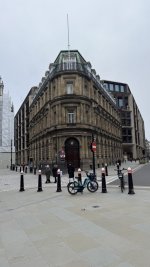
Wapping Wander - From the Thames Barrier to Aldwych, via the City of London

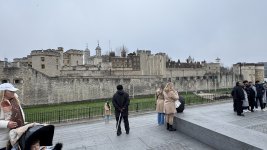
The Tower was busy with tourists, looking to get through the security checks but we are not going that way.

IMG_7814.jpeg

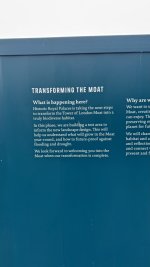
A couple of days ago, I had noticed that they had earthmovers in the eastern end of the moat. The reason why was explained on a notice:

IMG_7813.jpeg

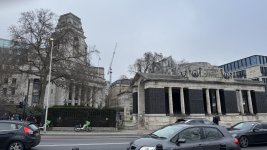
Then north just a bit, to Tower Hill, where lesser nobility and assorted traitors lost their heads. It’s also the site of the memorial to merchant seaman lost in wars, along with the former HQ of the Port of London Authority (now a multi-star hotel) and Trinity House, who look after all the lighthouses around our coast.

IMG_7815.jpeg

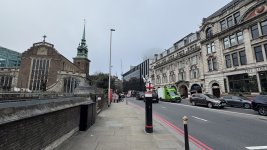
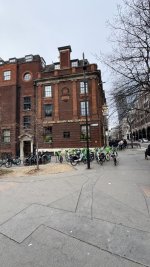
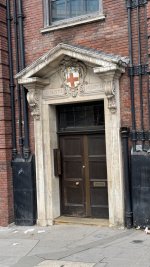
Turning left, we are about to leave Tower Hamlets and cross the border into the City of London, marked by the heraldic beasts. The church to the left is said to be the oldest church in the City, All Hallows by the Tower, dating originally from 675 AD. The City has 50 or so churches, reduced from over 100 in Medieval times through to the mid-1600’s. The Great Fire of 1666 did for some, the Blitz of 1940 for still more.

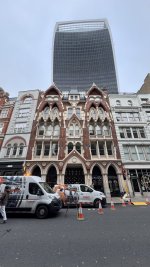
The arches behind the green van are the entrance to the former Mark Lane tube station, which became obsolete when the line was moved to Tower Hill. The building in the distance is the Walkie Talkie building on the western end of Fenchurch Street:

IMG_7819.jpeg

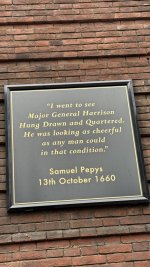
We’ll walk westwards, past the Hung, Drawn and Quartered pub (known simply as the HDQ) on a site linked somehow (I need to find out how) to Christ’s Hospital, which is away over on the other side of the City. Pepys lived not far away on Seething Lane and is buried in a nearby church.

IMG_7820.jpeg

IMG_7821.jpeg

IMG_7822.jpeg

Still walking west, we are on Eastcheap, where you’ll find (as is so common in the City) places where old meets new, in a wonderful jumble:

IMG_7823.jpeg

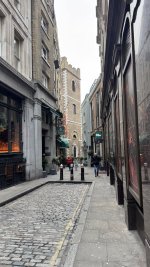
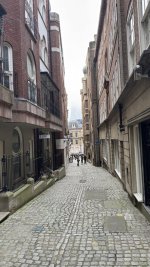
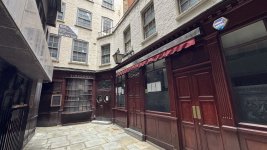
The City, though ravaged by fire, bonds and developers, still retains many of its old (and in some cases very old) lanes, passages and streets. There are no ‘roads’ in the City at all. Our second office was down one such lane (Lovat Lane) leading down from Eastcheap towards the river. Tge church is St Anne’s Lutheran Chuch, which itself backs onto another separate chuch, St Mary at Hill. I told you there is a lot of churches in the City:

IMG_7824.jpeg

Our office, the first in the redeveloped area is the building on the right. The buildings on the left were not there in our time, but were falling down ruins, left over from the Blitz and/ or fallen into disuse with the reduction in the use Billingsgate Fish Market, which was still trading each day. The area was almost a Dickensian slum, right in one of the richest area of real estate in the world. The cobbles are all original and used to glisten with fish scales, before being hosed down. I used to commute in from Finchley (N12) by motorcycle and park / abandon it in Lovat Lane, as nobody gave a toss. At the end os tge alley, yiu can see Billingsgate and just about visible behind it, the Shard on the other side of tge Thames,

IMG_7826.jpeg

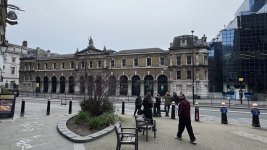
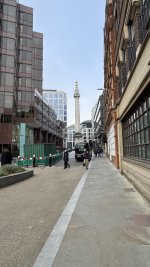
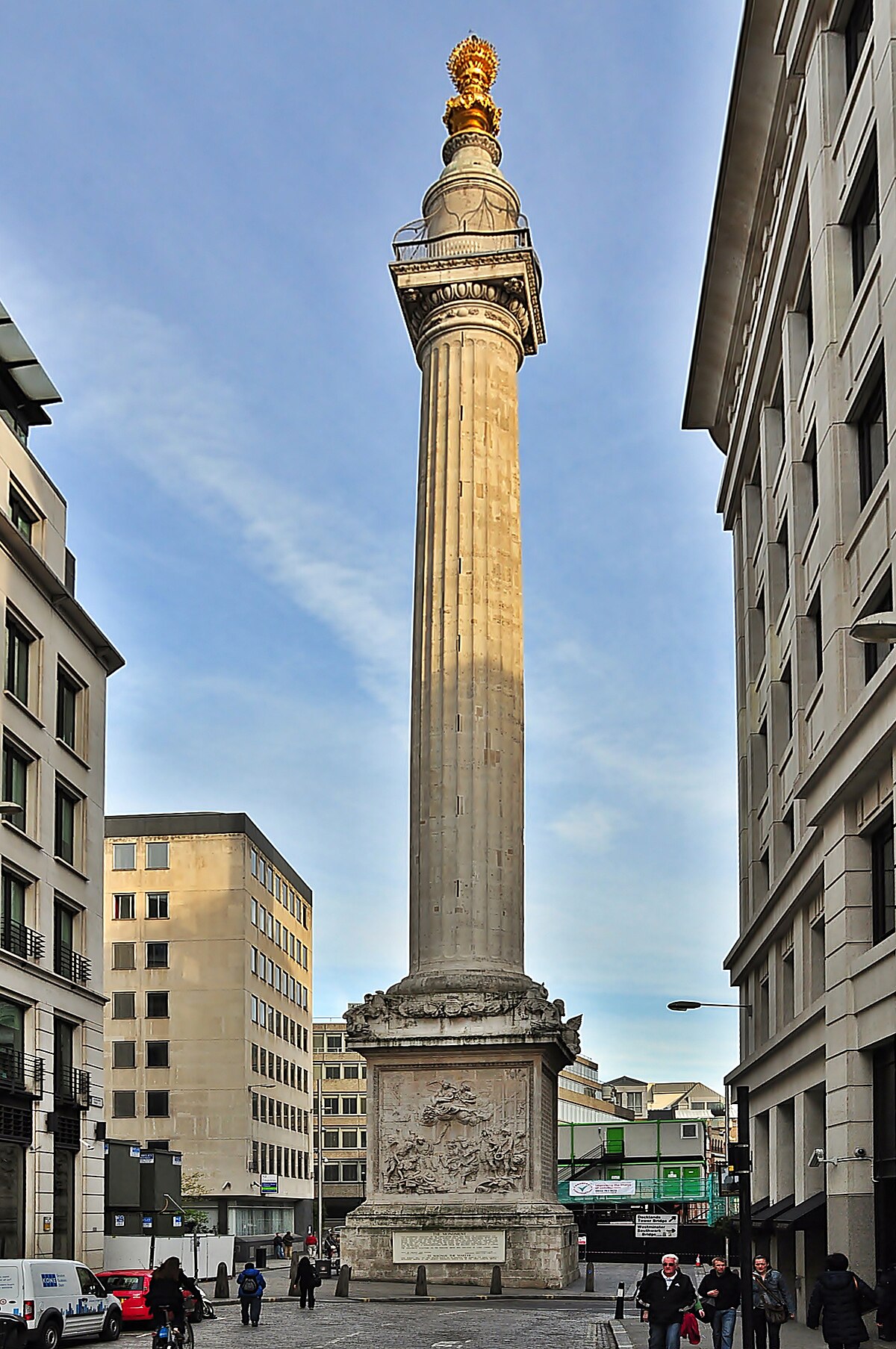
At the end of tge lane is the former Billingsgate (now an ‘events’ site) and turning right is the Monument, commemorating the Great Fire of 1666, which started near enough on that spot in a bakery on Pudding Lane. Pudding Lane is still there, naturally, as sometimes very little changes. The pub, just visible to the left of the first picture is now the Walrus & Carpenter. When we had our office, it was the Red Lion, only open to workers in Billingsgate and open from roughly midnight thro’ to 08:30. It was though not entirely unknown for us to drop in for a pint before work.

IMG_7827.jpeg

IMG_7828.jpeg


Last edited:
Thanks for that Wapping. Have you seen this map of Tudor London for browsing or cross reference purposes? I really like it.
 
Thanks for that Wapping. Have you seen this map of Tudor London for browsing or cross reference purposes?

Thank you.

I am due a visit to the Guidhall at some point, I’ll pick one up.

I often look at maps, where they overlay the old roads of the City on top of the ‘modern’ streets. It’s noticeable how many have not changed, since Roman and Medieval times.
 
Last edited:
Thank you, an excellent read and tour. I’ve not been to London in years, but this makes me think I really should, so much history.

In answer to a question by Doc, no bar on the Cutty Sark, but there is the Cutty Sark pub just along from it, which used to be home to our MG owners club meetings- happy times many years ago.

Thanks again, enjoying this history tour :)
 
Thanks Richard, very enjoyable tour around some historic areas, gives me a few ideas for wanders when next 'doon the smoke' I love watching John Rogers rambling around London on YouTube, also Robs London, Joolz and Jago Hazard etc
 
Thank you everyone for the kind comments.

I have spent just short of 40 years, wandering in idle moments around the ‘Square Mike’ of the City of London * and still trip over oddities. The biggest change? None of the huge towering office blocks were here when I started. After a while you forget what was there before. One very simple example. The French AGF insurance company (it is now part of Germany’s Allianz) had their first office next door to the post office in Leadenhall Market. That went in the early 80’s. Their second office, again in Leadenhall Market, was up some rickety stairs and still had a live fire in the brokers’ waiting area.

Leadenhall Market was itself still a functioning market then (it isn’t now) the streets within the market running with blood come closing time of the many butchers’ shops. You can still see how the road curves down to the edge, so that the blood and hosed water would run down to the drains. It’s the march of progress; a lot of it very good, if sometimes a bit sterile.

I and my immediate colleagues will be the last generation to remember ‘How it was’. I bet though, that in 2065 there will be Wapping 2, saying much the same thing, as the hover bus hovers outside his 92nd floor window and he prepares to wander to the Swan (still there, no doubt) for a pint of London Pride.

* I still need to do the 50 remaining City churches and the more besides ruins. I’d also like to do the livery companies. How ridiculous perhaps to have 50 (there used to be 100 or more) churches in a square mile. But they tell us something about the people who lived, worked, loved and died within or just outside of the City of London’s walls, for well over a thousand years.
 
Last edited:
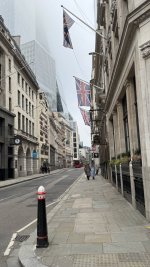
Turning up from the Monument, across Fenchurch Street, we can walk up Lime Street to Lloyd’s of London, the immediate streets for a roadhouse of about 250 yards full of insurance and reinsurance offices. You can just see the edge of the Gherkin building, across Leadenhall Street on St Mary Axe. The latter is maybe interesting as the street takes its name (as so many do) from the church. There used to be a sign in Lime Street, recording that used to be the site of the Coal Office, where imported coal was taxed. A thoughtless developer removed it; another little tiny piece of history removed and lost.

IMG_7830.jpeg

Turning left from Lime Street, we come to the Victorian splendour of Leadenhall Market:

IMG_7831.jpeg

I often see fans of Harry Potter standing for selfies outside this blue door. I have no idea why:

IMG_7832.jpeg

Then, taking a little former alley in the market, we come to my favourite City pub, the Swan on Gracechurch Street (it’s those churches again). The pub is not very large, being just the width and length of the yellow / magnolia wall to the right of the first picture (left in the second) and the small room on the first floor of the ‘bridge’ across the alley:

IMG_7833.jpeg

IMG_7834.jpeg


Last edited:
Looks to be some great hidden pubs around. Presumably not visited by tourists ?
 
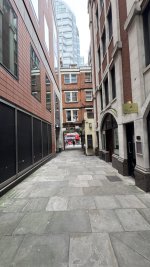
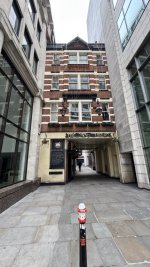
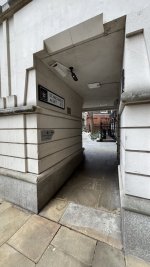
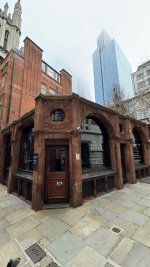
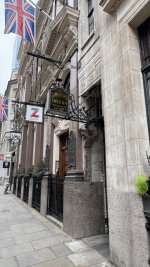
Crossing over Gracechurch Street, we can cut the corner between Gracechurch Street and Cornhill by taking one of the alleys (named after yet another chuch) into a little warren of courts, alleys and passages. Passing by the Jamaica pub (known the the jam pot) and the now closed Simpsons, not to be confused with the same named restaurant in the Strand. The closure of Simpsons, whose sign still hangs on Cornhill at the narrow entrance to Ball Court, is one of the saddest tales of the last year or so; with a greedy freeholder trampling all over history and the City of London Corporation (the City’s supposed ‘guardians’) unwilling to step in. Someone should take the sign and shove it somewhere painfull up the person who allowed this to happen:

IMG_7835.jpeg

IMG_7836.jpeg

IMG_7837.jpeg

IMG_7840.jpeg

IMG_7841.jpeg


Last edited:
Looks to be some great hidden pubs around. Presumably not visited by tourists ?

Yes, there are some great ‘hidden’ pubs but also some horrible ones, built in the last 20 or so years into former banking halls, little better than Weatherspoons. Naturally enough, I don’t frequent the latter.
 
....´´All Bar One´´..I think these are terrible places.....
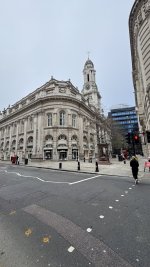
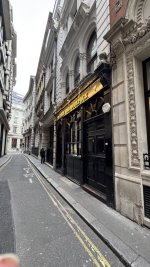
Another one which is nice but a bit further West is this one: Ye Olde Mitre. It is a Fullers pub so beer might not be to everyone taste. Doc - London Pride on draught is better than in the bottle. :LOL: :LOL:
If Wappers is heading that way maybe we get a pic on his tour

Maybe we should start a thread:
´´Show us your favourite pubs´
and why they are so good. could also server as reference for others.
 
....´´All Bar One´´..I think these are terrible places.....
Another one which is nice but a bit further West is this one: Ye Olde Mitre. It is a Fullers pub so beer might not be to everyone taste. Doc - London Pride on draught is better than in the bottle. :LOL: :LOL:
If Wappers is heading that way maybe we get a pic on his tour

Maybe we should start a thread:
´´Show us your favourite pubs´
and why they are so good. could also server as reference for others.
I still have a bottle ready for a guest to drink. I wanted to enjoy it but wasn't to my taste.
 
Out onto Cornhill, with the expensive shops of the Royal Exchange in front of of us:

IMG_7838.jpeg

But we’ll turn right to cut down Finch Lane, past the Cock and Woolpack (aka the Tool and Tampon):

IMG_7842.jpeg

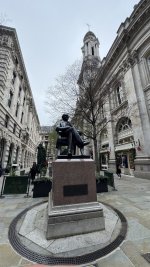
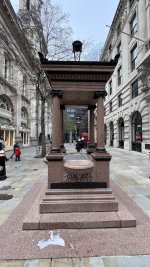
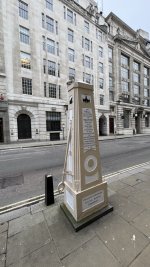
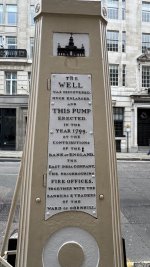
To emerge on Threadneedle Street, to cut back again to Cornhill, past the Royal Exchange and its monument to the great philanthropist, Peabody, the old drinking fountain and even older water pump. The reference to the East India Company (the Amazon of its day) is interesting only in as much as, besides a pub on Fenchurch Street (not far from where the East India Company had its HQ) and a very large dock, almost no record of a company that traded for well over 300 years, owned its own army and ‘owned’ the whole of India, ever existed.

IMG_7844.jpeg

IMG_7845.jpeg

IMG_7846.jpeg

IMG_7847.jpeg

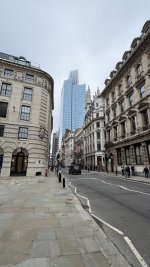
Pausing to just look back eastwards towards the City towers, now behind us:

IMG_7848.jpeg

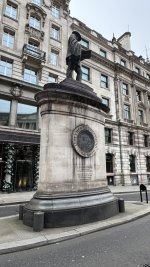
Before turning left on Cornhill, to walk past the statue of Gratehead, who invented the method of underground tunnelling to build the tube lines:

IMG_7851.jpeg

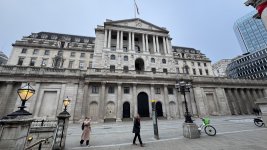
To arrive at Bank (taking its name from the Bank of England):

IMG_7853.jpeg

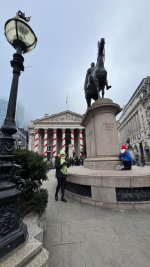
with the front of the Royal Exchnge, the London Troops Memorial and Wellington’s statue:

IMG_7854.jpeg

We are now in the very centre of the City of London, the ‘insurance’ part behind us and standing where all the banks used to have their headquarters, before they all moved to Docklands / Canary Wharf.

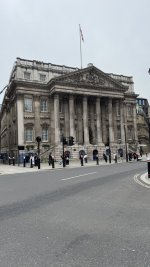
Here’s the Mansion House, just across the road, home of the mayor of the City of London:

IMG_7855.jpeg

and the City of London magistrates court, where I once appeared in front of the the very frightening Lady Lord Mayor, sitting as a stipendury magistrate. My crime? Speeding on my motorcycle through the City. You can see how brown the buildings are, when left uncleaned, a reminder of a time when London was blanketed in smoke from thousands of coal fires:

IMG_7856.jpeg


Time to continue westwards, still in the City to……. To be continued……
 
Last edited:
Thank you everyone for the kind comments.

I have spent just short of 40 years, wandering in idle moments around the ‘Square Mike’ of the City of London * and still trip over oddities. The biggest change? None of the huge towering office blocks were here when I started. After a while you forget what was there before. One very simple example. The French AGF insurance company (it is now part of Germany’s Allianz) had their first office next door to the post office in Leadenhall Market. That went in the early 80’s. Their second office, again in Leadenhall Market, was up some rickety stairs and still had a live fire in the brokers’ waiting area.

Leadenhall Market was itself still a functioning market then (it isn’t now) the streets within the market running with blood come closing time of the many butchers’ shops. You can still see how the road curves down to the edge, so that the blood and hosed water would run down to the drains. It’s the march of progress; a lot of it very good, if sometimes a bit sterile.

I and my immediate colleagues will be the last generation to remember ‘How it was’. I bet though, that in 2065 there will be Wapping 2, saying much the same thing, as the hover bus hovers outside his 92nd floor window and he prepares to wander to the Swan (still there, no doubt) for a pint of London Pride.

* I still need to do the 50 remaining City churches and the more besides ruins. I’d also like to do the livery companies. How ridiculous perhaps to have 50 (there used to be 100 or more) churches in a square mile. But they tell us something about the people who lived, worked, loved and died within or just outside of the City of London’s walls, for well over a thousand years.
Thanks for posting.
I worked on the Isle of Dogs, on and off, between 82 & 84 at the beginning of it’s modern development. We were building apartment blocks along the river and a few starter homes ‘inland’ - I don’t suppose the starter homes lasted long as Canary Warf came along not long after.
There were still a lot of ‘locals’ but they saw the writing on the walls and were generally sad to see their old community being gentrified and resigned to the fact that soon they would be shifted out to some God awful estate on the edge of London - as many had been before them.
We would often go for a pint in the Waterman’s Arms - the doors were open all day but if we went in and no one was behind the bar we could pull ourselves a pint and leave the money on the counter.

Different times now but I do wish I had bought one of those apartments back then 😉
 
Different times now but I do wish I had bought one of those apartments back then

In the early 80’s, I bought my two bedroom terraced house in Bethnal Green, E2 for £9,000. No kitchen or bathroom and an outside loo. It last sold for £920,000. One of its several sisters in the same row *, has just gone through £1,300,000. Hey-ho, you can’t keep everything.


* It’s only odd numbers. The even numbers of the row opposite were bombed flat and demolished, replaced by a less than glamorous block of 50’s to 60’s flats.

 
Last edited:
In the early 80’s, I bought my two bedroom terraced house in Bethnal Green, E2 for £9,000. No kitchen or bathroom and an outside loo. It last sold for £920,000. One of its several sisters in the same row *, has just gone through £1,300,000. Hey-ho, you can’t keep everything.


* It’s only odd numbers. The even numbers of the row opposite were bombed flat and demolished, replaced by a less than glamorous block of 50’s to 60’s flats.
I did the same in Hackney in 1986. A two-bedroom house for £42,500 (the neighbours thought I was stark, staring mad). I sold it in 1996 for £95,500 and I thought I was the smartest man in the world. Recently sold for £807,000 (and it was too small for us when we became a family of three) ....


Back
Top Bottom