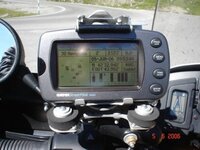
What does the 'D' mean?

ovenpaa

Registered user
Joined
Jan 9, 2005
Messages
3,946
Reaction score
1
Location
UK again Pah!..
I have been meaning to ask for ages, what does the 'D' mean over the bars in the satelite status screen of the 2610, I know it is probably in the book, but that is at home, I am at work, and I will forget by the time I get back... :) :)

Edit - guess the location anyone? the height is in metres.
 

Attachments

  • DSC01022.JPG
    DSC01022.JPG
    28.1 KB · Views: 371
ovenpaa said:
what does the 'D' mean over the bars in the satelite status screen of the 2610

You're receiving corrected differential (the D!) data from an EGNOS satellite (in Europe, WAAS in the US, and GLONASS in the former Soviet republics)

There y'go.

-Rob
 
ovenpaa said:
I have been meaning to ask for ages, what does the 'D' mean over the bars in the satelite status screen of the 2610, I know it is probably in the book, but that is at home, I am at work, and I will forget by the time I get back... :) :)

Edit - guess the location anyone? the height is in metres.
On that great road between La Seu d'Urgel and Sort? :nenau
 
ovenpaa said:
Edit - guess the location anyone? the height is in metres.

avinguda del consell general in andorra?
 
robD said:
You're receiving corrected differential (the D!) data from an EGNOS satellite (in Europe, WAAS in the US, and GLONASS in the former Soviet republics)

There y'go.

-Rob
I'm impressed Rob if noone else is :thumb
 
robD said:
You're receiving corrected differential (the D!) data from an EGNOS satellite (in Europe, WAAS in the US, and GLONASS in the former Soviet republics)

There y'go.

-Rob

Cheers, I actually took time out to research this after your handy hint!
 
robD said:
You're receiving corrected differential (the D!) data from an EGNOS satellite (in Europe, WAAS in the US, and GLONASS in the former Soviet republics)

Hi Rob:

The first part of your statement is correct, but the last bit of info in the parenthetical remark is incorrect.

WAAS (Wide Area Augmentation Service) and EGNOS (European Geostationary Navigation Overlay Service) are two implementations of what is referred to generically as SBAS (Satellite Based Augmentation Service). But - SBAS only augments the satellite navigation system that is operated by the US Military - the system known as GPS (Global Positioning System). The GLONASS system is an entirely different satellite based navigation system that is operated by Russia (before that, the CIS, and before that, the CCCP). It is possible that there is some kind of augmentation system for GLONASS, however, if there is, it won't be of any use to those of us who use the GPS (American military) system.

Here's a quick decoder for the alphabet soup of acronyms:

Satellite Based Navigation System
There are two systems that I know of, the system operated by the US Military (known as GPS), and the system operated by the Russian military (known as GLONASS). Although the two systems are very similar in concept, they are not compatible with each other. It's just like cell phone systems in the USA - you can have a GSM phone, or a CDMA phone - they both look the same, but the GSM ones won't work on the CDMA networks and vice-versa.

GPS is actually a 'brand name', not a generic term. The problem is that many people use the US Military name for their system (GPS) as a generic term for all satellite based navigation systems - kind of like using the word 'Kleenex' to refer to facial tissue.

The GLONASS system has never achieved any consumer market penetration. A few years ago, some companies that made aircraft navigation systems offered systems that would listen to both the GPS satellite constellation and the GLONASS satellite constellation, but no-one was willing to pay the extra money for such a 'belt and suspenders' system, so, the avionics companies gave up on that.

Just to confuse matters even further - the EC is in the process of starting up their own satellite based navigation system, which will be called GALILEO. This is going to be the biggest commercial flop since Motorola just about went bankrupt putting up the Iridium satellite phone system. Heck, if the Americans are already offering their service (GPS) free of charge, who is going to want to pay for an identical service that only covers Europe? Your tax money at work... :rolleyes:

Satellite Based Augmentation Service (SBAS)
SBAS is the correct generic term to describe any system that augments (=corrects minor localized errors) in the American mulitary (GPS) satellite navigation constellation. Both WAAS and EGNOS are examples of SBAS. The Japanese also operate a SBAS, and the Indians are working on getting one operational as well.

SBAS systems are very simple - here's how they work: You go buy a GPSR, and mount it on a cement plinth somewhere, such that it will never move. You then monitor where that GPSR tells you it is, and note the errors that it makes (e.g. 5 feet too far north, 8 feet too far west). Then, you send the error information up to a simple, el-cheapo transponder that you rent on a plain old commercial satellite (just like Sky TV), and that el-cheapo transponder sends out a message to all the GPSRs on motorcycles in the area, advising them of the error that exists at the moment. The GPSRs on the motorcycles then apply the appropriate correction to the position that they have calculated by listening to the satellites in the GPS constellation.

There are other forms of augmentation systems - for example, local differential augmentation that is used by mariners, and if you want, you can even buy your own augmentation system (for about $3,000) and set it up in your back yard. Farmers in America frequently operate their own augmentation systems to allow them to achieve centimeter accuracy (yes, centimeter) when planting, fertilizing, and harvesting crops.

Oh, by the way - Ovenpaa, your software is out of date. If you had the latest software, it would say 'EGNOS', not 'WAAS'. The most recent software is smart enough (and politically correct enough) to know which side of the ocean it is on, and use the correct local word when referring to SBAS. :D

Michael
 
PanEuropean said:
Oh, by the way - Ovenpaa, your software is out of date. If you had the latest software, it would say 'EGNOS', not 'WAAS'. The most recent software is smart enough (and politically correct enough) to know which side of the ocean it is on, and use the correct local word when referring to SBAS. :D

Michael
Now I am confused, apart from updating to City Navigator v8 which I have just done what else needs updating or is this a reference to 2610 firmware of some kind?
 
Dander over to www.garmin.com and check out the firmware updates at Updates & Downloads, Unit Software. I'd link it directly, but it involves downloading (or not) a web updater :thumb
 
Just to confuse matters even further - the EC is in the process of starting up their own satellite based navigation system, which will be called GALILEO. This is going to be the biggest commercial flop since Motorola just about went bankrupt putting up the Iridium satellite phone system.

Whilst I'm no expert on GALILEO, I disagree. US GPS technology is something 2 decades old. Things have moved on more than a touch. I understand that a GALILEO receiver chipset should ultimately be avaiable for about 1 quid, meaning every phone will have one. More accurate and cheaper. It also opens the doors for horrible orwellian ideas - every bike and car could so easily have one and be tracked - no more speeding for us :(

Certainly there are a lot of companies out there who think it will be a sucess and are pumping money into it.

Just because VHS did the basic job it didn't stop DVDs, even when they couldn't record so were clearly functionality inferior :eek:
 
ovenpaa said:
Now I am confused, apart from updating to City Navigator v8 which I have just done what else needs updating or is this a reference to 2610 firmware of some kind?

Hi Ovenpaa:

There are (basically) three different software components involved in your Garmin system. Two go inside the GPSR itself, and the other goes on your computer, to allow you to manipulate routes, tracks, and so forth on your computer, and then transfer this information to and from your GPSR.

Here's a quick overview:

1) Cartography (maps)
This is what you just updated, judging from your reference to getting 'Version 8'. You do have to pay for map updates, which come out about once a year or so. Most people don't update every year - for recreational use, updating every second year is generally good enough.

2) Software that runs the GPSR (Unit Software)
This refers to the software that actually makes the GPSR work - that tells it how to find the satellites, how to present information on the screen, what the buttons should do, and so forth. Software updates are free from Garmin for the life of your GPSR. Updates tend to come out about once every 6 weeks or so when a GPSR is new and first released to market, and then the release cycle slows down to once or twice a year when the product becomes mature. The easiest way to get software updates for your GPSR is to download a little program from Garmin that will automatically look at your GPSR and download and install these updates. The program is called WebUpdater, to get it, just click here.

3) MapSource
This is a program that allows you to manipulate routes, waypoints, and stuff like that on your computer, and send that information to and from your GPSR. Some GPSRs come with a simplified version of MapSource called 'Trip and Waypoint Manager' - it's basically the same thing.

If you found a CD in the box when you bought your GPSR, that CD had MapSource on it, and it will automatically install when you stuff the CD in your computer. MapSource program updates are also free, forever. To check to see if an update is available, just go to the HELP menu from within the MapSource program, and select 'Check for Update'.

Hope this helps you put everything in perspective.

Michael
 
jimbo said:
Whilst I'm no expert on GALILEO, I disagree. US GPS technology is something 2 decades old. Things have moved on...

Hi Jimbo:

I hear what you are saying, but my point is this: If there is already a widely used, well understood satellite based navigation system available FREE, who the heck is going to want to pay for what will be (more or less) the same thing?

The best analogy I can think of is the failure of the Motorola sponsored Iridium satellite phone system. It was a technological tour de force, an amazing system (basically, a handheld cell phone that would work anywhere in the world, as long as you were outdoors), but it flopped commercially, because 99% of the world's portable phone users could fully meet their needs with the existing GSM phone system. There just weren't enough interested customers available to make Iridium a commercial success.

I kind of foresee the same problem with the ESA's (European Space Agency) planned satellite navigation system. It might make some inroads in very specialized applications where value can be added - and, more likely, where governments can mandate that GALILEO and not GPS be used, such as truck toll systems - but it is not likely to take over from GPS. That train has already left the station, and has way too much of a head start so far as widespread consumer acceptance is concerned.

On top of all that, consider that there are three major consumer markets for satellite navigation: North America, Europe, and the more highly developed countries in Asia. GALILEO can only be sold in one of those markets, but GPS can be sold in all three.

It's a 'government prestige' project, nothing more.

Michael
 
PanEuropean said:
It's a 'government prestige' project, nothing more.
Just as the US system is not there primarily for consumer purposes, I think that Galileo's introduction may also have more do with non-commercial requirements.
 
PanEuropean said:
On top of all that, consider that there are three major consumer markets for satellite navigation: North America, Europe, and the more highly developed countries in Asia. GALILEO can only be sold in one of those markets, but GPS can be sold in all three.


Michael

why do you say that GALILEO can only be sold in one market? Its intenational, having more satelites and a better global coverage than GPS.

If you are wondering why I'm so enthusiastic about GALILEO, its because I spend a dinner sat next to a chap involved in the software development, and I thought it all sounded dead exciting.
I take your point about why pay for something that it free. Is the plan to charge the end users? I guess it must be, although there will be alot of 'added value' services that will be chargable.
 
Hi Jimbo:

It is my understanding that the GALILEO system will only provide navigation coverage for Europe. However - I could be wrong about that (It wouldn't be the first time... :D )

Michael
 
Satellite navigation exists because the military need it. A consumer market is just a convenient extra, sat-nav would exist anyway regardless of the commercial sector so that smart weapons can locate their designated targets etc. I suspect that GALILEO will add considerably to the accuracy of modern weapons targetting. If it helps you get from A to B on your bike or aeroplane, so much the better.


Back
Top Bottom