


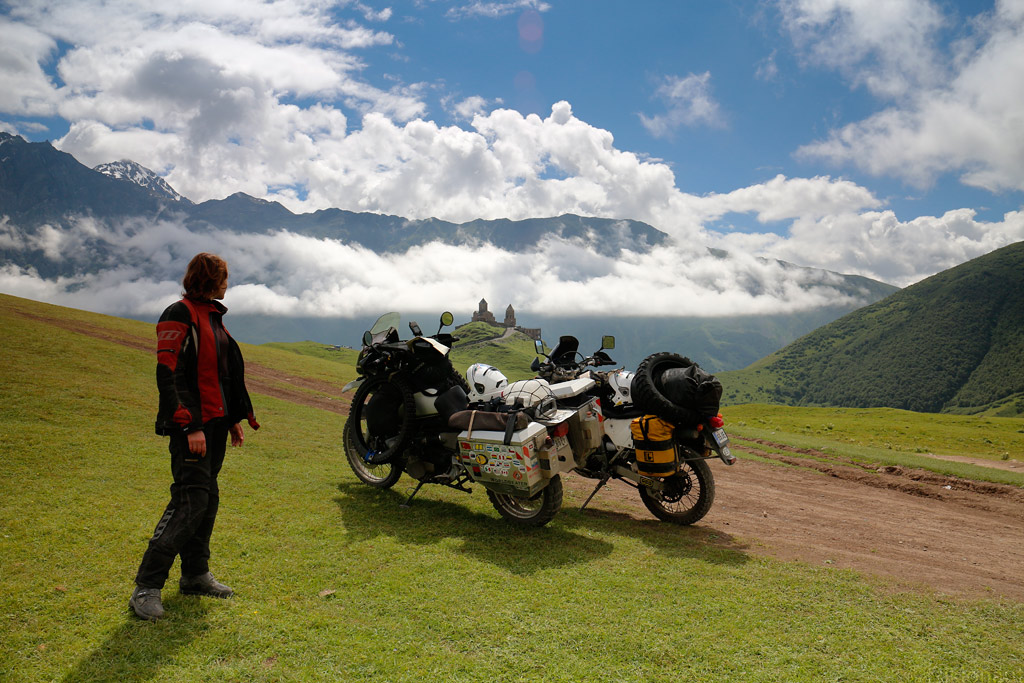
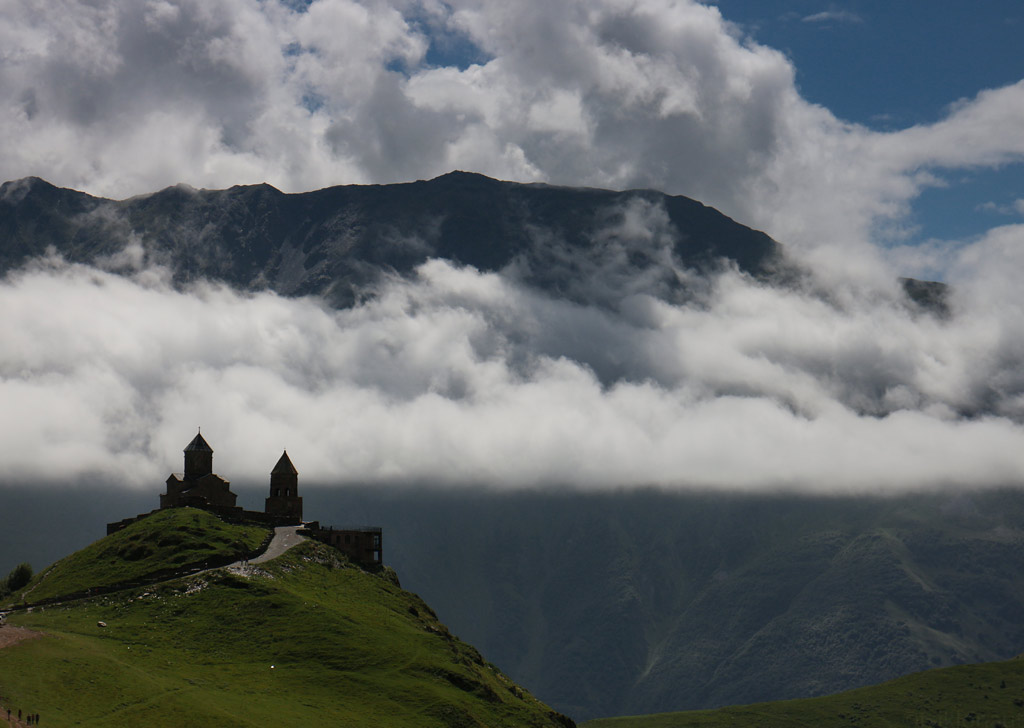
Back in Georgia, we headed further north, to see Kazbegi (or Stepantsminda, as it is now called). There, at the altitude of 2170, is located the famous, spectacularly set church of Tsminda Sameba. To reach it, one has to take a rather vertical, badly eroded rocky track from the village down below.


Riding back south we stopped by the Russia-Georgia Friendship Monument.
The mountains we had seen was still not enough, so we headed east towards the region of Tusheti, known for its wild nature (and of course, more mountains!). We decided to take a shortcut through the foothills of the Caucasus, and surely enough the road was rather bumpy and totally void of traffic. We rode for tens of kilometres without even a tiniest settlement in sight. At one point we noticed a sign pointing towards some fortress a few kilometres off the road, and we decided to indulge the inner tourist in us - we’d been rocking along the bumps for long enough, and we felt we could use a reward. The track leading to the fortress (not featured in tourist literature) was truly narrow, steep and featured loose rocks, so when we had finally arrived by the fortress, we were really pleased not to have slipped and called over.
The fortress (or rather its remnants) was quite amazing, with a huge yard and a church standing in the middle of it. And no one around! We quickly decided to pitch our tent underneath a large tree right in the yard of the fortress, which, as we found out later, dated back to the 8th century.

Church in the fort is from the 10th century.

Us guarded from the wolves and bears with the fortifications, over thousand years old and still standing.
The next day we were on our way to Tusheti, a rather remote area in the northeastern corner of Georgia. The mountains separating it from the rest of Georgia are so high that the area can only be accessed a few months a year. Even the “locals” move to the lower grounds for the long winter.
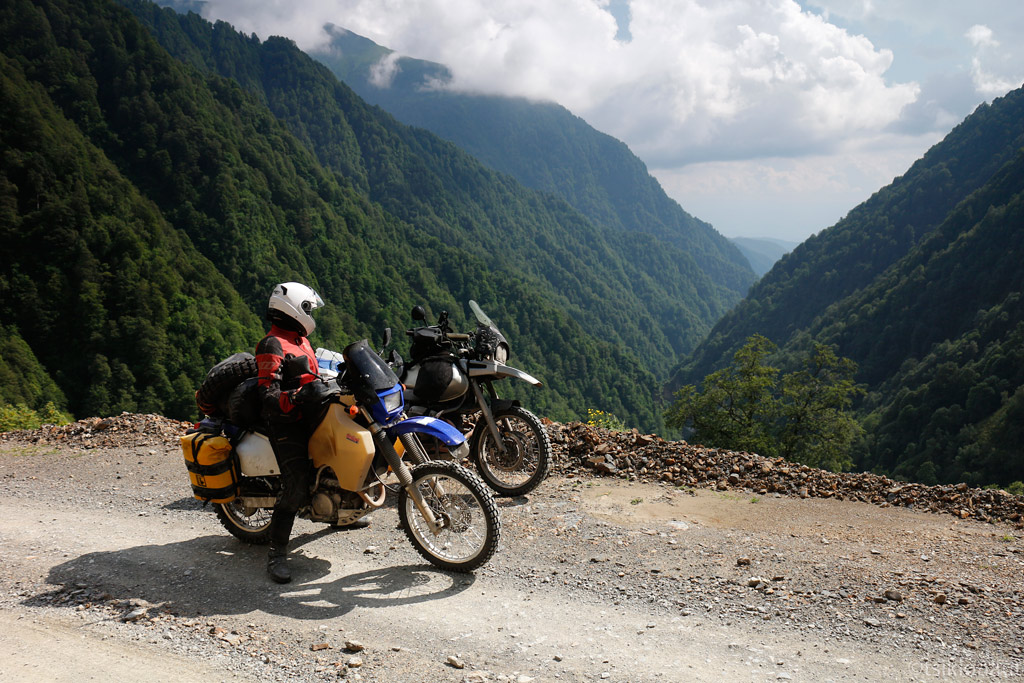
The track going to Tusheti is, as expected, very rocky, bumpy, sometimes muddy, and the closer to the Abano Pass (2900 meters high), the steeper it becomes. In places, the track sticks very close to the mountainside, with unimaginably steep (and long!) drop on the other side. For those afraid of altitude, riding or driving the track can be quite a challenge. It all becomes even more surreal as the track reaches the height of the clouds and you cannot see a bit across the edge.
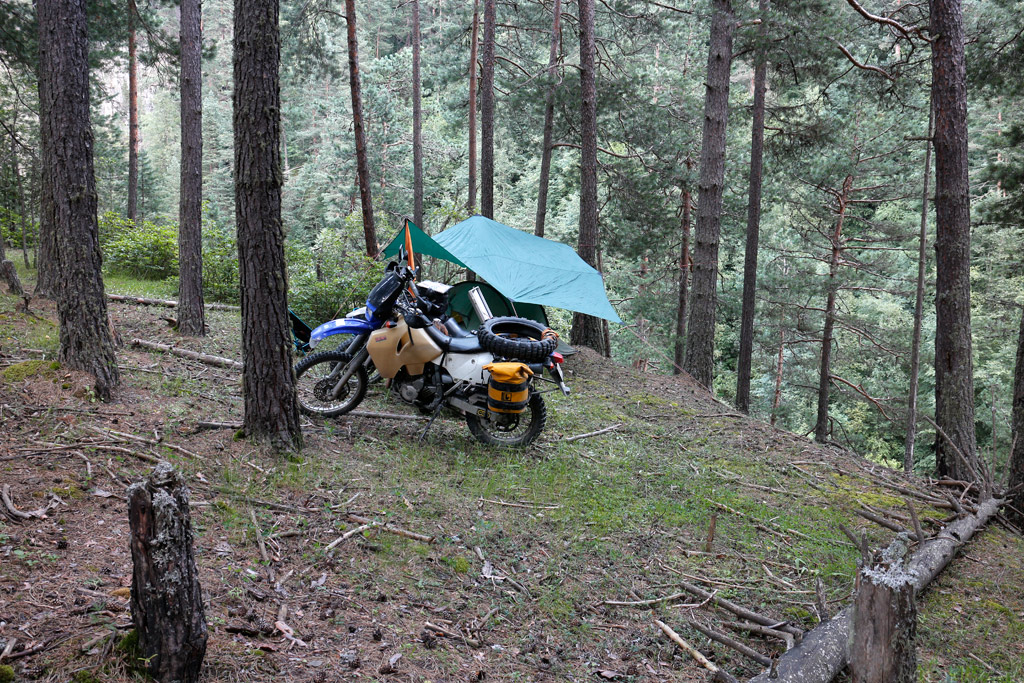
Picture doesn't say much...
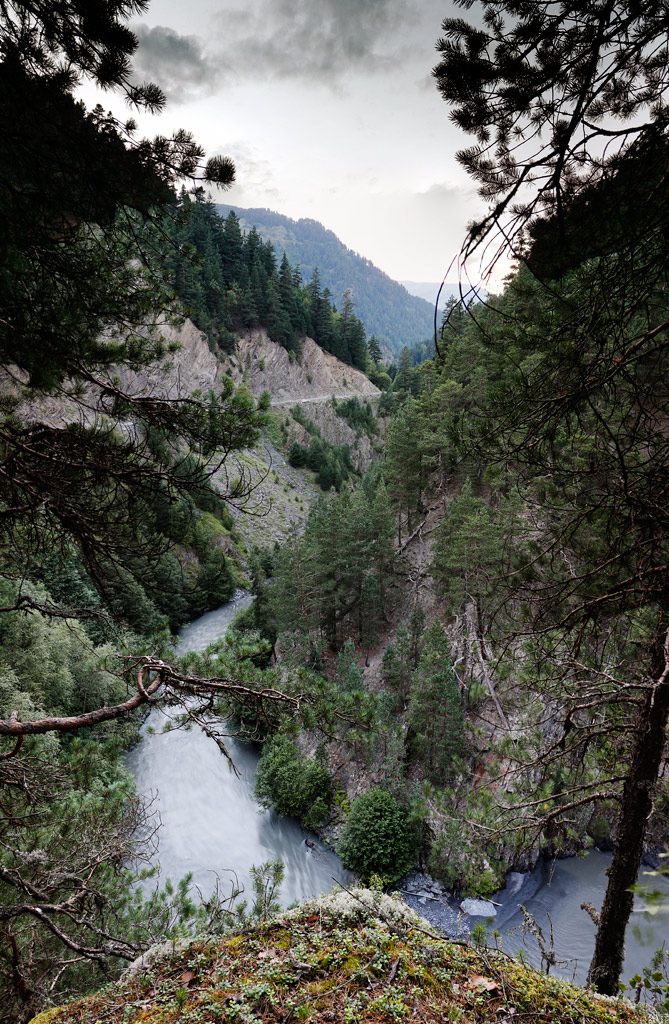
Two meters behind the tent was this kind of gravitational freefall opportunity off the vertical cliff. Try not to go too far to pee during the pitch dark night...

Tusheti.
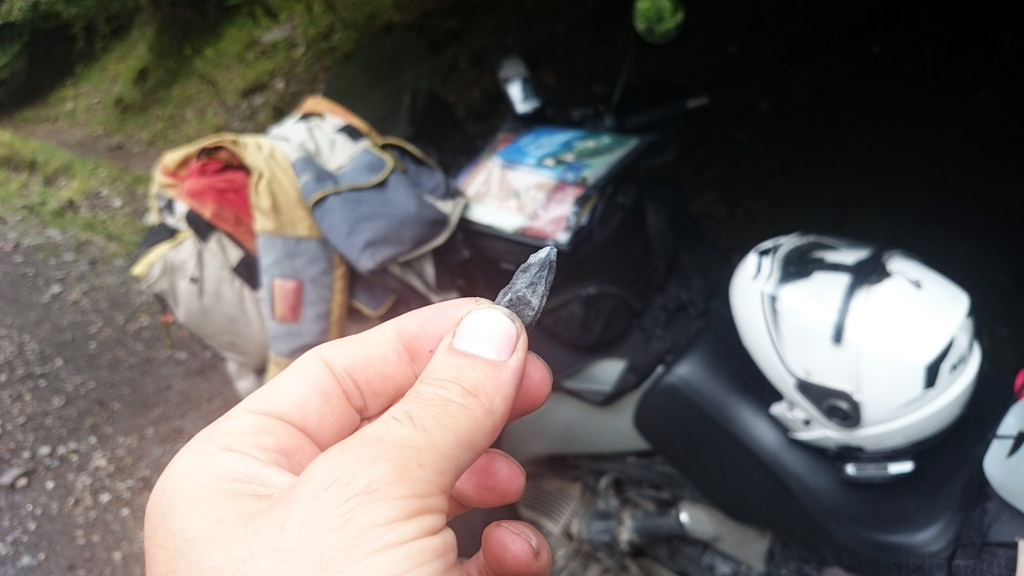
A flat. Found this in my tyre. Looks like a tip of a spear.
And a video about riding the Tusheti.
In general it seems that it takes around 5000 kilometres to really get into the swing of a motorcycle adventure and to start forgetting about the “normal” life and problems related to it. In time, those things gradually get replaced by perceptions of things and events around you in real time. We reached our first 5000 kilometres while in Azerbaijan - a country that is not really on a tourist map.
But as much or as little we would have loved to give it a good chance, we were restricted by stupid customs regulations, according to which a bike can only be temporarily imported for a maximum of 72 hours, so basically one can simply transit the country. And the timing is so precise that they count the time by the minute! One way “around” it is to pay a hefty deposit at the border but then again one has to exit via the same border post to get the money back. At the same time, for cars it is possible to apply for a real temporary import permit allowing for the vehicle to stay in the country the same time you are according to your visa. Anyhow, we were planning to exit on the other side of the country - more precisely, through the port of Baku, leaving by ferry that would take us across the Caspian Sea.
So we only had three days and nights to get to Baku, get our Uzbekistan visas (we had arranged in advance to pick them up there) and get onto some cargo ship that sails to Kazakhstan. We would have liked a lot to pay a visit to Turkmenistan too, but getting even a transit visa would have meant lots of hassle, a lot of time (which we didn’t have this time as we do have to get back to work at fixed time), and in fact still a great amount of uncertainty, so we skipped this plan. So Kazakhstan was our next destination, and we were hoping, really hoping that there would be a cargo ship going there in this meagre time window of 72 hours - actually minus the time it would take us to get to Baku, which is one full day of riding from the border with Georgia. The thing is, that those ships don’t have a schedule, leaving when full, and according to Lonely Planet, in worst case scenario, there are times when there is just one ship sailing every two weeks…
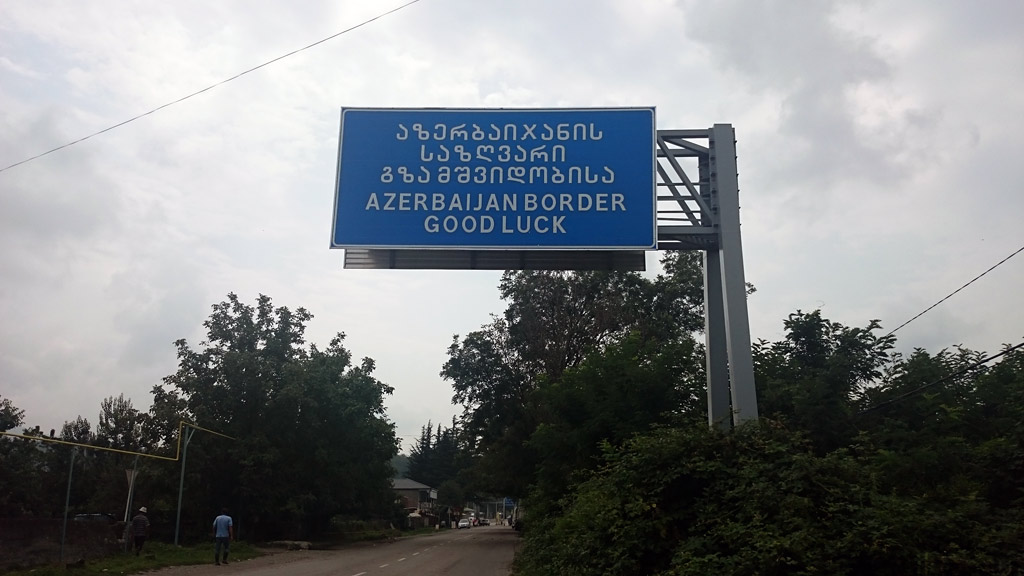
So we headed towards the Azerbaijan border with lots of anxiety. Not just because of this 72-hours rule, but also because as you know, we had been visiting Nagorno Karabakh, which in their eyes is illegal - but we didn’t have any indication about that in our passports. Then again, we’d heard that they’re even suspicious about Armenian stamps, because the country is their “enemy”. We’d actually heard quite some number of not-so-nice stories about the border crossing and the associated hassles, so as we’d cleared the super easy formalities on the Georgian side and rolled towards the Azerbaijani border post a few hundred meters away, we were somewhat anxious. The sign on the Georgian side seemed both discomforting and funny at the same time:
In fact, we were guided through the formalities in a rather efficient (maybe even slightly friendly) way, the whole process taking probably less than an hour. We did get asked some questions about our route in Armenia, and our luggage was briefly searched for related maps, books and souvenirs, but in general, our fears were not justified. We did not even have to pay the “road tax” than many had mentioned in their reports.
In fact, we were guided through the formalities in a rather efficient (maybe even slightly friendly) way, the whole process taking probably less than an hour. We did get asked some questions about our route in Armenia, and our luggage was briefly searched for related maps, books and souvenirs, but in general, our fears were not justified. We did not even have to pay the “road tax” than many had mentioned in their reports.
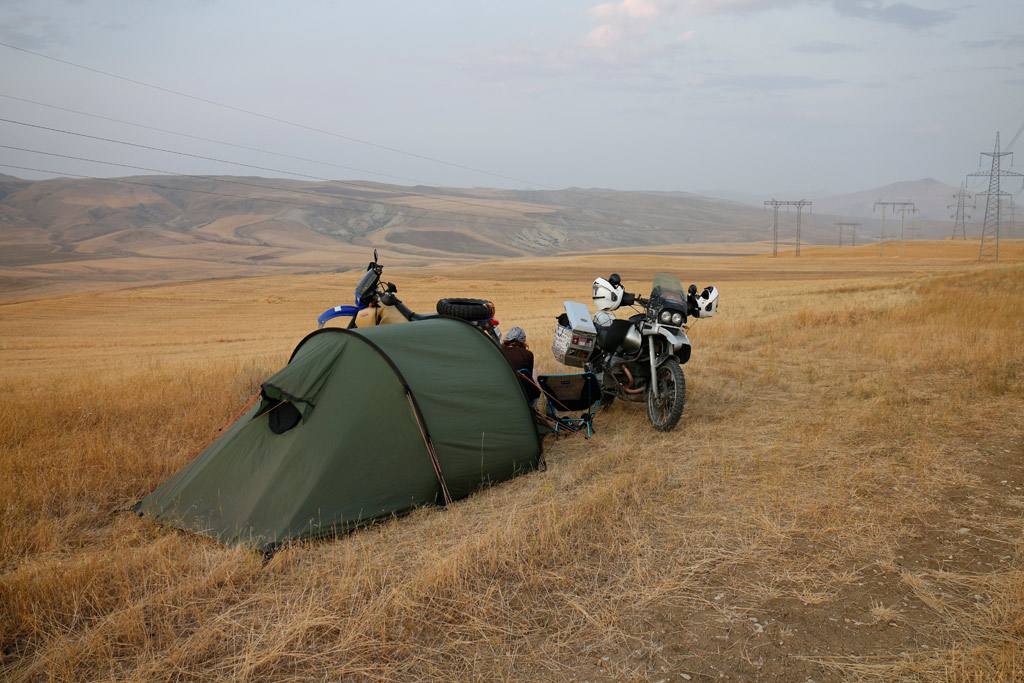
It was a long way to reach Baku, and when the Sun was about to set we still had some 150 kilometres to cover. Rather than pushing on, we decided to find a place to camp. Noticing an off-road track going up the hill next to the road, we followed it for a while. It was a high-voltage power line service track that obviously didn’t see much traffic, so we pitched our tent right next to it.
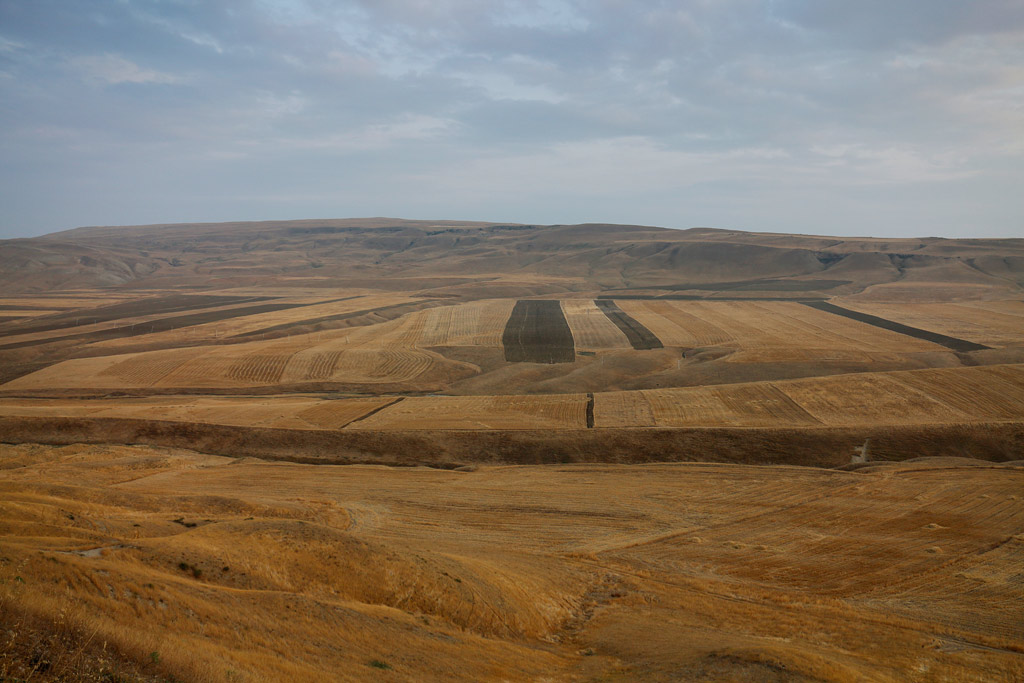
Next day we had to get up early - before sunrise, so that we would arrive in Baku before nine. We needed to find a place to print our Uzbekistan visa invitation letters, find the right branch of a specific bank to pay the visa fee, and find the embassy to pick up our visas before we could start arranging for our transport across the Caspian. After arriving in Baku (which was delightfully empty, so we could lose and find our way again without too much traffic stress) we got all the necessary bits sorted relatively efficiently.
As we called the harbour ticket office we were surprised to find out that a ship would be leaving the same evening. Although we secretly had wished that we’d been given a little more time to see Baku and Azerbaijan, we grabbed the opportunity and asked to keep place for us on that ship, as no one really knows when the next one would leave, and we simply didn’t have time due to that stupid import restriction. We had half a day before we had to be at the harbour of Alat, some 70 kilometres south of Baku. After having a lunch of fried eggs and potato at a local eatery, we headed into the nearby mountains to contemplate some “mud volcanoes”. They are not as big as the name would perhaps imply, but pretty impressive nonetheless, quietly but incessantly spitting out grey mud. It appears that around half of all mud volcanoes in the World are located in Azerbaijan.
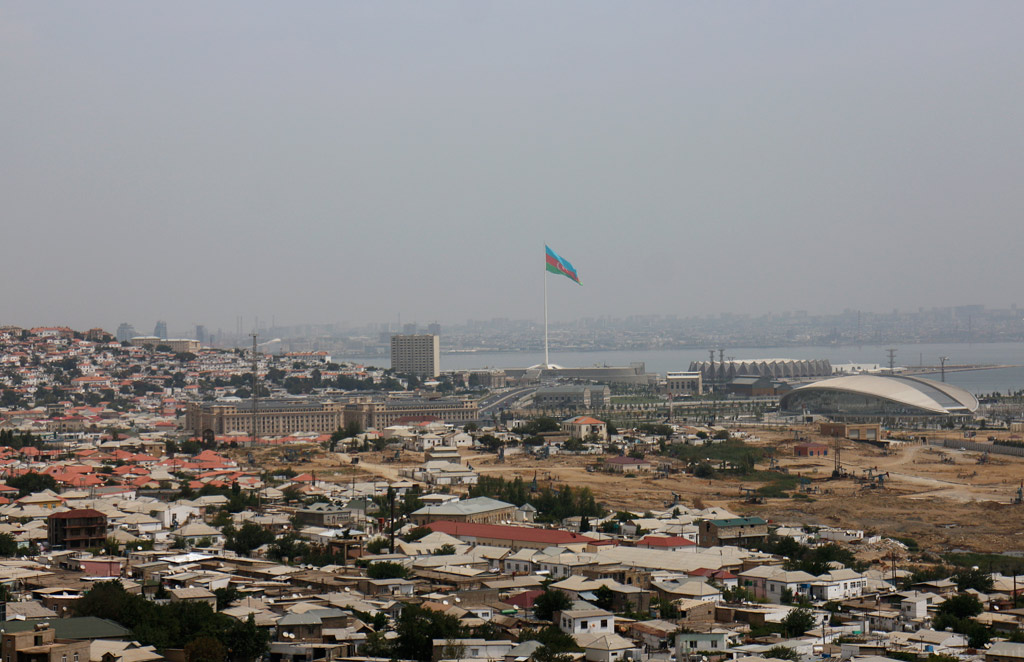
Baku, in the center is the 2nd tallest flagmast in the World.
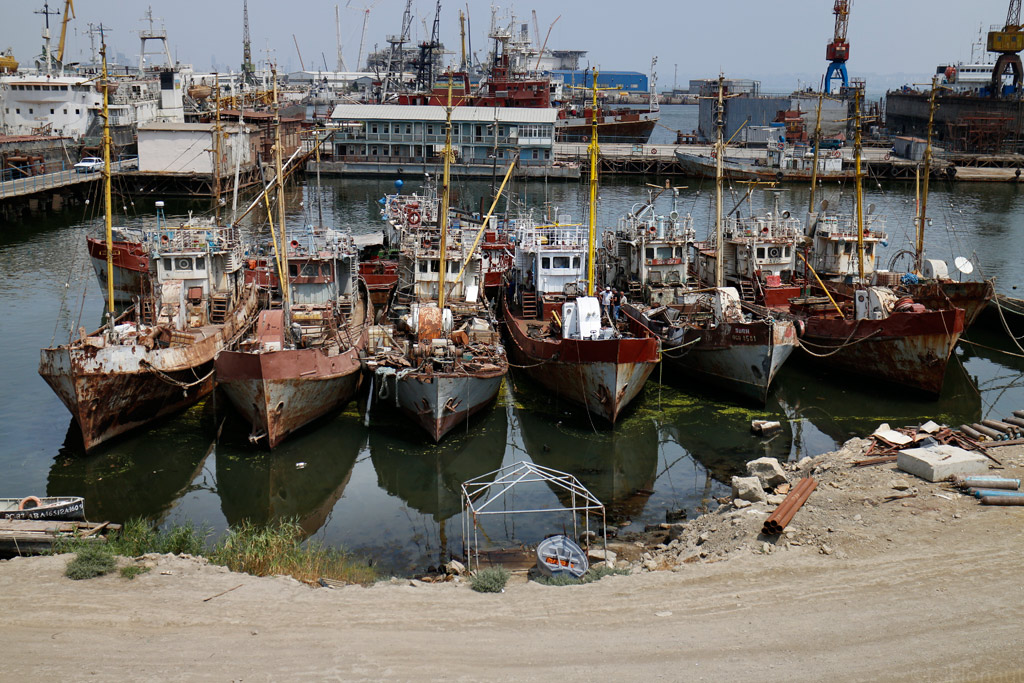
Port of Baku.
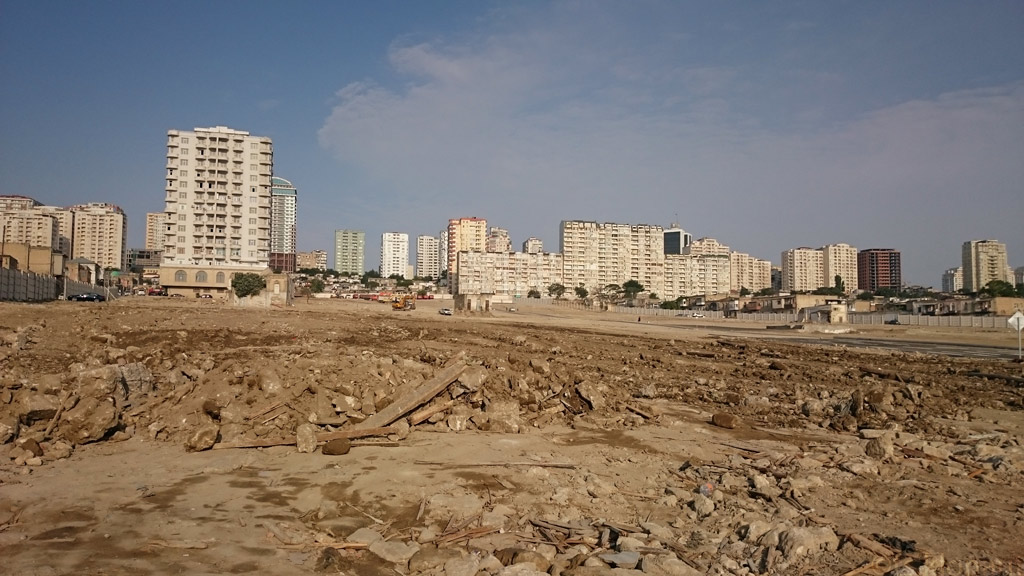
City.
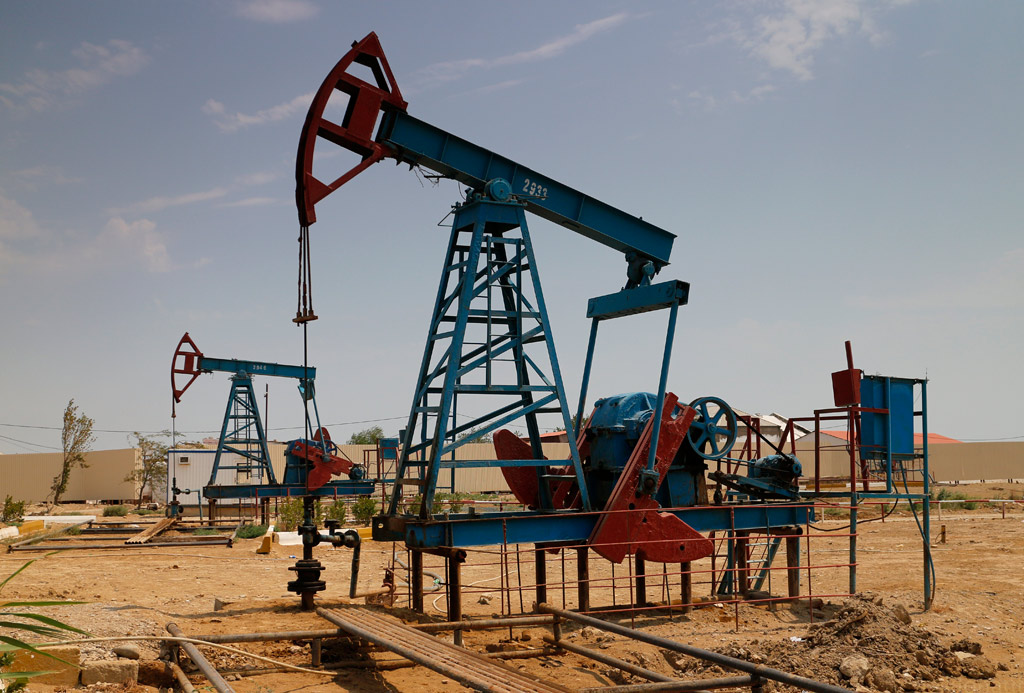
Oil pumps going strong in the city of Baku, not too far from the centre.
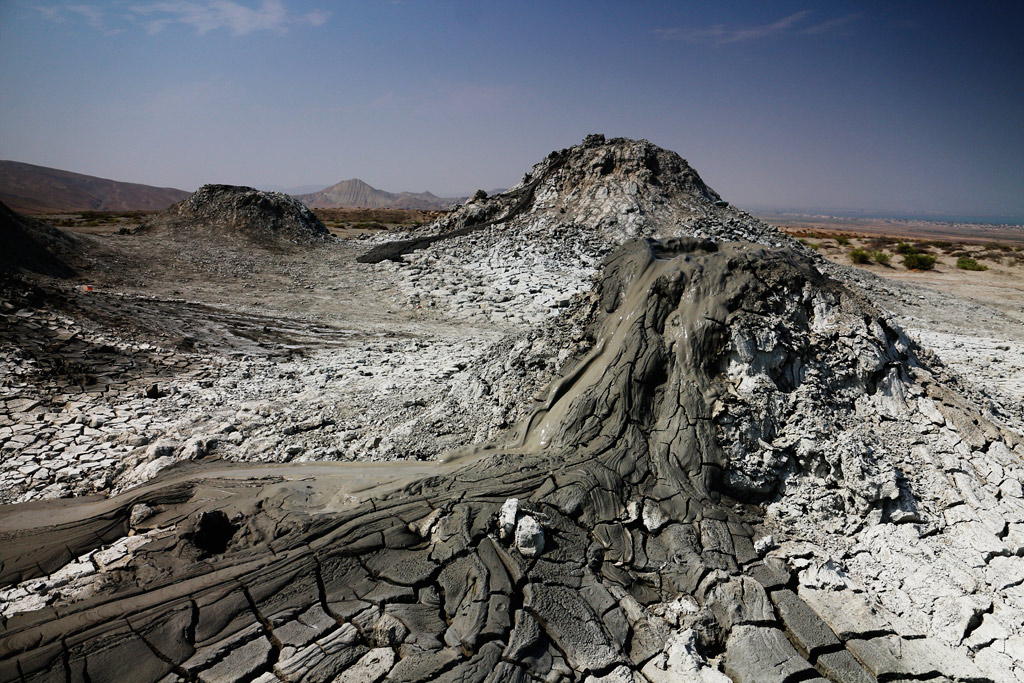
Qobustan mud volcanos in Azerbaijan.
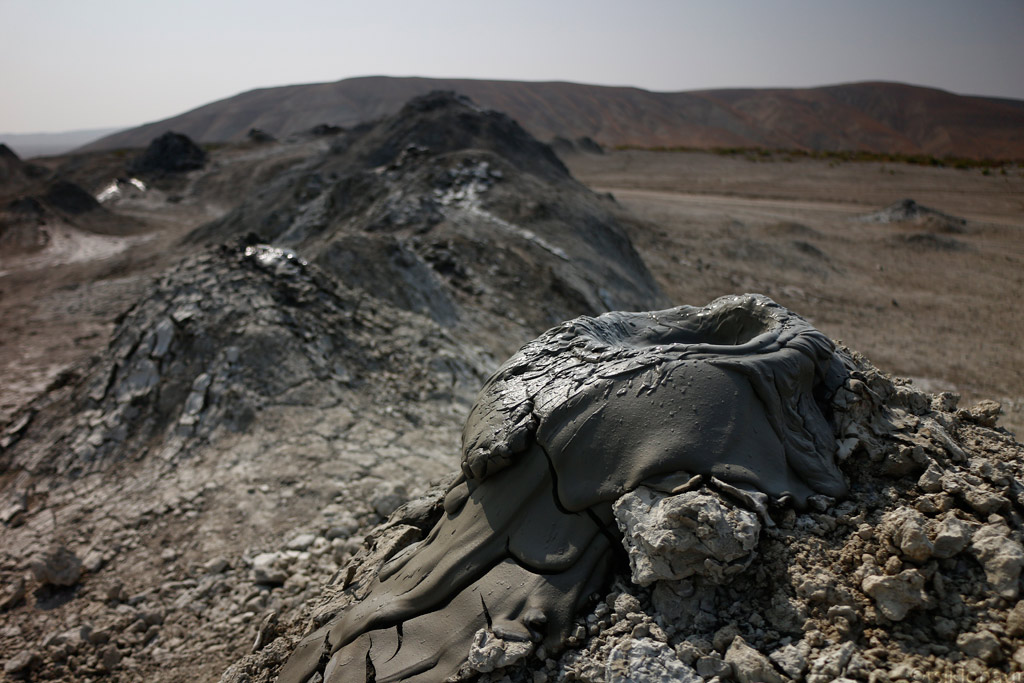
From the location of the mud volcanoes we would actually see the harbour, and as we noticed there was a ship docked at the harbour (it was about 4PM, but our ship wasn’t supposed to arrive before 6PM), we figured it was better to get ourselves over to Alat as quickly as possible - just in case it really was our ship and it was going to leave early - because as we know, they leave as soon as they are loaded. Well, it wasn’t. Instead, it was the one that was supposed to have left last night but was still there.
After some confusion - there were more passengers than there were bunk beds - we got the tickets to the same ship that stood at the harbour. We were told it would leave the same evening, and indeed, we were ushered through immigration, customs and search procedures much quicker than we’d anticipated, and after only a few hours time we were already told to board the ship. That was quick! We’d heard of people waiting for a full day under the scorching Sun, and sometimes even overnight at the harbour before things got moving. So we were spared of that “adventure”. In an hour or so the Sun set, whereas there seemed to be no movement on the car and train deck, so it seemed more and more unlikely we would get moving any time soon.
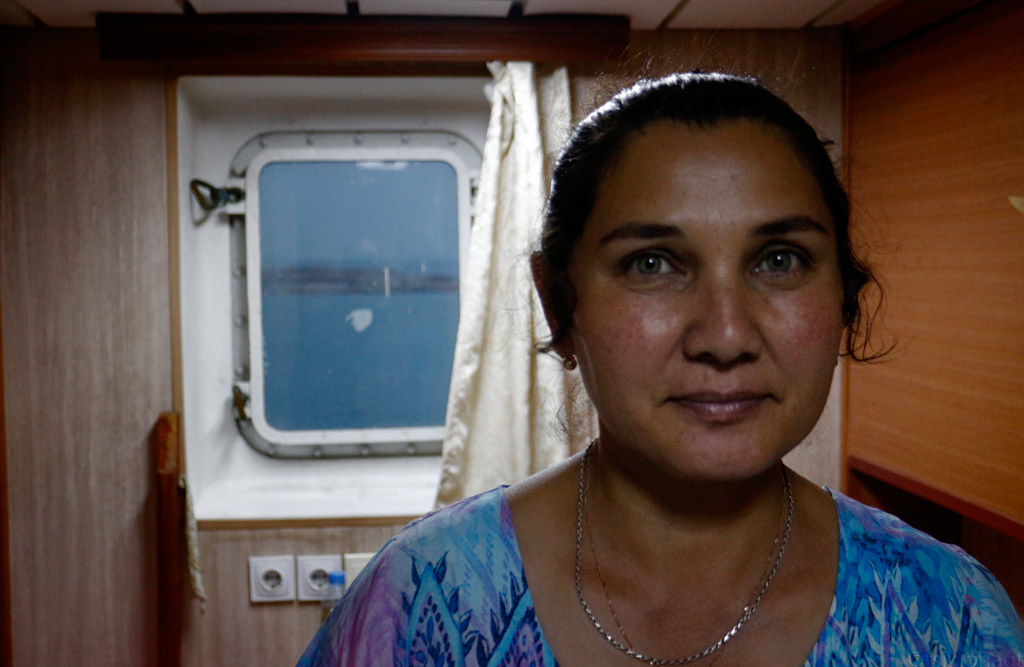
We were assigned a four-people cabin that we would share with an Azerbaijan-Uzbek couple.
As the ship was not moving, it was terribly hot in the ship. Not sure if it even had air conditioning - if it did, it was never switched on. Probably there wasn’t any, as Professor Gül (this was the ship’s name) looked as old as it sounded. We figured our chances of getting any sleep would be better outside, on the upper deck. So we grabbed our mats and sleeping bags, and fell into hectic sleep in the heavy fumes of the ship’s engines.
As the Sun was about to rise, we felt gusts of air tousling our sleeping bags. Opening our eyes, we could see the ship slowly manoeuvring out of the harbour. As we’d said farewell to the dry coast of Azerbaijan, we dug ourselves deeper into our sleeping bags and tried sleeping for another hour.
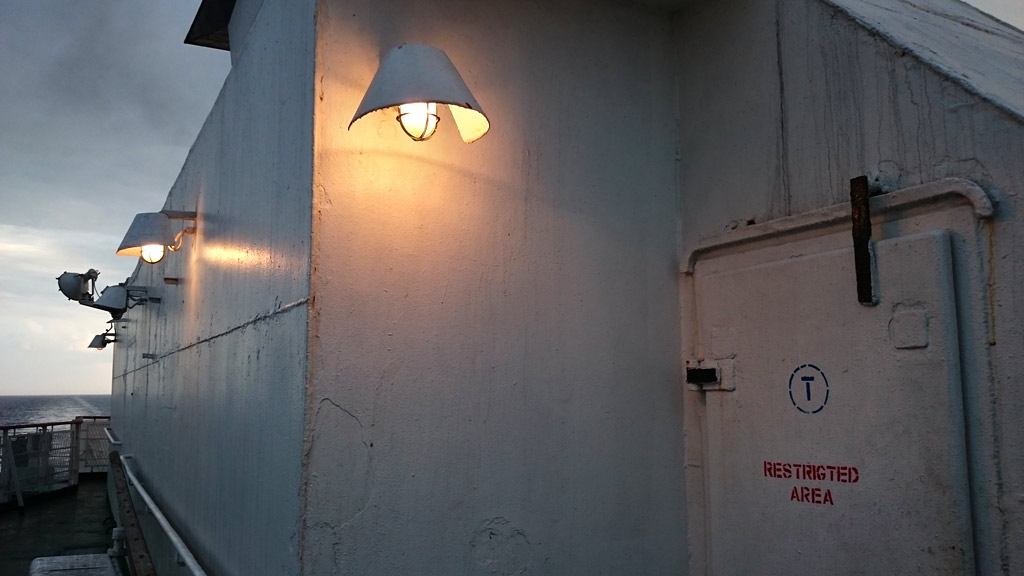
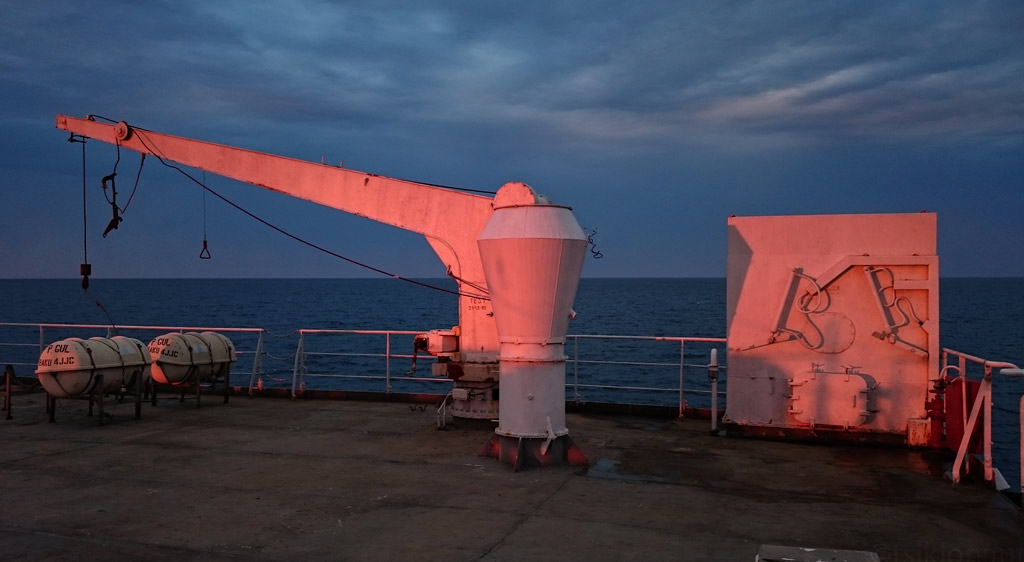
Caspian sunset.
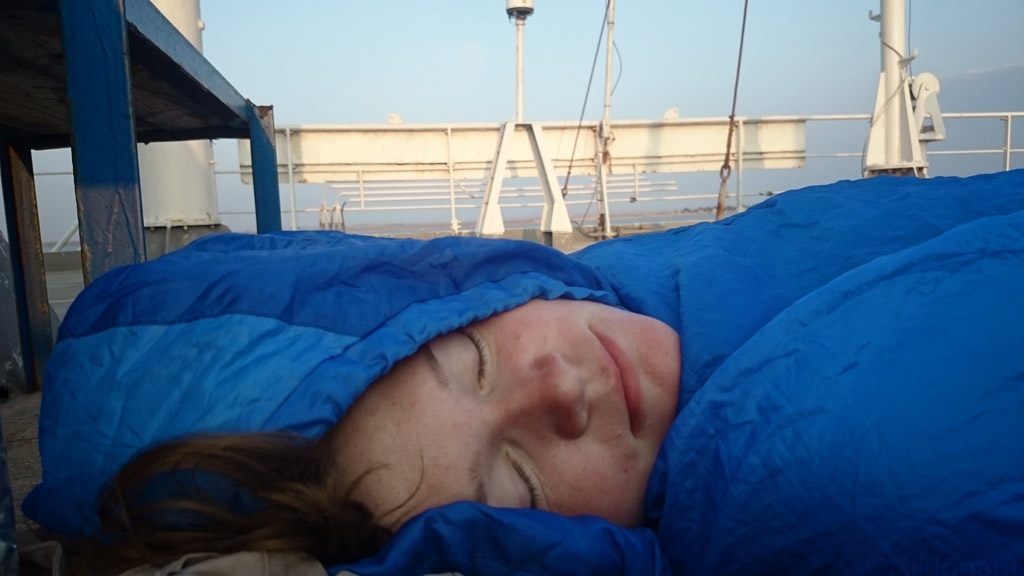
Sleep on the cargo ship upper deck.
Cheers,
Margus & Kariina
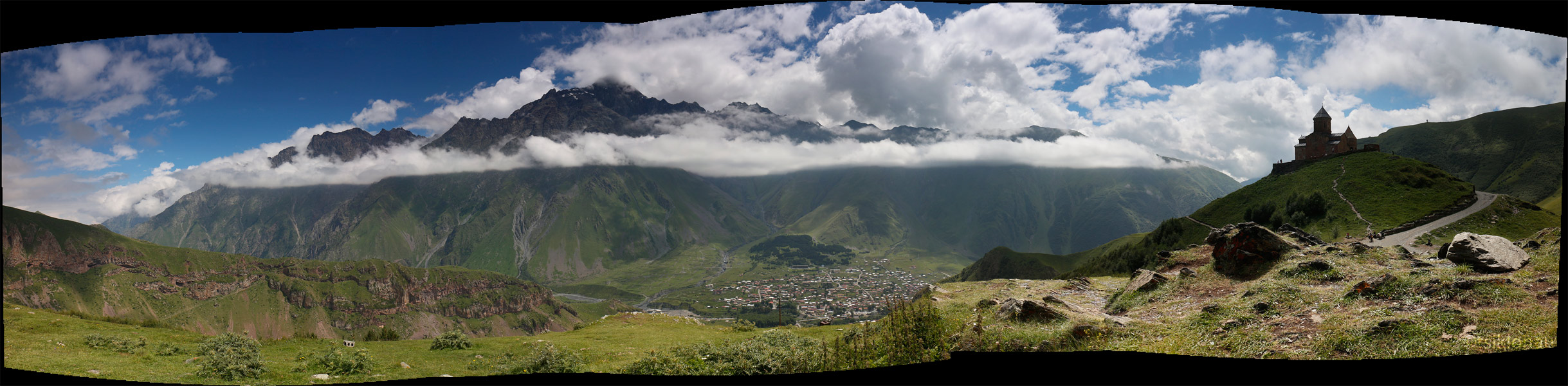
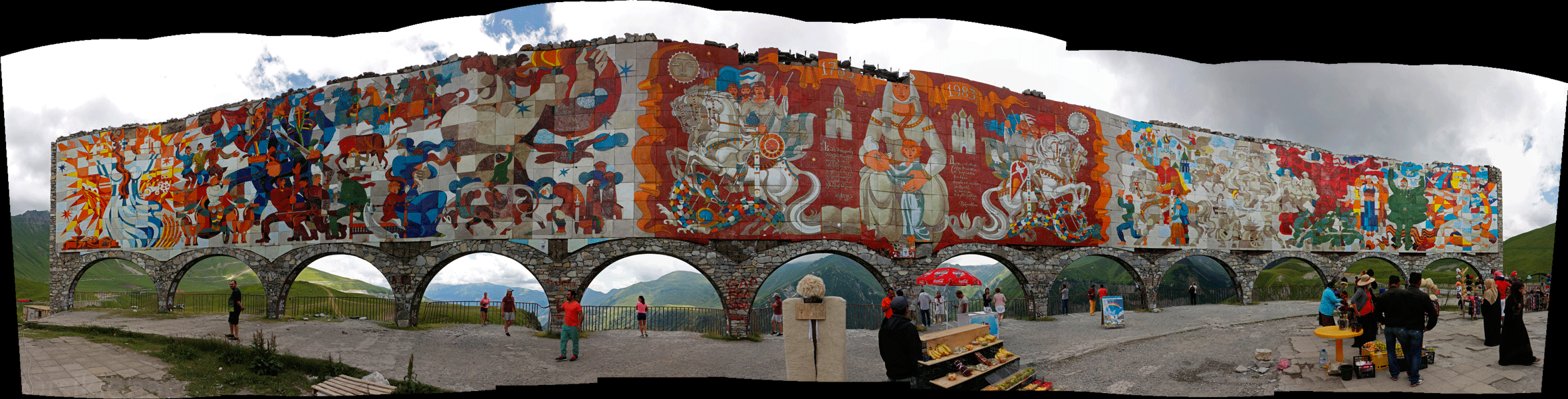
Riding back south we stopped by the Russia-Georgia Friendship Monument.
The mountains we had seen was still not enough, so we headed east towards the region of Tusheti, known for its wild nature (and of course, more mountains!). We decided to take a shortcut through the foothills of the Caucasus, and surely enough the road was rather bumpy and totally void of traffic. We rode for tens of kilometres without even a tiniest settlement in sight. At one point we noticed a sign pointing towards some fortress a few kilometres off the road, and we decided to indulge the inner tourist in us - we’d been rocking along the bumps for long enough, and we felt we could use a reward. The track leading to the fortress (not featured in tourist literature) was truly narrow, steep and featured loose rocks, so when we had finally arrived by the fortress, we were really pleased not to have slipped and called over.
The fortress (or rather its remnants) was quite amazing, with a huge yard and a church standing in the middle of it. And no one around! We quickly decided to pitch our tent underneath a large tree right in the yard of the fortress, which, as we found out later, dated back to the 8th century.
Church in the fort is from the 10th century.
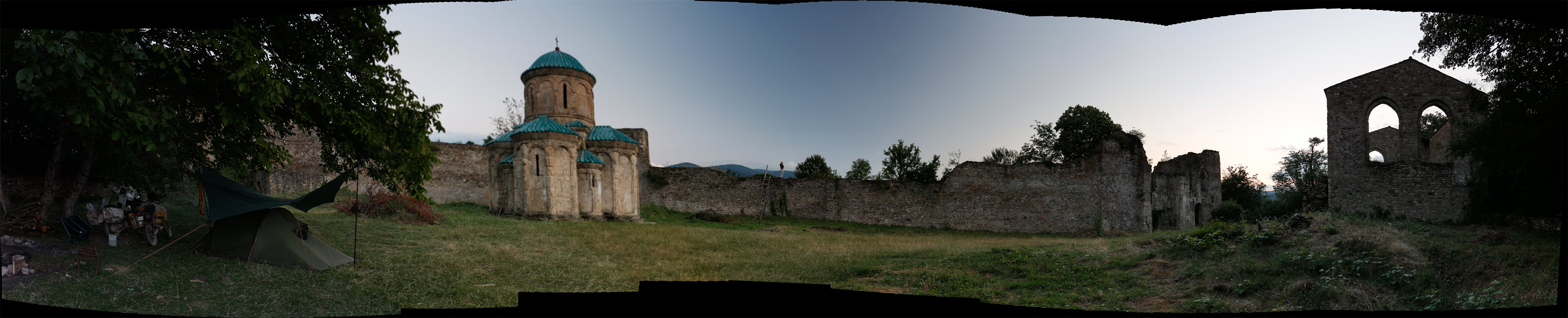
Us guarded from the wolves and bears with the fortifications, over thousand years old and still standing.
The next day we were on our way to Tusheti, a rather remote area in the northeastern corner of Georgia. The mountains separating it from the rest of Georgia are so high that the area can only be accessed a few months a year. Even the “locals” move to the lower grounds for the long winter.
The track going to Tusheti is, as expected, very rocky, bumpy, sometimes muddy, and the closer to the Abano Pass (2900 meters high), the steeper it becomes. In places, the track sticks very close to the mountainside, with unimaginably steep (and long!) drop on the other side. For those afraid of altitude, riding or driving the track can be quite a challenge. It all becomes even more surreal as the track reaches the height of the clouds and you cannot see a bit across the edge.
Picture doesn't say much...
Two meters behind the tent was this kind of gravitational freefall opportunity off the vertical cliff. Try not to go too far to pee during the pitch dark night...
Tusheti.
A flat. Found this in my tyre. Looks like a tip of a spear.
In general it seems that it takes around 5000 kilometres to really get into the swing of a motorcycle adventure and to start forgetting about the “normal” life and problems related to it. In time, those things gradually get replaced by perceptions of things and events around you in real time. We reached our first 5000 kilometres while in Azerbaijan - a country that is not really on a tourist map.
But as much or as little we would have loved to give it a good chance, we were restricted by stupid customs regulations, according to which a bike can only be temporarily imported for a maximum of 72 hours, so basically one can simply transit the country. And the timing is so precise that they count the time by the minute! One way “around” it is to pay a hefty deposit at the border but then again one has to exit via the same border post to get the money back. At the same time, for cars it is possible to apply for a real temporary import permit allowing for the vehicle to stay in the country the same time you are according to your visa. Anyhow, we were planning to exit on the other side of the country - more precisely, through the port of Baku, leaving by ferry that would take us across the Caspian Sea.
So we only had three days and nights to get to Baku, get our Uzbekistan visas (we had arranged in advance to pick them up there) and get onto some cargo ship that sails to Kazakhstan. We would have liked a lot to pay a visit to Turkmenistan too, but getting even a transit visa would have meant lots of hassle, a lot of time (which we didn’t have this time as we do have to get back to work at fixed time), and in fact still a great amount of uncertainty, so we skipped this plan. So Kazakhstan was our next destination, and we were hoping, really hoping that there would be a cargo ship going there in this meagre time window of 72 hours - actually minus the time it would take us to get to Baku, which is one full day of riding from the border with Georgia. The thing is, that those ships don’t have a schedule, leaving when full, and according to Lonely Planet, in worst case scenario, there are times when there is just one ship sailing every two weeks…
So we headed towards the Azerbaijan border with lots of anxiety. Not just because of this 72-hours rule, but also because as you know, we had been visiting Nagorno Karabakh, which in their eyes is illegal - but we didn’t have any indication about that in our passports. Then again, we’d heard that they’re even suspicious about Armenian stamps, because the country is their “enemy”. We’d actually heard quite some number of not-so-nice stories about the border crossing and the associated hassles, so as we’d cleared the super easy formalities on the Georgian side and rolled towards the Azerbaijani border post a few hundred meters away, we were somewhat anxious. The sign on the Georgian side seemed both discomforting and funny at the same time:
In fact, we were guided through the formalities in a rather efficient (maybe even slightly friendly) way, the whole process taking probably less than an hour. We did get asked some questions about our route in Armenia, and our luggage was briefly searched for related maps, books and souvenirs, but in general, our fears were not justified. We did not even have to pay the “road tax” than many had mentioned in their reports.
In fact, we were guided through the formalities in a rather efficient (maybe even slightly friendly) way, the whole process taking probably less than an hour. We did get asked some questions about our route in Armenia, and our luggage was briefly searched for related maps, books and souvenirs, but in general, our fears were not justified. We did not even have to pay the “road tax” than many had mentioned in their reports.
It was a long way to reach Baku, and when the Sun was about to set we still had some 150 kilometres to cover. Rather than pushing on, we decided to find a place to camp. Noticing an off-road track going up the hill next to the road, we followed it for a while. It was a high-voltage power line service track that obviously didn’t see much traffic, so we pitched our tent right next to it.
Next day we had to get up early - before sunrise, so that we would arrive in Baku before nine. We needed to find a place to print our Uzbekistan visa invitation letters, find the right branch of a specific bank to pay the visa fee, and find the embassy to pick up our visas before we could start arranging for our transport across the Caspian. After arriving in Baku (which was delightfully empty, so we could lose and find our way again without too much traffic stress) we got all the necessary bits sorted relatively efficiently.
As we called the harbour ticket office we were surprised to find out that a ship would be leaving the same evening. Although we secretly had wished that we’d been given a little more time to see Baku and Azerbaijan, we grabbed the opportunity and asked to keep place for us on that ship, as no one really knows when the next one would leave, and we simply didn’t have time due to that stupid import restriction. We had half a day before we had to be at the harbour of Alat, some 70 kilometres south of Baku. After having a lunch of fried eggs and potato at a local eatery, we headed into the nearby mountains to contemplate some “mud volcanoes”. They are not as big as the name would perhaps imply, but pretty impressive nonetheless, quietly but incessantly spitting out grey mud. It appears that around half of all mud volcanoes in the World are located in Azerbaijan.
Baku, in the center is the 2nd tallest flagmast in the World.
Port of Baku.
City.
Oil pumps going strong in the city of Baku, not too far from the centre.
Qobustan mud volcanos in Azerbaijan.
From the location of the mud volcanoes we would actually see the harbour, and as we noticed there was a ship docked at the harbour (it was about 4PM, but our ship wasn’t supposed to arrive before 6PM), we figured it was better to get ourselves over to Alat as quickly as possible - just in case it really was our ship and it was going to leave early - because as we know, they leave as soon as they are loaded. Well, it wasn’t. Instead, it was the one that was supposed to have left last night but was still there.
After some confusion - there were more passengers than there were bunk beds - we got the tickets to the same ship that stood at the harbour. We were told it would leave the same evening, and indeed, we were ushered through immigration, customs and search procedures much quicker than we’d anticipated, and after only a few hours time we were already told to board the ship. That was quick! We’d heard of people waiting for a full day under the scorching Sun, and sometimes even overnight at the harbour before things got moving. So we were spared of that “adventure”. In an hour or so the Sun set, whereas there seemed to be no movement on the car and train deck, so it seemed more and more unlikely we would get moving any time soon.
We were assigned a four-people cabin that we would share with an Azerbaijan-Uzbek couple.
As the ship was not moving, it was terribly hot in the ship. Not sure if it even had air conditioning - if it did, it was never switched on. Probably there wasn’t any, as Professor Gül (this was the ship’s name) looked as old as it sounded. We figured our chances of getting any sleep would be better outside, on the upper deck. So we grabbed our mats and sleeping bags, and fell into hectic sleep in the heavy fumes of the ship’s engines.
As the Sun was about to rise, we felt gusts of air tousling our sleeping bags. Opening our eyes, we could see the ship slowly manoeuvring out of the harbour. As we’d said farewell to the dry coast of Azerbaijan, we dug ourselves deeper into our sleeping bags and tried sleeping for another hour.
Caspian sunset.
Sleep on the cargo ship upper deck.
Cheers,
Margus & Kariina





