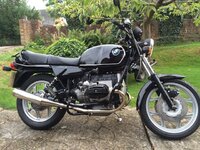
1988 R80RT -> R80 Part 1

Ta for that. Just heading for Specsavers ...

Ha ha.

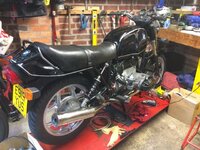
Anyway, nearly there I think. Just need to sort the cable runs and finish the fuel connections and tomorrow I could be ready to try running it!

 

Attachments

  • IMG_3139.jpg
    IMG_3139.jpg
    71.1 KB · Views: 329
The Ignition Switch

Dave, I have similar 80RT Mono (1988) ignition issue.

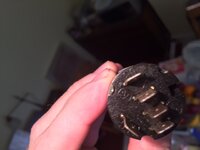
My RT was stolen, the ignition switch being pulled out as they tried to hotwire. I bought a new switch from Motorworks, its the five pin as shown on the right photo. Can't swear its the correct switch as I don't have the old one to compare it to, but Motorworks certainly believe it is.

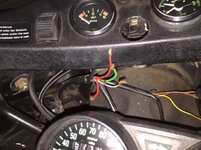
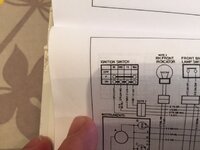
My problem is that the wires don't exactly match the Haynes wiring diagram (looking at the left photo I have 3 reds, a green and a grey). Mine is an old police bike (still has the siren and an air horn) so may explain the difference but if your wire colours are a match for mine I would be interested to hear from you. At the moment I have little idea as to which wires go to which pin.

Thanks

Billy
 

Attachments

  • IMG_0765.JPG
    IMG_0765.JPG
    60.3 KB · Views: 307
  • IMG_0747.jpg
    IMG_0747.jpg
    53.8 KB · Views: 296
  • IMG_0767.JPG
    IMG_0767.JPG
    78.4 KB · Views: 303
And just noticed your third photo which pretty much answer my question; your colours look identical to mine. Couple of questions if you could assist:

- is the 2nd pin from left as you look at your switch vacant (no wire attached)?
- do you have a thinner red wire (than the other two) and does this go to the angled pin?

Thanks again.
 
Hi Billy
Pleased to hear that my wiring isn't unique having three reds!
On my original switch which seems the same as yours the 'double' red goes to pin 56, the angled one. I think the thinner red is permanently live for the clock. The thicker reds do need to go to one of the middle 30 pins (I'm pretty sure they're the same connection) or the 56 pin. On mine the thin red is connected to the thick red which goes to 56 so no confusion.
Hope this helps.
 
It does! Thank you Dave. I think with your information and a bit of trial and error I can get the connections right now. Pleased I spotted your post else I would have had to engage the services of an auto electrician; I don't have the skills for tracing. Thanks for your help. Billy
 
Well, just about finished! Started it up and it runs well. Just a minor bit of tuning to do.

One of the last glitches was that the headlight didn't work. After much searching it turned out to be the headlight relay. It works if you give it a good whack or take the cover off and nudge the contact.
A new one arrived in the post Saturday and it doesn't work! Made in 1996 and corroded around the base....I'll be having words on Tuesday. I've tried to find an equivalent locally but no luck. Wish I hadn't been over confidant and booked an MOT for Tuesday which I'll now have to cancel :blast


The only other thing is getting the twin front brake calipers bled which is proving a bit of a challenge. The bike came with a Stahlbus bleeder valve which I'm not happy with. I'm getting a tiny bit of feel in the lever now but there's still air in the system. I'll get a standard bleed nipple next week. I'm more comfortable with simplicity!

So, what next.....?
 

Attachments

  • IMG_3152.jpg
    IMG_3152.jpg
    93 KB · Views: 393
  • IMG_3156.jpg
    IMG_3156.jpg
    76.4 KB · Views: 262
  • IMG_3157.jpg
    IMG_3157.jpg
    78.1 KB · Views: 262
Hey, Well done.

I'm impressed that you kept on and that you were able to finish this in what has obviously been difficult circumstances.

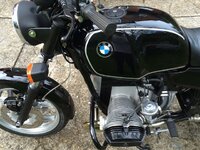
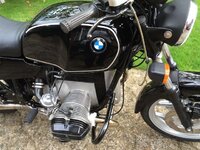
The bike is a credit to you....plain, simple and understated.

One question though, and please correct me if I am wrong, no offence will be taken.

Front forks.

Have you reassembled these back to front?

I always thought that the wheel spindle head was on the offside with the locking nut on the nearside. Also, the calipers were always behind the fork leg, or have you done a larger disc conversion?
 
Hey, Well done.

I'm impressed that you kept on and that you were able to finish this in what has obviously been difficult circumstances.

The bike is a credit to you....plain, simple and understated.

One question though, and please correct me if I am wrong, no offence will be taken.

Front forks.

Have you reassembled these back to front?

I always thought that the wheel spindle head was on the offside with the locking nut on the nearside. Also, the calipers were always behind the fork leg, or have you done a larger disc conversion?

Hi Dr Nosh, thanks for the comments. I can see why you think that about the forks but the calipers are correct for the monoshock. Also, the wheel spindle head is on the offside.
 
Hi Dr Nosh, thanks for the comments. I can see why you think that about the forks but the calipers are correct for the monoshock. Also, the wheel spindle head is on the offside.

Just spotted this. The wheel spindle head is on the near side! :blast
 
Hi Folks
I've had a problem with a leaky rear main seal since putting the bike on the road and it was bad enough that I had to fix it.
I've got a few questions if anybody can help:
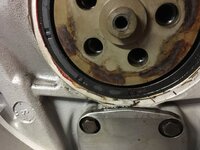
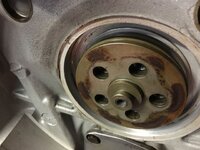
There should be an O ring somewhere between the flywheel and the crankshaft. I've taken the seal out as shown but is there a removable plate with an O ring underneath it?
I don't want to force it to try and separate it and that brings me to my next question, do I need to replace the O ring if it's there? Could this be a source of the leak?
Would I need to remove this plate to get the seal to mate properly i.e. put the seal in and then the plate afterwards.
I've ordered the "later" lipped seal from Motorworks. Should I soak this in oil for a few hours before installing and if so should I then fit it 'dry' ish?

I really want to get this right as I don't want the hassle of taking it apart again so any tips much appreciated :thumb2

Cheers
David
 

Attachments

  • IMG_3758.jpg
    IMG_3758.jpg
    52.8 KB · Views: 252
  • IMG_3762.jpg
    IMG_3762.jpg
    48.2 KB · Views: 242
Hi Folks
I've had a problem with a leaky rear main seal since putting the bike on the road and it was bad enough that I had to fix it.
I've got a few questions if anybody can help:
There should be an O ring somewhere between the flywheel and the crankshaft. I've taken the seal out as shown but is there a removable plate with an O ring underneath it?
I don't want to force it to try and separate it and that brings me to my next question, do I need to replace the O ring if it's there? Could this be a source of the leak?
Would I need to remove this plate to get the seal to mate properly i.e. put the seal in and then the plate afterwards.
I've ordered the "later" lipped seal from Motorworks. Should I soak this in oil for a few hours before installing and if so should I then fit it 'dry' ish?

I really want to get this right as I don't want the hassle of taking it apart again so any tips much appreciated :thumb2

Cheers
David

That "boss" your looking at in the picture, the goldy looking one with the 5 holes and protruding centre piece...... that pulls off the end of the crank. Inside is the "O" ring you're looking for (usually red in colour).
Replace it, even if it looks ok.

Let the new rear crank seal soak in oil for a while before fitting it. Then push the "boss" back in place which bends the the ribbed part of the seal to fold backwards and to seal against the boss .

One thing to beware of when doing all this, in fact you should have been aware of before you've got this far... The crank thrust washer can drop off it's locating dowel very easily... You don't want this happening as it's not good, and you'll be cursing yourself for weeks, nay months..

What you got to do is be very careful pulling that boss off, you don't want the crank moving, at all.

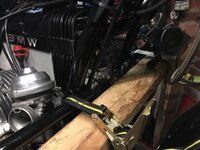
So remove the front engine cover, and using a piece of wood/plastic of the appropriate thickness 10mm or so , place it onto the front of the alternator stator and refit the front cover on top of it, so the crank is held pushed back in the case leaving you to get on with removing the "boss" without a care in the world.
 
The end of the crank,pictured is actually a cup that fits over the crank,the o' ring fits into a machined groove in the cup.
This cup is also used as the machined surface for the crank thrust bearing,
Warm it up with a hot air gun and gently lever it out.
Be careful not to push the crank forward at any time ,I normally remove the front cover and use a strap to apply rearwards pressure on the rotor,
 
That "boss" your looking at in the picture, the goldy looking one with the 5 holes and protruding centre piece...... that pulls off the end of the crank. Inside is the "O" ring you're looking for (usually red in colour).
Replace it, even if it looks ok.

Let the new rear crank seal soak in oil for a while before fitting it. Then push the "boss" back in place which bends the the ribbed part of the seal to fold backwards and to seal against the boss .

One thing to beware of when doing all this, in fact you should have been aware of before you've got this far... The crank thrust washer can drop off it's locating dowel very easily... You don't want this happening as it's not good, and you'll be cursing yourself for weeks, nay months..

What you got to do is be very careful pulling that boss off, you don't want the crank moving, at all.

So remove the front engine cover, and using a piece of wood/plastic of the appropriate thickness 10mm or so , place it onto the front of the alternator stator and refit the front cover on top of it, so the crank is held pushed back in the case leaving you to get on with removing the "boss" without a care in the world.
What he said:thumb:D:D
 
That "boss" your looking at in the picture, the goldy looking one with the 5 holes and protruding centre piece...... that pulls off the end of the crank. Inside is the "O" ring you're looking for (usually red in colour).
Replace it, even if it looks ok.

Let the new rear crank seal soak in oil for a while before fitting it. Then push the "boss" back in place which bends the the ribbed part of the seal to fold backwards and to seal against the boss .

One thing to beware of when doing all this, in fact you should have been aware of before you've got this far... The crank thrust washer can drop off it's locating dowel very easily... You don't want this happening as it's not good, and you'll be cursing yourself for weeks, nay months..

What you got to do is be very careful pulling that boss off, you don't want the crank moving, at all.

So remove the front engine cover, and using a piece of wood/plastic of the appropriate thickness 10mm or so , place it onto the front of the alternator stator and refit the front cover on top of it, so the crank is held pushed back in the case leaving you to get on with removing the "boss" without a care in the world.

Thanks a lot Neil (and Mikeyboy). That's just the help I was looking for.
Don't think the crank is going to move - forward at least! :D:thumb2
 

Attachments

  • IMG_3774.jpg
    IMG_3774.jpg
    51.7 KB · Views: 213
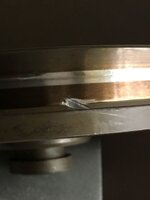
OK, boss off! And I think this might have been the problem - hope so.

A chisel gouge on the edge which had a sharp nib standing proud. Now dressed and should be alright with a bit of luck.....
 

Attachments

  • IMG_3780.jpg
    IMG_3780.jpg
    23 KB · Views: 173
:bowTerrific advice from Steptoe and Mikeyboy. To think that some folk begrudge paying their sub to this forum!



Back
Top Bottom