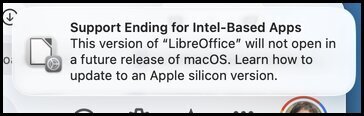
Apple support for Intel based apps ending?

Orinoco

Well-known member
UKGSer Subscriber
Joined
Jun 1, 2010
Messages
2,017
Reaction score
594
Location
The Bride Valley
Help!

I've had this message a couple of times now when opening LibreOffice and Basecamp. I've tried to read the apple support page, link below, but there are so many if's, buts and caveats I'm really not sure what I need to do. I have a newish M1 MacBook Air which has Tahoe OS on it, no idea whether this is Intel based or Mac's own chip.

Does it mean I'll need a new MacBook or just that I'll need to find something else for word-processing and cannot use Basecamp any more?

Apologies for the question, I'm clearly not as bright as I like to think I am :D

Thanks folks

1780399740529.jpg

 
I have a newish M1 MacBook Air which has Tahoe OS on it, no idea whether this is Intel based or Mac's own chip.

It's not Intel based. You're good. Update your Libre Office app. There is a version that runs on Apple Silicon natively.
Any Mac with chips starting with "A" or "M" are what it is called Apple Silicone.


When using older, Intel based, Macs you won't be allowed to install OS over a certain version. So, all the old software will keep working on that machine.
 
To further explain this:

Apple switched processor architecture a few times over the last 30 years.
The first very big switch was from CISC to RISC processors. It was the end of the Motorola 680x0 family that was replaced by PowerPC chips.

Years after, during the "Mhz wars" Apple was severely lagging behind in processing power and stuffing Macs with multiple CPUs to keep up. At the time, the switch from MacOS to OSX was complete (and because of the kernel used in the operating system) there were massive rumors for years about a switch to Intel, and it was easier for Apple to switch chips again, from PowerPC to Intel processors/architecture. Rumors were real. There was a funny bit from Jobs during the keynote about this:


Then, in more recent years, Apple developed their own chips - faster, more efficient in terms of energy: Apple Silicon.
Apple Silicon uses ARM Architecture (of the very British ARM) as Apple used ARM stuff for ages. The defunct Newton personal assistant line had ARM processors, and earlier Apple hardware. But my memory of this stuff, and the intertwining between Apple and ARM historically, can be wrong here and there.


Anyway, long story short: each time Apple changed architecture was like switching from a 2 cylinder petrol engine to, say, a 4 cylinder diesel. Different stuff.
The same code wouldn't run properly from one processor to another, so Apple always included emulators (Rosetta) inside their operating system.

If you ran 68k software (Written for Motorola 680x0 processors) on a PowerPC Mac, for example, the more powerful PowerPC processor would "emulate" a 68040 processor and run the software, albeit slower than a real 68040, but it maintained continuity for software for the years that took people to "migrate" almost seamlessly to the new platforms, while who was making the software would "translate" newer versions of their app.

The apps had to contain both version of the code... a lot of work around it.


The same happens today. You have Universal apps that can run both Intel or Apple Silicon or you have Apple Silicon only or Intel only apps.
MacOS can still emulate an Intel processor if you run an Intel only app on a newer Mac equipped with Apple Silicon processors.
From the new versions of the OS they are dropping this emulator, so you will need the proper Universal or Apple Silicon specific version of the app.

How this translates for people with newer Macs is fairly simple: keep your apps updated, ad it will work without issues.

I hope I didn't make this even more confusing than before. :D
 
Last edited:
To further explain this:

Apple switched processor architecture a few times over the last 30 years.
The first very big switch was from CISC to RISC processors. It was the end of the Motorola 680x0 family that was replaced by PowerPC chips.

Years after, during the "Mhz wars" Apple was severely lagging behind in processing power and stuffing Macs with multiple CPUs to keep up. At the time, the switch from MacOS to OSX was complete (and because of the kernel used in the operating system) there were massive rumors for years about a switch to Intel, and it was easier for Apple to switch chips again, from PowerPC to Intel processors/architecture. Rumors were real. There was a funny bit from Jobs during the keynote about this.


Then, in more recent years, Apple developed their own chips - faster, more efficient in terms of energy: Apple Silicon.
Apple Silicon uses ARM Architecture (of the very British ARM) as Apple used ARM stuff for ages. The defunct Newton personal assistant line had ARM processors, and earlier Apple hardware. But my memory of this stuff, and the intertwining between Apple and ARM historically, can be wrong here and there.


Anyway, long story short: each time Apple changed architecture was like switching from a 2 cylinder petrol engine to, say, a 4 cylinder diesel. Different stuff.
The same code wouldn't run properly from one processor to another, so Apple always included emulators (Rosetta) inside their operating system.

If you ran 68k software (Written for Motorola 680x0 processors) on a PowerPC Mac, for example, the more powerful PowerPC processor would "emulate" a 68040 processor and run the software, albeit slower than a real 68040, but it maintained continuity for software for the years that took people to "migrate" almost seamlessly to the new platforms, while who was making the software would "translate" newer versions of their app.

The apps had to contain both version of the code... a lot of work around it.


The same happens today. You have Universal apps that can run both Intel or Apple Silicon or you have Apple Silicon only or Intel only apps.
MacOS can still emulate an Intel processor if you run an Intel only app on a newer Mac equipped with Apple Silicon processors.
From the new versions of the OS they are dropping this emulator, so you will need the proper Universal or Apple Silicon specific version of the app.

How this translates for people with newer Macs is fairly simple: keep your apps updated, ad it will work without issues.

I hope I didn't make this even more confusing than before. :D
Thanks for that, it was useful and the clip quite funny (y)
 
To further explain this:

Apple switched processor architecture a few times over the last 30 years.
The first very big switch was from CISC to RISC processors. It was the end of the Motorola 680x0 family that was replaced by PowerPC chips.

Years after, during the "Mhz wars" Apple was severely lagging behind in processing power and stuffing Macs with multiple CPUs to keep up. At the time, the switch from MacOS to OSX was complete (and because of the kernel used in the operating system) there were massive rumors for years about a switch to Intel, and it was easier for Apple to switch chips again, from PowerPC to Intel processors/architecture. Rumors were real. There was a funny bit from Jobs during the keynote about this:


Then, in more recent years, Apple developed their own chips - faster, more efficient in terms of energy: Apple Silicon.
Apple Silicon uses ARM Architecture (of the very British ARM) as Apple used ARM stuff for ages. The defunct Newton personal assistant line had ARM processors, and earlier Apple hardware. But my memory of this stuff, and the intertwining between Apple and ARM historically, can be wrong here and there.


Anyway, long story short: each time Apple changed architecture was like switching from a 2 cylinder petrol engine to, say, a 4 cylinder diesel. Different stuff.
The same code wouldn't run properly from one processor to another, so Apple always included emulators (Rosetta) inside their operating system.

If you ran 68k software (Written for Motorola 680x0 processors) on a PowerPC Mac, for example, the more powerful PowerPC processor would "emulate" a 68040 processor and run the software, albeit slower than a real 68040, but it maintained continuity for software for the years that took people to "migrate" almost seamlessly to the new platforms, while who was making the software would "translate" newer versions of their app.

The apps had to contain both version of the code... a lot of work around it.


The same happens today. You have Universal apps that can run both Intel or Apple Silicon or you have Apple Silicon only or Intel only apps.
MacOS can still emulate an Intel processor if you run an Intel only app on a newer Mac equipped with Apple Silicon processors.
From the new versions of the OS they are dropping this emulator, so you will need the proper Universal or Apple Silicon specific version of the app.

How this translates for people with newer Macs is fairly simple: keep your apps updated, ad it will work without issues.

I hope I didn't make this even more confusing than before. :D
thanks for the explanation
 
To further explain this:

Apple switched processor architecture a few times over the last 30 years.
The first very big switch was from CISC to RISC processors. It was the end of the Motorola 680x0 family that was replaced by PowerPC chips.

Years after, during the "Mhz wars" Apple was severely lagging behind in processing power and stuffing Macs with multiple CPUs to keep up. At the time, the switch from MacOS to OSX was complete (and because of the kernel used in the operating system) there were massive rumors for years about a switch to Intel, and it was easier for Apple to switch chips again, from PowerPC to Intel processors/architecture. Rumors were real. There was a funny bit from Jobs during the keynote about this:


Then, in more recent years, Apple developed their own chips - faster, more efficient in terms of energy: Apple Silicon.
Apple Silicon uses ARM Architecture (of the very British ARM) as Apple used ARM stuff for ages. The defunct Newton personal assistant line had ARM processors, and earlier Apple hardware. But my memory of this stuff, and the intertwining between Apple and ARM historically, can be wrong here and there.


Anyway, long story short: each time Apple changed architecture was like switching from a 2 cylinder petrol engine to, say, a 4 cylinder diesel. Different stuff.
The same code wouldn't run properly from one processor to another, so Apple always included emulators (Rosetta) inside their operating system.

If you ran 68k software (Written for Motorola 680x0 processors) on a PowerPC Mac, for example, the more powerful PowerPC processor would "emulate" a 68040 processor and run the software, albeit slower than a real 68040, but it maintained continuity for software for the years that took people to "migrate" almost seamlessly to the new platforms, while who was making the software would "translate" newer versions of their app.

The apps had to contain both version of the code... a lot of work around it.


The same happens today. You have Universal apps that can run both Intel or Apple Silicon or you have Apple Silicon only or Intel only apps.
MacOS can still emulate an Intel processor if you run an Intel only app on a newer Mac equipped with Apple Silicon processors.
From the new versions of the OS they are dropping this emulator, so you will need the proper Universal or Apple Silicon specific version of the app.

How this translates for people with newer Macs is fairly simple: keep your apps updated, ad it will work without issues.

I hope I didn't make this even more confusing than before. :D
Thanks for the explanation, excellent.
I’ve previously asked the same or similar question following a similar email.
I use new Apple stuff - an iPhone 17 and a MacBook Air with M4 however, I also continue to use an older (2011) MacBook Air.
Having had another email (in German for some reason?? do I I assume this older device will not be able to run the updates but will continue to use the version it currently uses baring in mind 365 is a cloud app?
Thanks again.
Pasted translation here:
Your files are safe. Here you can find out what happens next.

We'd like to let you know about a change to Microsoft 365 on one of your macOS devices.

From the 13th July 2026, a security certificate update is required to keep Microsoft 365 and Office apps up to date. On devices that do not support this update, Word, Excel, PowerPoint, Outlook, and OneNote switch to read-only mode. You can still open and view all your files, but you can't edit and save them on this device. Your files are safe.

According to our records, one of the macOS devices associated with your account cannot run macOS 12 (Monterey) or later. This means that your device will be used from the 13th Microsoft 365 apps can no longer be fully supported by July. Your subscription is active, your account remains unchanged, and all content stored in OneDrive is still available. Simply proceed as follows:


Use the free Microsoft 365 web apps. Open Word, Excel, and PowerPoint in any browser on any device—such as your current device. No download or setup is required. If your files are stored in OneDrive, those files will open as usual and continue to work.


Use a supported device. Sign in to Microsoft 365 apps on any supported macOS or other device with your existing account. Your content is immediately available for you. For more information, see the system requirements.

Learn more

Any questions? Contact Microsoft Support.

Thank you for choosing Microsoft.

THE EMAIL IS IN AN OP-PO BOX.

Privacy Policy | Imprint

Microsoft Corporation, One Microsoft Way, Redmond, WA 98052 USA
 
Hey Skippy: yes, your older MacBook Air has an Intel processor and won’t (actually already isn’t) be able to upgrade OS.

I suspect you can keep using the web version of the apps as a workaround on that computer to be fair.
But not 200% sure.


Back
Top Bottom