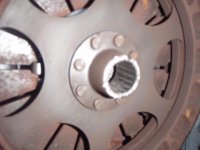
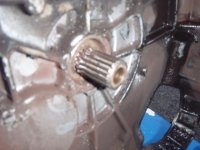
Audio Diagnostic Please. It doesn't sound right and has no drive...

It’s not the FD. My money is on input splines and/or a blitzed clutch.

Edit - I see Steptoe got there long before me.

 

So drained the gearbox (I know where it is now). Oil came out pretty clear with only a slight dusting of black which I assume to be metal scrapings. I was expecting nearer a litre but got perhaps half that. Cold engine of course but as the oil was pretty fluid, I left it draining so I'll see in the morning. Perhaps tipping the bike a bit would produce a little more but the drain bolt was pretty close to the lowest point.

No chips or flakes of metal so not a catastrophic gearbox failure as far as I was expecting.

Is it the same oil for gearbox as final drive?

Drive splines at the engine end then?
 
the drive shaft can break in two - but normally your leg falls off
 

So drained the gearbox (I know where it is now). Oil came out pretty clear with only a slight dusting of black which I assume to be metal scrapings. I was expecting nearer a litre but got perhaps half that. Cold engine of course but as the oil was pretty fluid, I left it draining so I'll see in the morning. Perhaps tipping the bike a bit would produce a little more but the drain bolt was pretty close to the lowest point.

No chips or flakes of metal so not a catastrophic gearbox failure as far as I was expecting.

Is it the same oil for gearbox as final drive?

Drive splines at the engine end then?
With no sparkles in the gear oil?

I suspect the splines have ripped out of the clutch rather than a broken input shaft

I have seen this quite a few times over the years
 

Attachments

  • no splines one.jpg
    no splines one.jpg
    105.8 KB · Views: 58
  • No Splines three.jpg
    No Splines three.jpg
    47.5 KB · Views: 58
  • No Splines two.jpg
    No Splines two.jpg
    62.8 KB · Views: 58
Last edited:
So is it more disassembly to establish whether a new spline or would it be safe to say at this stage, a new clutch would do it.?

I see on Beemerboneyard there is a used transmission but it has bad splines. https://www.beemerboneyard.com/23007693731.html That could leave me with two sets of transmissions potentially in the same condition. I think I know the answer and its to delve deeper...
 
In the UK a new gearbox input shaft for my 1200 (fully assembled with bearings, drops straight in) cost me £500 from BMW. A full clutch kit for a 1200 cost me £400.

Not sure on the exchange rate to NZ currency, but it ain't a cheap job although its not particularly difficult for a decent home mechanic to replace the input shaft assembly. Its important to heat the gearbox casings to expand the bearing housings before attempting to split the cases and lift the gear clusters out.

I wonder if your torsion damper on the input shaft has failed, leading to shock loading of the splines when on and off throttle ?? I recall the early 1200 had a simple coil spring torsion damper like the earlier 1100/1150 whereas my later 2008 bike had the stupid "spring washers in a cage" type thing where the cage breaks up.
 

So engine side splines and driveshaft spline receiver look fine (better condition than the one pictured on the Beemerboneyard at least). Better than I was expecting for the mileage unless it has already been replaced.

NZ exchange rate is about 2:1 so equivalent of NZ$800 which would make it worth it. With everything looking ok so far, the next step would be clutch? I think there is a fair amount of dissasembly to get in there but I can't make it less roadworthy than currently.

Is a clutch kit a set of the more consumable parts compared with a full clutch assembly from a wreckers?
 
The clutch kit is the pressure plate and friction plate. The pressure plate bolts to the flywheel on three cast stand off legs as the clutch works kind of backwards to a typical dry car clutch. The friction plate is a simple metal wheel with fibre bonded on both sides. There is no release bearing as the clutch is operated directly via a pushrod between the slave cylinder and the pressure plate centre operating disk. New clutch bolts are needed (x6) as they are one-use only.

A pity you aren't in UK, I have a hardly worn spare clutch boxed up in my loft from when I last had my hexhead apart, plus an extra friction plate.

The female splines are in the middle of the friction plate so if you wanted to do the job at low cost and trusted the old pressure plate, a new friction plate is about £100 UK (so presumably $200NZ).
 
Is it likely to be the pressure and friction plate alone that need replacement? It will take me some time to take the bike apart sufficiently to get in there to confirm. As it sounds like rattling and there is a failure to engage the gears, I'm concerned that there might be more extensive damage than a worn out set of plates. I have found a guide to take the bike apart so can start the disassembly as a long term project.

If the parts in your loft are not going to get used, happy to pay for them and shipping. Even on a boat, they would get to me before I had the bike ready for installation.
 
as mentioned the clutch is back to front vs a dry car clutch - but I guess the two main parts will wear

the pressure plate on cars is often what fails, as the fingers of the diaphragm spring wear and can snap off - but on this the ring gear is the spring, so you need this

the centre plate's friction material vanishes and it gets thinner, helping it slip, but they can also break the cush-drive springs leading to noise and judder - I wasn't aware the plate can fail on its splines. That would suggest the material used was inferior to the required spec - but of course german manufactures and their accountants practicing alchemy is one of their hobbies (creating gold at the parts counter) so quite likely.


can't see your model specifics but a late 2006 here:


there have been a couple of posts about bits inside the box making noises... with parts 10, 3 and 4 in the link below getting replaced for free on some early bikes (now only available from BM as the entire shaft built up) - as usual germans use the wrong naming - its the input shaft... so the bit externally that the clutch plate sits on

 
Whatever - you need to pull the gearbox. And a good opportunity for a project, you probably can’t make it worse.

In doing so you’ll find out in the first 30 mins if it’s the drive shaft (it won’t be).

Get spannering, then you’ll know what you need to fix, only you can judge whether it’s worth it.
 
If the parts in your loft are not going to get used, happy to pay for them and shipping. Even on a boat, they would get to me before I had the bike ready for installation.
I'll dig them out and take a photo for you. They should be fine as part-used parts, I only replaced them myself as I had clutch slip at low miles which turned out to be the slave cylinder at fault however my BMW dealer said if it was caused by oil contamination ( a possibility) they wouldn't cover it under warranty and I would incur the full clutch change cost including labour and taxes. Like all clutch jobs you never know for sure until its apart.

No idea how much the shipping to NZ will cost, its fairly heavy plus I can't PM you as you are not subscribed.
 
I'll dig them out and take a photo for you. They should be fine as part-used parts, I only replaced them myself as I had clutch slip at low miles which turned out to be the slave cylinder at fault however my BMW dealer said if it was caused by oil contamination ( a possibility) they wouldn't cover it under warranty and I would incur the full clutch change cost including labour and taxes. Like all clutch jobs you never know for sure until its apart.

No idea how much the shipping to NZ will cost, its fairly heavy plus I can't PM you as you are not subscribed.
I'll dust off my zip tie clippers and refer to the pair of videos in Korean that are a pretty good demo of disassembly and reassembly.

dissassembly
reassembly

It will give me a chance to learn a new language while learning to swing a spanner. Mine is a 2005 US import to NZ I think with the speedo in MPH.

I'll clear a space in the garage to store the offerings and get at it.
 
Unfortunately the pressure plate on a 1200 is one piece also incorporating the flywheel and diaphragm spring . Unlike the 1150 which comes in separate parts and the reason why the 1200 part is more expensive. The cover plate is a single item on both the 1150 and 1200.
 
Unfortunately the pressure plate on a 1200 is one piece also incorporating the flywheel and diaphragm spring . Unlike the 1150 which comes in separate parts and the reason why the 1200 part is more expensive. The cover plate is a single item on both the 1150 and 1200.
Still a 1200 but that site botus linked has the bike as a 2004. I was robbed! I'm sure it hit the showroom in the US in 05 or perhaps landed in NZ that year. Thanks @botus

as mentioned the clutch is back to front vs a dry car clutch - but I guess the two main parts will wear

the pressure plate on cars is often what fails, as the fingers of the diaphragm spring wear and can snap off - but on this the ring gear is the spring, so you need this

the centre plate's friction material vanishes and it gets thinner, helping it slip, but they can also break the cush-drive springs leading to noise and judder - I wasn't aware the plate can fail on its splines. That would suggest the material used was inferior to the required spec - but of course german manufactures and their accountants practicing alchemy is one of their hobbies (creating gold at the parts counter) so quite likely.


can't see your model specifics but a late 2006 here:


there have been a couple of posts about bits inside the box making noises... with parts 10, 3 and 4 in the link below getting replaced for free on some early bikes (now only available from BM as the entire shaft built up) - as usual germans use the wrong naming - its the input shaft... so the bit externally that the clutch plate sits on

 
Still a 1200 but that site botus linked has the bike as a 2004. I was robbed! I'm sure it hit the showroom in the US in 05 or perhaps landed in NZ that year. Thanks @botus
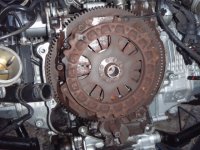
They’re all the same clutches up until 2008. If buying a new clutch pressure plate unit to fit your bike (only the new type are available) you’ll also need a new pushrod as your one won’t operate the new clutch


Back
Top Bottom