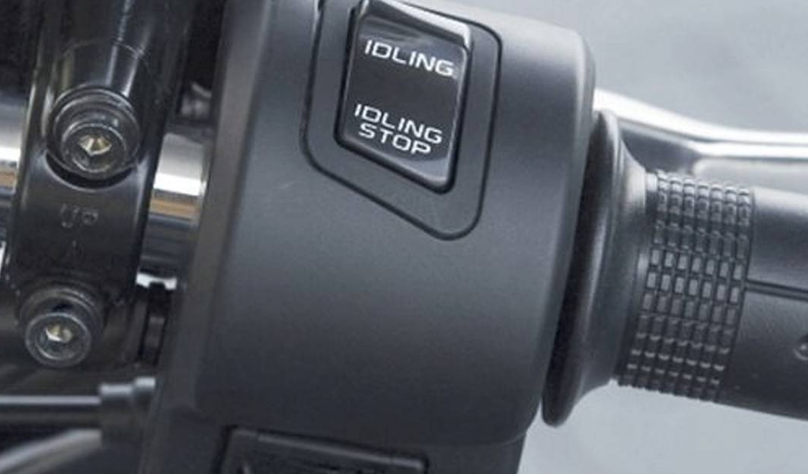
Auto Stop/start

So you classify that as stop and start, it is not really and you know that.............there is a lot more involved, if that is your only answer Rich, best leave it to the experts, and that aint me, I just gave an opinion.

That’s how I do it if I need to, but why would stop start cause the bike to be jerky?
 
That’s how I do it if I need to, but why would stop start cause the bike to be jerky?

Read again Rich nice tuning of the ECU and all the sensors, to give smooth throttle control, to roll away nicely is it so hard, or are you just grasping at straws, because you jumped in to fast wrongly...........:blast
 
Read again Rich nice tuning of the ECU and all the sensors, to give smooth throttle control, to roll away nicely is it so hard, or are you just grasping at straws, because you jumped in to fast wrongly...........:blast

I’m not grasping at straws at all. You mentioned that the bike could be jumpy or jerky, if using stop/ start technology but haven’t explained why.

You know exactly what you meant when you typed your original post, hence the emoji, but are trying to back peddle.

Tell us why any bike would need to be “tuned” to run stop/ start smoothly. The bike would either switch off when stationary and the clutch pulled in, or in neutral, but why would it suddenly become jumpy or jerky?
 
I’m not grasping at straws at all. You mentioned that the bike could be jumpy or jerky, if using stop/ start technology but haven’t explained why.

You know exactly what you meant when you typed your original post, hence the emoji, but are trying to back peddle.

Tell us why any bike would need to be “tuned” to run stop/ start.

Exactly what I said you jumped in wrongly, now rather than ask people to tell you all the time, why do you not try to explain some things, it gets tedious the Why, Tell, say, yet you never share or explain anything technical, it is same old say, tell, why, now if you want this thread to be turned into one of your best friends taboo threads, go ahead, but that was not what I was saying, so if you cannot except that so be it, now be a sport and share your technical knowledge with the forum.
 
Um... stop / start on a motorcycle wouldn't be used often anyways.

Being a riding God myself, I rarely stop. In between filtering, slow riding, perfectly positioned excellence.... Don't need to stop / start.

Just saying, like. :D
 
With the cars they have a beefed up starter/alternator.
The engine also will stop in a primed position to start again.
I would imagine on a bike the only safe time to turn off would be with clutch out in neutral. Also a sensor in the saddle, I guess, so it would never restart unless a rider was on the bike as a car will restart itself without moving off if the battery is running too low or it really needs to kick AC on (I’m sure there are other reasons they restart themselves without you moving off).
I doubt it would be mandated for bikes. Nobody ever really leaves a bike idling do they?

Is there any reason why you can’t leave the ignition on but the kill switch off other than draining battery or does it have other bad effects?
 
Forgetting the vehicle changes required momentarily, why do it in the first place, was it just fuel saving, emissions or both, I don’t know for sure.

Newer cars seem to have smoothed out the system to the point the on/off is far less noticeable than it used to be. Do HGVs have it ?

Obviously there are considerably less motorcycles than cars so it is unlikely to have such an impact, but on the basis of small margins add up it could be on its way.
 
Exactly what I said you jumped in wrongly, now rather than ask people to tell you all the time, why do you not try to explain some things, it gets tedious the Why, Tell, say, yet you never share or explain anything technical, it is same old say, tell, why, now if you want this thread to be turned into one of your best friends taboo threads, go ahead, but that was not what I was saying, so if you cannot except that so be it, now be a sport and share your technical knowledge with the forum.

I didn’t mention jumpy or jerky, you did Shaun. I’m simply asking you why you think a bike would suddenly become jumpy or jerky if it had stop start, as there’s no reason why it should.

If anyone has to explain that conclusion to the forum, it’s you.
 
Do HGVs have it ?
.


It seems that there is little benefit from the system unless there is a lot of start/stops in the journey and a stronger battery seems to be required to run the system

Certainly, for an artic on a trunking schedule, there is little benefit to be had from stop-start. Nevertheless, the duty cycle for a truck or bus in urban conditions is harsh, and the period when the vehicle is at idle can be substantial.

Cummins does offer a true automatic stop-start system on its four-cylinder B4.5 and six-cylinder B6.7 Euro VI diesels, such as with ADL’s Enviro 400 double-decker with Voith or ZF automatic transmission. Says Kevan Browne: “Around 1,500 buses with this system are in operation in the UK today. The engine is specified with the stop-start enhancements and upgraded starter motor. The OEM then adapts their battery charge and air system controls to align with the stop-start cycle.” Cummins is also offering stop-start on B6.7 engines for the US truck market.

http://www.transportengineer.org.uk...res/stop-start-transmissions-in-trucks/182478

“The Cummins system is designed for a maximum of 30 stops per hour,” says Browne, “but typically this will not exceed 18 stops during normal operation. The OEM can trim the system to operate in all circumstances – such as all stops in traffic – or just for bus stops and only aligned to the door opening. This flexibility allows the system to be configured to the operational scenario.”

A hydraulic ERS can also form the basis of a hybrid driveline. Colorado-based Lightning Systems has developed a system called LightningHybrid, designed for trucks in “heavy-duty drive cycles like delivery, transit and refuse”. The system “safely and efficiently regenerates braking energy in composite hydraulic accumulators, which are a fraction of the cost and weight of batteries”.

Vehicle braking powers a hydraulic pump/motor connected to the final drive via a clutch. It moves fluid from a low-pressure reservoir to a high-pressure accumulator, compressing a nitrogen-filled bladder which acts as a spring. When the vehicle needs to accelerate, the pressurised fluid is released, driving the truck. The system is designed for vehicles over 5 tonnes gvw, and can even be retrofitted; it is typically mounted below the load area, between the gearbox and differential. UPS has undertaken trials of the system in the US and UK, and has ordered 50 delivery vehicles for use in the Chicago area.


Since multiple engine starts in a short amount of time would put a lot of stress on conventional starter motors, to the point of destroying them prematurely, cars that have “start-stop” use heavy duty starts, specifically designed for the job at hand.

They also have better batteries, which in certain vehicles can also be charged via regenerative braking, thus making them micro-hybrids. In the overall hybrid cars scheme, micro-hybrids are just below mild-hybrids, and two steps bellow full hybrids.

Some carmakers have resorted to a so-called integrated starter-alternator (ISG), while others only use a heavy-duty starter motor and call it a day. Both versions of a start-stop system work in similar ways and achieve the same thing, though, better fuel economy in stop and go traffic.

All is fine and dandy, especially since the technology is not expensive and has a much lower weight disadvantage compared to what is found under the hood of a full hybrid. But is everything as fantastic as all these carmakers are making it seem?

Modern cars have so many electronics and power consumers that they need a lot of continuous current to keep working, especially when the ICE, the main “distributor of volts to the battery” is shut down. Lights, climate control, audio system, not even the airbags will work if there is no power, which is why in cars with start-stop the battery is put through much higher strain.

https://www.autoevolution.com/news/the-engine-start-stop-systems-conspiracy-108734.html

Heres an example by Honda for the PCX125 scooter
https://www.rideapart.com/articles/257369/how-motorcycle-stop-start-works/

Now, overcoming compression to start an engine constantly during urban driving would normally be a huge drain on the battery. The PCX and other Stop/Start equipped vehicles reduce that energy requirement by opening the exhaust valve slightly on stop, decreasing compression while the piston compresses the fuel/air mixture for a restart.

1be8f01c3fb018cbf4e8dbba2ba2b148.png


The wifes mazda CX-3 Skyactive 2.0 Petrol uses sequential combustion to restart the engine in 0.35secs with a tiny kick from the starter. The battery is an uprated 12 cell item from the normal 6 cell, but hardly any heavier.
 
I didn’t mention jumpy or jerky, you did Shaun. I’m simply asking you why you think a bike would suddenly become jumpy or jerky if it had stop start, as there’s no reason why it should.

If anyone has to explain that conclusion to the forum, it’s you.

Ok for simplicity as simple things are hard for you to grasp it seems, stop and start 2 wheel vehicles at the moment are automatic, I am not taking into account DCT bikes at the moment, a bike has a clutch, you follow up to there, for the bike to have stop and start would need to be in neutral, and possibly if you are sitting on a hill maybe hill HSC added also, we already know HSC has to have quite a bit more throttle added to take off, and can be jerky, sure you know that, but maybe you will say KTM is fine, so more throttle power and smoothness more powerful battery and extra sensors will all have to be tuned in, to make the bike silky smooth, now if you cannot grasp this, just email Bosch who really know how ECU,s work and they might send you their top secret R&D that they might be working on, or you can ask some of your friends who specialise in bikes, maybe they can help you more technically, as you believe whatever they say, yet on this forum, I repeat and certainly here, you only ever ask for others to explain, yet you show nothing ever, just SHOW, TELL, ASK, EXPLAIN at least we try here to move forward, we can be wrong but we try to find out how and eventually get there with help of some good lads who really try, showing a plate of food is nice nothing technical but only helps the waistline.

 
Forgetting the vehicle changes required momentarily, why do it in the first place, was it just fuel saving, emissions or both, I don’t know for sure.

I think it started as a method to slightly game the emissions regulations and make the vehicle appear more efficient.
I know in Germany they are required to switch off their vehicles if stopped for a particular amount of time so maybe it started there to make their life easier.
 
I think it started as a method to slightly game the emissions regulations and make the vehicle appear more efficient.
I know in Germany they are required to switch off their vehicles if stopped for a particular amount of time so maybe it started there to make their life easier.

That is correct, and in Germany we can only filter if traffic is not moving, however be very careful if traffic is stopped it is normally for an accident, and Germans move their cars more to the left and the right, to allow emergency vehicles through, do not get caught in that lane filtering, fine is heavy....back to stop n start..;)
 
Why would you want to stop, anyway?:nenau

Believe it or not, I see a lot of people (in London, mostly scooters) doing it manually at traffic lights.
I suppose they do it with the illusion of saving some petrol.

While I'm perfectly happy to use it on my car... considering that you need the engine to keep the bike upright (especially with heavy stuff) when maneuvering, I wouldn't be feel safe on a motorbike – even stopped at red lights – with the engine off to be fair.
 
Ok for simplicity as simple things are hard for you to grasp it seems, stop and start 2 wheel vehicles at the moment are automatic, I am not taking into account DCT bikes at the moment, a bike has a clutch, you follow up to there, for the bike to have stop and start would need to be in neutral, and possibly if you are sitting on a hill maybe hill HSC added also, we already know HSC has to have quite a bit more throttle added to take off, and can be jerky, sure you know that, but maybe you will say KTM is fine, so more throttle power and smoothness more powerful battery and extra sensors will all have to be tuned in, to make the bike silky smooth, now if you cannot grasp this, just email Bosch who really know how ECU,s work and they might send you their top secret R&D that they might be working on, or you can ask some of your friends who specialise in bikes, maybe they can help you more technically, as you believe whatever they say, yet on this forum, I repeat and certainly here, you only ever ask for others to explain, yet you show nothing ever, just SHOW, TELL, ASK, EXPLAIN at least we try here to move forward, we can be wrong but we try to find out how and eventually get there with help of some good lads who really try, showing a plate of food is nice nothing technical but only helps the waistline.

Finally. :clap

It wasn't that hard now, was it? Maybe if you'd opened with that, I wouldn't have had to squeeze the information out of you. :rolleyes:

Your next challenge is to get rid of the chip off your shoulder. :comfort ;)
 
Finally. :clap

It wasn't that hard now, was it? Maybe if you'd opened with that, I wouldn't have had to squeeze the information out of you. :rolleyes:

Your next challenge is to get rid of the chip off your shoulder. :comfort ;)


Because I try to explain, you should try also.............

:D I have no chip, I thought you had the secret...............:P
 
Believe it or not, I see a lot of people (in London, mostly scooters) doing it manually at traffic lights.

I meant, why would you want to stop moving... :P

TBH, I will stop my [bike] engine at lights; railway crossings, etc. It's not about saving petrol, it's about polluting less.
 
we already know HSC has to have quite a bit more throttle added to take off, and can be jerky, sure you know that

My 1250 doesn't. You can just feel it for a split second holding back as you start to pull away, but no more revs than I normally use.
 
Because I try to explain, you should try also.............

:D I have no chip, I thought you had the secret...............:P

There was nothing for me to explain, it was your statement.

Anyway, we got there in the end, although it would have been better without the insults from you.


Back
Top Bottom