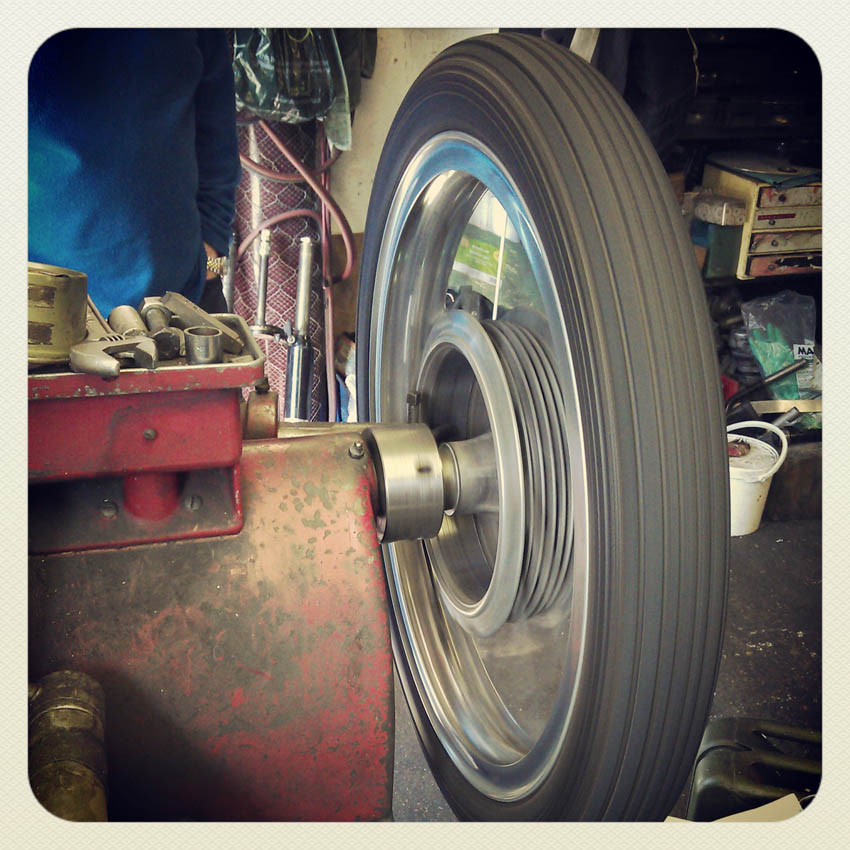
Hi there guys, thanks for all the replies. Sorry for not getting back earlier but I had been offline for some days.
My 'had a go' term stands for 'chucked the hub as true as I could and skimmed the drum until ovality disappeared."
Then, laced the wheel. I agree that the easiest way to go is skim a complete laced wheel, but of course the other way should work also. A properly laced rim on a true hub gets you a perfect wheel. If the hub is true to begin with and after lacing the brake is still oval, then repeat the lacing procedure since this is the cause of the problem.
Also, thanks for the advice on setting up the hub on the lathe, but they are not easily applicable on the specific case:
1. A device as the 'brake doctor' cannot be easily used on a R80 monolever hub, since there are no bearings and the respective true surfaces.
2. The 'dowels' option is also not optimum for the specific hub. The problem is that the only true surface that is used to center the hub on the bevel wheel shaft is on the inside of the drum. There is a little protrusion that fits inside the bevel wheel shaft. The hub mounting holes are not (i think) intended to center, and hence, are not accurately machined in order to be used as reference. Of course, there are many ways around this, such as actually finding out whether the mounting holes are actually true (e.g. with a turned off milling maching and a divider), or come up with a reference plate that will fit the hub from the inside and will be a press fit to a shaft passing though the hub center hole and chucked on the lathe). I must, however, notice that the mounting holes, even if not perfect, are, probably, true enough for the specific procedure.
The thing, dear ukgsers, however is that my problem seems to be something else. In fact, I chucked up the hub (on its own) on the lathe again, used the outer rim (the closest to the drum that seems like machined) or the tapered section of the centering protrusion and trued it as well as I could. Then, checked the drum and was also true. So, it must be something else, and here it is what I think it is:

If you take a look at what I have called 'centering protrusion' you'll see the marks from the female part of the bevel wheel axle. The wheel axle's female part is not a full circle, it is machined away except from the locations of the mounting holes. So, what I think happened is that, earlier in this bike's life it had been ridden with the rear wheel not properly tightened, ending up with these grooves on the hub that wont allow for proper centering. So, what I am facing is (most probably) not an oval drum but an offset wheel, depending of how lucky I am fitting the wheel!!! (that explains the effect appearing more or less severe at some cases, for no good reason)
The simple and obvious experiment, i.e. fitting the wheel loosely, tightening up the brake adjuster so that it'll 'center the hub' and then tightening the wheel mounting bolts really worked, no brake pedal waving (static experiment of course, since the wheel is not laced).
So, I am thinking of tig-filling of the marks on the hub and careful machining using as a reference the tapered end of the centering spigot (not very easy) or the true drum it self (somewhat risky...).
Will certainly let you know!
thanks,
Thanos