Bronze welding

Paul Rochdale

Registered user
Joined
Jan 20, 2006
Messages
1,741
Reaction score
0
Location
Maidstone
20120330_145138.jpg

http://i211.photobucket.com/albums/bb54/zx10bri/20120330_145138.jpg

20120330_145227.jpg

http://i211.photobucket.com/albums/bb54/zx10bri/20120330_145227.jpg

23072011224.jpg

http://i211.photobucket.com/albums/bb54/zx10bri/23072011224.jpg

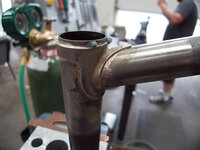
Ever seen bronze welding before to this standard?
 
Looks like aluminum welding with the big fish scales, well impressive, but I always thought the weld medium had to be hot enough to flow not as if its too cool and form scales, but I'm probably wrong
 
Those welds will be great once they've been cleaned up with an angle grinder:D:D
 
That's not that hard when you use a gas fluxer.I done a chassis once,and had some twat telling his mate it was tig welded.I told him it was brazed,and he told me not to talk bollox.When we got down to the nitty gritty of it,and he found out off someone else that I had done it the day before,he went all shy.Bless:D
 
Mate of mine does TIG welding that neat. I'm sure he could weld wet tissue paper if he tried :D

PS. What's the difference with SIF Bronzing??
 
Miff.

I'm also in Norfolk.....and I'm looking for a skilled welder to do some frame repairs/mods to a Montesa Cota 248 frame.

Would your mate be interested for £?

Can you put us in touch if so.

:beerjug:
 
for anyone remotley interested, brazing is like high temp soldering, two bits well fitted together and capilliary action. Stength is due to mechanical fit of the parts and the brass glue holding them together.

Bronze welding is similar but the gaps are bigger and the strength is supplied by the welding medium (ie the bronze).

Big difference between bronze welding and regular is that in bronze you dont melt the two metals to be joined, you heat them to just below the melting point and then fill in with the bronze, in regular welding the two bits to be joined are both heated above melting point and the filler is used to fuze the two together to form one bit and thus the joint. This equaly applies if you are talking about, gas, arc, metal or plastic welding the principle is the same.


p.s. it is really easy to cheat as well, you can do your welding or brazing as nasty looking as you like and then afterwards go over with just the flame and little circular motions and you end up with lovley looking "stack of coins pushed over"
 
for anyone remotley interested, brazing is like high temp soldering, two bits well fitted together and capilliary action. Stength is due to mechanical fit of the parts and the brass glue holding them together.

Bronze welding is similar but the gaps are bigger and the strength is supplied by the welding medium (ie the bronze).

Big difference between bronze welding and regular is that in bronze you dont melt the two metals to be joined, you heat them to just below the melting point and then fill in with the bronze, in regular welding the two bits to be joined are both heated above melting point and the filler is used to fuze the two together to form one bit and thus the joint. This equaly applies if you are talking about, gas, arc, metal or plastic welding the principle is the same.


p.s. it is really easy to cheat as well, you can do your welding or brazing as nasty looking as you like and then afterwards go over with just the flame and little circular motions and you end up with lovley looking "stack of coins pushed over"

As I understand it Bronze welding is the recommended method for frames made from chrome moly tube (Reynolds 531). I have an ancient CCM chassis which I assume was bronze welded but the joints are smooth rather as if it has been brazed. What I'd like to know is that if I want to make some minor changes to the frame, probably using mild steel, would it be best to weld, braze or bronze weld it? Also does the nickel plating (which is knackered) change anything in terms of welding (ie should I blast it first)?
 
As I understand it Bronze welding is the recommended method for frames made from chrome moly tube (Reynolds 531). I have an ancient CCM chassis which I assume was bronze welded but the joints are smooth rather as if it has been brazed. What I'd like to know is that if I want to make some minor changes to the frame, probably using mild steel, would it be best to weld, braze or bronze weld it? Also does the nickel plating (which is knackered) change anything in terms of welding (ie should I blast it first)?

We are talking in general, and ideal situations there is some cross over from one to the other.

Brazing and Braze Welding (bronze Welding) are almost the same, brazing most usualy uses brass filler rod (alloy of copper and zinc) the the other bronze (copper and tin) the melting point of both is roughly similar. But you can braze with silver, special stainless, and plastic welding is effectivley braze welding with plastic, but I will only refer to steel/brass and bronze here.

Brazing would most usualy be used where joints are socketed such as in push bike frames or old harley/brit bikes where you had pre made joints into which the tubes were inserted.

Braze Welding would most usualy be used where the tubes are butted together.

either is used in applications where some give is required and a normal welded joint would crack, although strictly speaking the weld is stronger than the original material, and cracks normaly appear to one side of the weld site or the other. With either type of brazing the steel to be brazed is not heated as hot therefore does not harden in the same way and the filler is flexible as opposed to a steel filler.

A bronze welded joint appears as the bike frame at the start of the thread, a more usual brazed joint is the picture below. In a proper brazed joint you should only see a thin line of filler, in a welded joint you should see the "stack of coins" pushed over look, even were it has all been filled down if you see a big broad band of filler then it should be welded.

Your problems arise when people braze with brass when they should be welding with bronze, there are lots of people who dont appreciate that there is a difference.

Without seeing your frame I would suggest that it should be bronze welded, and I would clean off any plating prior, the nickel will only be a thin coat, and it would have been applied after the original jointing of the tubes.

Either brazing or braze welding can be used to join disimilar metals such as
Mild Steel - Galvanized Steel
Stainless Steel - Copper
Mild Steel - Stainless Steel
Stainless Steel - Copper-Nickel
Mild Steel - Cast Iron

The technique to use should be dictated by the way in which the tubes are jointed together.

 

Attachments

  • br1.jpg
    br1.jpg
    107.8 KB · Views: 349
Either brazing or braze welding can be used to join disimilar metals such as
Mild Steel - Galvanized Steel
Stainless Steel - Copper
Mild Steel - Stainless Steel
Stainless Steel - Copper-Nickel
Mild Steel - Cast Iron

Very interesting - thanks for that.

Is a flux paste used on the tubes prior to brazing or bronze welding ?? If so, what is it ??

Thanks.

Bob.


Back
Top Bottom