Clutch replacement YES/NO, tips-experiences?

Tsiklonaut

GS pervert
UKGSer Subscriber
Joined
Sep 25, 2004
Messages
3,473
Reaction score
9
Location
semi-homeless
Thinking about replacing my clutch before the big trip.

Currently the bike has around 80,000km (50,000miles) on the clock, works OK so probably still some clutch left. But there could be almost the same much mileage from the trip added, so what do you reckon - should I replace the clutch before leaving? Or better to go on the "if ain't broke don't fix it" route?

Other thing I'm worried about is the dryness of the splines, that can turn out to be a show stopper at one point of the longish journey following with weeks of (more exotic) parts-waiting etc import paperwork hassle in the middle of nowhere. So maybe indeed it's better to replace the clutch and re-grease the splines whilst I'm there(?)

If yes, what should I replace? I.e. is it better idea to replace the whole clutch as a kit (friction place, pressure plate, spring etc) or it's waste of money and better to just go for the spring and friction plate?

Also I know there should be (much cheaper) aftermarket clutch plates available for 1100s too (apparently fits for some models of (BMW?) cars), are they worth it per long term or is it better to get the OEM-only bits?

Any advice and experiences on the issue highly welcome!

Cheers, Margus :beerjug:
 
Hi Margus,

Well, I'd say that like me, you've read the posts on here regarding longevity of clutches. You also know how you've treated it in the past. Knowing how I've treated mine, I think I'd take the chance on it. But I think I would take things apart enough to re-grease the splines if there's a chance of them drying out.

But hey, I can't even get my injectors to fire, so you're probably much better waiting for someone better qualified to come along...

:aidan

Dave.
 
But I think I would take things apart enough to re-grease the splines if there's a chance of them drying out.

Hi Dave,

yes, a thought about opening up and just re-greasing splines came into my mind too. Also then I get a chance to measure the thickness of the clutch plate, it's it's near the critical then better to replace it.

So I believe we've answered the first part of my question. :thumb2

The second one is IF the clutch needs replacing then should I replace it as a full OEM kit, or just the plate+spring leave the rest old? Or use aftermarket bits?

eBay has Ferodo clutch plate for R1100 for example for 60EURos. Worth it? :confused:
 
Thinking about replacing my clutch before the big trip.

Currently the bike has around 80,000km (50,000miles) on the clock, works OK so probably still some clutch left. But there could be almost the same much mileage from the trip added, so what do you reckon - should I replace the clutch before leaving? Or better to go on the "if ain't broke don't fix it" route?

Other thing I'm worried about is the dryness of the splines, that can turn out to be a show stopper at one point of the longish journey following with weeks of (more exotic) parts-waiting etc import paperwork hassle in the middle of nowhere. So maybe indeed it's better to replace the clutch and re-grease the splines whilst I'm there(?)

If yes, what should I replace? I.e. is it better idea to replace the whole clutch as a kit (friction place, pressure plate, spring etc) or it's waste of money and better to just go for the spring and friction plate?

Also I know there should be (much cheaper) aftermarket clutch plates available for 1100s too (apparently fits for some models of (BMW?) cars), are they worth it per long term or is it better to get the OEM-only bits?

Any advice and experiences on the issue highly welcome!

Cheers, Margus :beerjug:


Hi Margus,
I recently changed my clutch with 85000km on the clock. Without entering into details, the friction plate had 5.5mm (4.8mm is the minimum) and I am unsure what a new disc spec is (6.2mm?). I did the last 20.000km as I got it used so I didn't know which use it had.
The whole set is in excellent condition and therefore I am happy for having replace the friction plate only.
One thing you can do is to look at the friction plate - just remove the starter and try to spin a bit the engine until you see the friction plate. You will be able to reach your own conclusion fairly easily.
Cheers
 
Never done a "Dry Clutch" on a bike but done loads on cars and trucks. We developed the opinion that its false economy not to replace all the clutch components whilst it was apart.

Regards oem or pattern parts ......... Always go for the best. Ask about as much as possible regarding any reccomendations for manufacturers and conversely ones to steer clear of.

No blinding revelations here mate as I`m sure you can see but if I was going on what appears to be a mega trip like yours with this mileage on the bike I think I would replace the clutch in the comfort of my own garage and with the best parts available.

Give yourself the edge against the odds of a breakdown or failure and you increase the odds for a great trip IMHO .. :thumb2
 
hello,replace the whole thing imo,but ive never got more than 45kmiles out of one;its not fun doing it at the side of the road.I would also do the seal and replace the actuator arm and have the shaft out while I was there regards
 
ps personally frustrated with oem sachs plate and currently investigating getting a more durable,more modern material rivetted on to a lucas plate,meeting a friend of a friend who prepares rally cars [fingers crossed]
 
Take out the starter and have a look.
If you have not off-roaded too much or fired the clutch on hill / sand, I'd expect 100k miles.
Clean and grease the starter shaft / bendix while at it.
 
Hi Margus,
Id keep the orginal clutch in and go with it,
but bring a spare plate, if it does start to go it
wouldnt go with out warning this gives you plenty
of time to find a place to change it. Piss easy to
replace just takes a bit of time.
Check the clutch piston behind arm before you go,
make sure all is free flowing, also if you are doing the clutch
alone take the clutch push rod out from the rear, less chance
of bending it when taking gearbox off.
Cant wait to read your trip report :bounce1:bounce1:bounce1
regards
joe
 
I'd change it before you go. Complete clutch kit.

Jobs done in the comfort of your garage, then no need to even think about during your trip.
 
hello,OE VERSUS AFTERMARKET.Done a lot of research on this,first of all I m not an engineer(but alot of experience in destructive testing...)Most people seem to think the oe sachs clutch is adequate,IMO its fine for popping down the shops but not riding round the world.I think they are using a woven fibrous polyamide asbestos substitute,not cutting edge technology but good enough to last for the duration of most peoples warranty.

Thanks for drawing my attention to the ferodo product,this looks like the same material(investigating)but at least the plate looks more robust,I say this because there is definitely a quality control issue with the splines on the sachs oe part.I have had the splines go at 20kms(not 20000kms) on an R and at less than 100km on a k.I have met three other people this has happened to,they replace them without question ,which would indicate knowledge of the problem.On measuring the friction plate I would argue that this imparts a false sense of security as even without contamination they can and do fail while within tolerance.I posted on this site LUCAS SINTERED CLUTCH.

I have not used one,and am yet to get feedback from a user,however technically this should be far more robust than sachs oe for several reasons.Its not resin/rivett bonded its braised/welded,the copper based compound will withstand considerably higher temperatures and in the event of seal failure its not completely trashed and its not ridiculously expensive.
The "ceramic" clutch sold by TT is a brave attempt but an evolutionary dead end.Its not ceramic at all,my understanding is that this refers to the process by which the compound is baked,in any case its got completely the wrong friction properties.It has a very abrupt torque curve delivering a harsh ,grabby action and in any case its ludicrously over priced.

I suppose it would be fine if you are a desert racer but with serious drawbacks in the real world.I would fit a complete clutch with a Lucas sintered friction plate and an uprated spring,the only downside I can see to this approach is it will be harder on the metal parts but who cares,its a false economy not to replace them every time with the friction plate.

The logical way around this is to use kevlar,its only comparitively recently that kevlar compounds with a friction coefficient in the right range have been available.I have 500mm2 of the same kevlar material used by caterpillar and john deere tractors coming my way for free courtesy of a nice American ,for some reason no one will even sell me the stuff in the UK.Roughly the same friction coefficient as oe,Ive ascertained independently of the supplier that a wear rate 10-20% of the oe material is not unreasonable,and 50-33% of the best sintered stuff.Best of all its not very abrasive and easy to mount.Anyway there you are,hope its useful regards
 
Last edited by a moderator:
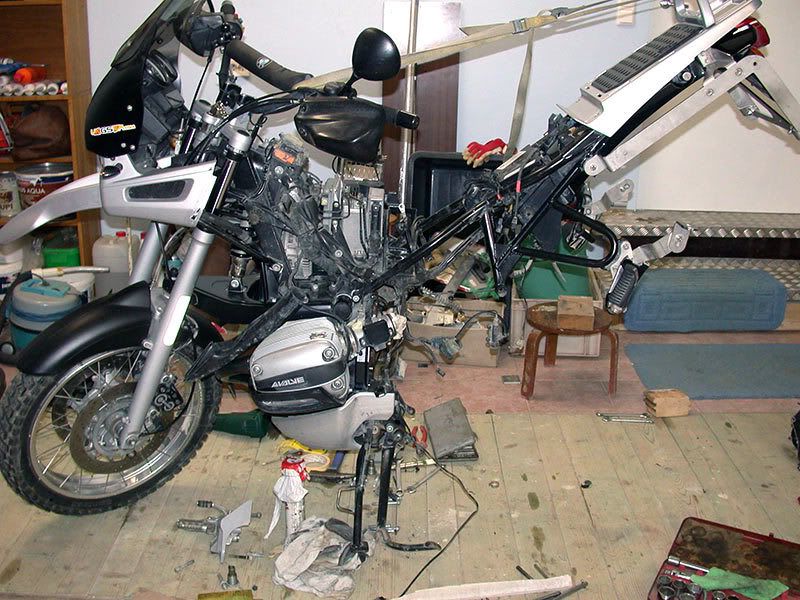
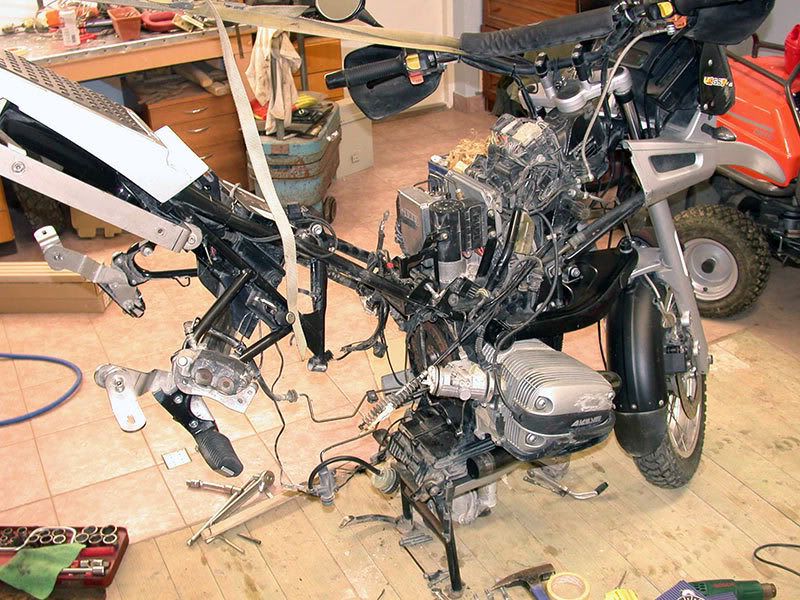
So I did replaced clutch on my 81Kkm bike.

Stripped:
DSCN2125.jpg


DSCN2131.jpg


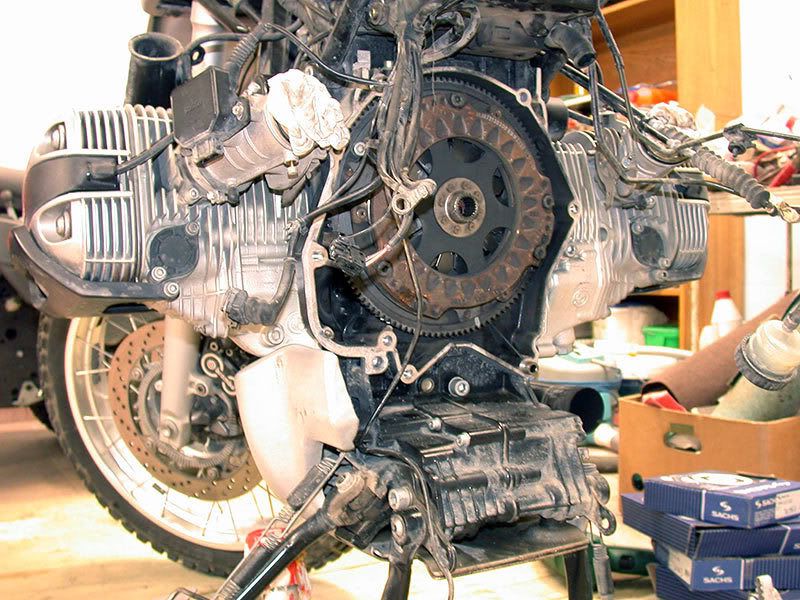
Old clutch:
DSCN2136.jpg


Looked relatively OK:
DSCN2142.jpg


Specced 5.3mm, that is about half-worn (new is 6mm, minimum allowed is 4.5mm). So with this estimate the clutch would be good for another 140-160,000km. But better to replace it when hard times ahead ;)
DSCN2144.jpg


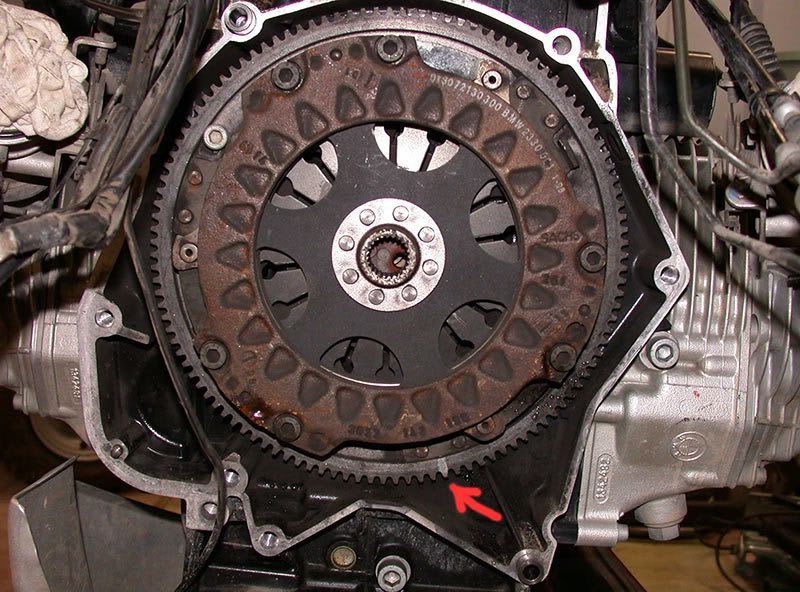
Note the position of old clutch kit (make your own markings if required). Especially check the white marking on the flywheel:
DSCN2128.jpg


White line markings on pressure plate and cover plate (matched on this pic, but DO NOT mach them like this on mounting):
DSCN2221.jpg


To balance the clutch you have to mount all the three (flywheel, cover- and pressure plate) the furthest away from each other. That'd be 120 degrees, but in some case you can't get perfect 120deg white line distribution, then just put them in the best way apart you can.

After you finger-tighten the bolts on new clutch temporarely put on new gearbox (better if you have additional pair of helping hands) to use it as a centering tool for friction plate:
DSCN2244.jpg


Give it couple of rounds of cranks (you can use alternator bottom pulley bolt for giving engine crank) so it centers itself and then tighten (but not hard) from startermotor window:
DSCN2230.jpg


Take the gearbox off, put TDC blocker bolt back on and final-tighten them to 18Nm:
DSCN2225.jpg


DO NOT FORGET to take off the flywheel blocking bolt after finally puting the gearbox back.

DSCN2242.jpg


Put everything back together. And yer done.

:beerjug:
 
Is this job difficult and time consuming? Or relatively easy, but time consuming? So how long did this job take?

The splines that you were concerned about, were they dry?

Which spline is it? I've read about it drying out, but not sure where it is?
 
Is this job difficult and time consuming? Or relatively easy, but time consuming? So how long did this job take?

The splines that you were concerned about, were they dry?

Which spline is it? I've read about it drying out, but not sure where it is?

It's doable when you have some wrenching experiences. It's time consuming. Dealers say it's a 6 hours job to replace clutch. I'd say it's about right. I did it two full days (I also replaced seals on both ends) and with various other smaller jobs along with beer (more time! :) ).

My gearbox input shaft splines (those tend to dry out) were OK. Still some lube left when I opened them:
DSCN2139.jpg


On re-lubing you have to put very little MP3 paste on the splines, otherwise it'll be thrown off the rotating shaft onto the clutch and kill the clutch. Too little and it'd dry out soon killing the splines.

I used toothbrush to keep the paste amounts under control on the surfaces both the friction plate splines and gearbox input splines (where the friction plate goes on):
DSCN2226.jpg
 
Margus. Your black engine/gearbox. Is that standard finish?
I didnt think they made a black engined 1100. Doesnt look like a 'paint job'
Enlighten us. Or thousands gsfolk will spend the rest of the day confused and unable to concentrate on important things.
 
Margus. Your black engine/gearbox. Is that standard finish?
I didnt think they made a black engined 1100. Doesnt look like a 'paint job'
Enlighten us. Or thousands gsfolk will spend the rest of the day confused and unable to concentrate on important things.

yep - i read it this morning and couldn't finish painting the downstairs dunny.

i was in turmoil :)


Back
Top Bottom